This Attendance Write-up Example helps managers document repeated attendance issues clearly, fairly, and consistently. Use it to record the facts, reference the relevant policy, set measurable expectations, and determine whether HR should review potential protected leave before a written warning is issued.
Table of Contents
- Key Facts
- What is an attendance write-up?
- What is the purpose of an attendance write-up?
- What absences should not trigger an attendance write-up?
- When to use an attendance write-up?
- What should you include in an attendance write-up?
- What does an attendance write-up example look like?
- 10 tips for giving written warnings to an employee
- Benefits of using Time Tracking Software
Key Facts
-
- An attendance write-up is a formal record of a policy-based attendance concern, the supporting facts, expected improvement, and possible next steps.
- In 2025, the U.S. Bureau of Labor Statistics reported a 3.2% absence rate among full-time wage and salary workers.
- The U.S. Bureau of Labor Statistics also reported a 1.7% lost-worktime rate among those workers in 2025.
- Before issuing discipline, confirm whether the absence may be protected. The U.S. Department of Labor states that eligible employees may take up to 12 workweeks of FMLA leave in a 12-month period.
What is an attendance write-up?
An employee may occasionally arrive late or miss work for legitimate reasons. When unexcused attendance issues become a documented pattern, managers should address them consistently and according to company policy. This document acts as a formal disciplinary documentation that addresses and solves instances of poor attendance at work. Attendance write-ups are really important for managing your employees overall performance. Employee attendance is crucial for maintaining high productivity and motivation levels. An attendance write-up is needed when an employee is having poor attendance and a verbal warning did not work.
Attendance issues can affect staffing coverage, workload distribution, and service continuity. In 2025, the U.S. Bureau of Labor Statistics recorded a 3.2% absence rate among 121.3 million full-time wage and salary workers, with a 1.7% lost-worktime rate.
An example of an attendance write-up
What is the purpose of an attendance write-up?
Attendance write-ups are a useful tool for managers to deal with reoccurring issues linked to attendance performance. The purpose of an attendance write-up is to formally inform the employee of the severity of the issue via documentation and communication. It creates a contemporaneous record of the facts, the policy expectation, the employee’s response, and the next review date. Documentation does not replace a protected-leave or accommodation review.
You should use an attendance write-up in situations where an employee’s attendance does not meet the expected standards. This could also mean that they are violating company policies such as attendance policies. It is crucial that when conducting an attendance write-up the company must be consistent, honest and in compliance with labor laws such as the Family and Medical Leave Act. Are you familiar with other US labor laws around time and attendance?, as highlighted by Family and Medical Leave Act | U.S., as noted by EEOC Sues Step2 Company for Sex, Pregnancy, and Disability Discrimination and Retaliation | U.S. Equal Employment Opportunity Commission Department of Labor Why not take a look at our article on time and attendance in the US.
What absences should not trigger an attendance write-up?
Before documenting an attendance violation, determine whether the absence may be protected. The U.S. Department of Labor states that eligible employees of covered employers may take up to 12 workweeks of unpaid, job-protected FMLA leave in a 12-month period, and covered private employers generally have 50 or more employees in 20 or more workweeks.
The U.S. Department of Labor’s January 2025 opinion letter confirms that FMLA-qualifying leave may run concurrently with employer-provided leave in certain circumstances, so managers should route possible leave cases to HR before assigning attendance points. The U.S. Department of Labor also confirms that a serious health condition may include a mental health condition when FMLA requirements are met.
Accommodation obligations may also apply. In a July 2026 enforcement action, the U.S. Equal Employment Opportunity Commission alleged that an employer disciplined pregnancy- and disability-related absences under an attendance policy after denying accommodations. In a November 2025 case, the U.S. Equal Employment Opportunity Commission similarly alleged that attendance points were assessed after an employee requested leave for cancer treatment.
When to use an attendance write-up?
| Issue | When a write-up may be appropriate | What to document |
|---|---|---|
| Repeated tardiness | Late arrivals continue after coaching. | Scheduled and actual start times, notice given, and prior discussions. |
| Unexcused absences | Absences breach the notification or approval policy. | Dates, missed shifts, notice record, and policy section. |
| Early departures | Leaving early becomes a documented pattern. | Departure times, operational impact, and prior coaching. |
Manager checklist before issuing a written warning
- Review the attendance record and policy threshold.
- Confirm that the incidents are not protected leave or accommodation-related.
- Record dates, times, notice provided, and prior coaching.
- Meet privately and give the employee an opportunity to explain.
- Set a specific review date and document the next policy-based step.
Address Attendance Issues with Confidence
What should you include in an attendance write-up?
When creating an attendance write-up it is very important to gather the correct data and ensure that everything listed is clear and easy to follow.
For consistent records, Factorial’s time and attendance software can help managers review clock-ins, breaks, and attendance inconsistencies before documenting a repeat pattern.
- Date of the write up: Include the date that you document that attendance performance issue.
- Employee data: Include the person in questions full name, job title, job department, work ID number and any other relevant personal details.
- Manager information: The manager who is writing the report must state their full name and job title.
- Absence dates and times: Specify the specific dates and times that this employee was late or absent.
- Type of absence issue: Portray if the issue is absenteeism, tardiness or leaving early.
- Description: Portray a clear and honest description of the issue that you have been facing. It is crucial that you stick to factual information and limit opinion based descriptions. Include any relevant background information.
- Previous issues: Explain how the employee’s actions have violated the attendance policy at your company. Record any previous attendance related issues that the employee did (ensuring to include dates and times).
- Impact statement: Include a description about the impact of the employees actions. This can include but is not limited to the impact on the wider team such as a dip in productivity, feelings of overwhelm due to additional burden and missed deadlines in team projects.
- Action plan: Explain next steps that the employee must follow in order to solve the issue. This could involve a meeting with someone like a director or senior member of staff, training around time off approval or a performance improvement plan (PIP). It is important to clearly state the consequences of continuing to violate the attendance policy which can include a disciplinary action or termination of the employment contract.
- Signature: Ensure there is a section of the document that allows the employee to acknowledge the attendance write-up by signing their name and adding the date.
What does an attendance write-up example look like?
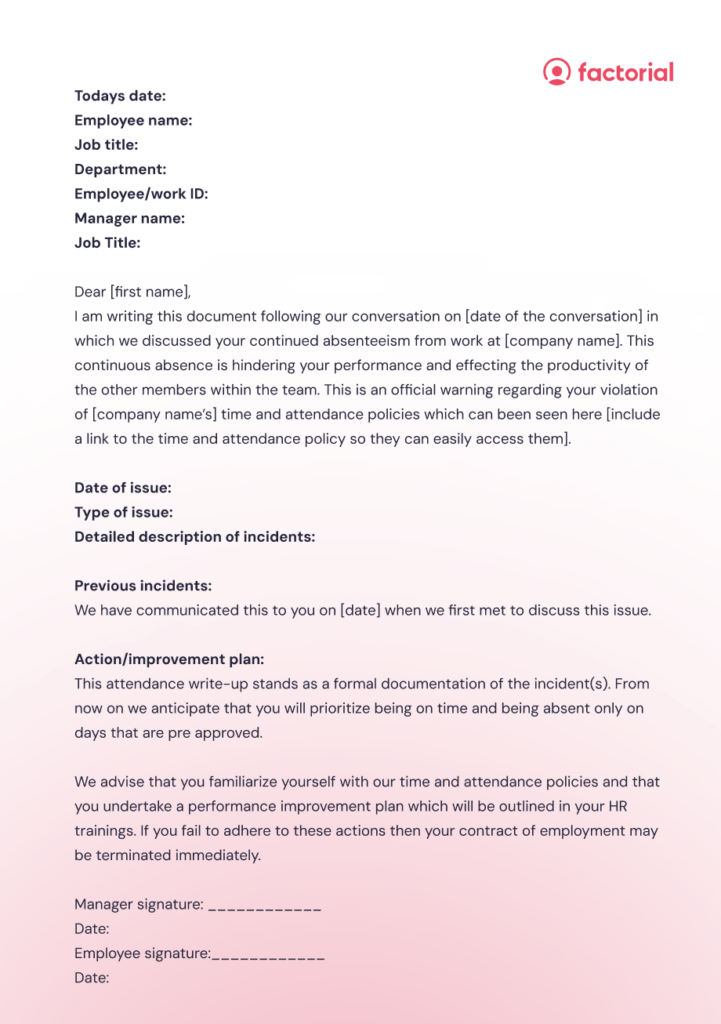
Today’s date:
Employee name:
Job title:
Department:
Employee/work ID:
Manager name:
Job Title:
Dear [first name],
This document follows our conversation on [date] regarding attendance concerns at [company name]. Our records show the following unexcused attendance incidents: [list dates, scheduled times, actual times, and notice provided]. These incidents may violate [company name’s] attendance policy, Section [X], which is available here: [insert policy link].
Date of issue:
Type of issue:
Detailed description of incidents:
Previous incidents:
We have communicated this to you on [date] when we first met to discuss this issue.
Action/improvement plan:
This attendance write-up documents the incidents listed above. Effective immediately, you are expected to report for scheduled shifts on time, follow the absence-reporting procedure, and request leave in accordance with company policy.
Please review our time and attendance policy and attend the follow-up meeting scheduled for [date]. We will review your attendance during the next [30/60/90] days. Further action, if warranted, will follow company policy and applicable law.
Manager signature: ____________
Date:
Employee signature:____________
Date:
Employee acknowledgment: My signature confirms that I received and reviewed this document. It does not necessarily indicate agreement with its contents.
Employee comments: ________________________________________________
10 tips for giving written warnings to an employee
- Be clear and honest when documenting any information about an incident.
- Address documented concerns promptly to prevent the issue from escalating.
- Note any relevant company policies and standards that have been violated.
- Use factual language. Avoid opinion based arguments or ambiguity.
- Keep privacy and confidentiality as a priority. Deliver the letter in private and avoid drawing attention to the matter.
- Provide a clear action plan for the employee to follow.
- Ensure that you prepare thoroughly and include all relevant documents or links to support your official warning.
- Schedule a follow-up meeting to review the employee’s progress against the documented expectations and review date.
- Seek advice from the HR team at your company if you are unsure about anything.
- Having a well designed time off tracking technology can help eliminate having to give attendance write-ups altogether! This software will assist HR teams, managers and the company overall to lower absenteeism rates. Why not try out Factorial and book your demo below!
Benefits of using Time Tracking Software
Absence management along with many of the HR functions are tough tasks to manage without the proper tools and resources. Time tracking is a continuous process and one that needs to be managed regularly. Factorial’s time and attendance software has a myriad of benefits including tracking clocking in and out, exporting detailed timesheets, managing overtime requests, creating paid and unpaid breaks and addressing time tracking inconsistencies along with many more features. Check out how Factorial can solve your time management paint points by booking a call with our HR product experts. They will bring tailored solutions to you and your team to help eliminate your repetitive, manual work, including:
- ✅ Syncing employee timesheets with payroll
- ✅ Geolocation & biometric time tracking options
- ✅ Associating logged hours with projects
FAQ
What should I write in an attendance write-up?
An attendance write-up should include the date, employee and manager details, specific dates and times of the absence, a factual description of the issue, reference to company policy, an action plan for improvement, and a space for signatures.
What is an example of a write-up?
An example of a write-up is a formal letter detailing the employee’s attendance violation. It includes the date of the issue, a description of incidents, reference to previous warnings, and an action plan. The document requires signatures from both the manager and the employee.
How to write a report on staff attendance?
To write a report on staff attendance, gather factual data on absences and tardiness for a specific period, noting any patterns. Using an all-in-one business management software like Factorial can automate this process by generating detailed timesheets and reports, simplifying absence management.