AI automation in HR is becoming essential as HR teams face more pressure than ever. They are expected to hire faster, support managers better, answer employee questions quickly, and provide leadership with useful insights, all while keeping day-to-day operations at their organisation running smoothly. The problem is that a lot of HR work is still repetitive administrative work. This admin work is manual and time-consuming, even in companies that already use digital tools. That is why AI automation in HR is the next step for organisations that want to continue to grow.
Table of Contents
- Key facts about AI automation in HR
- What is AI automation in HR?
- How does AI HR automation differ from digital HR?
- Why does AI automation in HR matter now?
- How does AI automation change HR’s day-to-day work?
- What are real examples of AI automation in HR?
- What are the benefits of AI automation in HR?
- How to get started with AI automation in HR
- Get started automating HR with AI
Key facts about AI automation in HR
- AI automation in HR uses AI to complete routine tasks, surface workforce insights, and support people decisions while HR retains accountability.
- The Department for Science, Innovation and Technology’s AI Labour Market Survey 2025 found that 97% of respondents identified at least one AI skills gap.
- CIPD research published in 2026 found that around 45% of organisations still use AI in an ad hoc or experimental way.
- Deloitte found that organisations taking a technology-focused approach to AI were 1.6 times more likely to miss expected investment returns than organisations taking a human-centric approach.

What is AI automation in HR?
AI automation in HR means using artificial intelligence to help complete HR tasks, answer questions, and connect information across different processes, creating AI-powered HR workflows. Instead of software only storing information, AI uses that information to generate answers, highlight useful insights, and help you finish the work you need to do in order to focus on the work you want to do.
For example, AI can:
- Track absences and review against policy and employee schedules.
- Help ensure that the rotas you create are in line with working time regulations.
- Help employees find the right policy or document.
- Prepare HR reports using live workforce data.
- Support managers before one-to-one meetings.
- Help with hiring and onboarding tasks.
Factorial launched its own AI Agent called One to give HR teams an easy way to create reports by simply asking questions, help automate repetitive work, and support their teams with real-time information by having it connect to their company data. This is what makes AI automation in HR different from basic software. It is not just a system that houses your data. It is a system that actively helps you in your tasks.
How does AI HR automation differ from digital HR?
A lot of companies already have digital HR tools, and many have already even started HR automation. Employees submit leave requests online, sign documents electronically, and access their information through a portal. That is useful, but it does not always mean HR is automated with AI, which opens a whole new world of possibilities.
Going digital is the bare minimum
Digital HR often looks like this:
- Forms are online instead of on paper.
- Data is stored in a system.
- HR still handles many steps manually.
Even when you use digital systems at work, managers still need to check different tools to get the full picture.
AI automation changes the way you work
AI automation in HR takes going digital further. It helps you connect your systems as if you were connecting the dots.
For example:
- A manager can see whether approving time off will create a staffing issue.
- An employee can ask where to find a policy and get the answer instantly.
- HR can ask for a turnover report and get it in seconds.
Factorial’s article on AI in HR explores the basics of how AI is changing the workplace by helping HR teams make better decisions and support employees more effectively. That is the real difference: digital HR stores information, while AI tools in HR drive automation and help people use that information quickly and effectively.
Why does AI automation in HR matter now?
There are a few reasons why organisations in the UK should focus on exploring AI automation in HR starting as soon as possible.
The need is not only technological. In CIPD’s 2022 survey of 814 UK business leaders, 29% said their organisation had introduced intelligent automation between 2019 and 2022, while 53% had not introduced any. This makes process design, workforce consultation, and skills planning central to successful adoption.
First, HR teams are dealing with a higher level of complexity in general. Hybrid work, hiring needs, and more pressure on managers all make HR harder to run successfully.
Second, employees benefit when the systems they use for work feel as easy to use as the apps they use outside work. They want fast answers, clear steps, and fewer delays. Outdated software doesn’t cut it anymore.
Third, leadership needs HR to contribute more strategic value. That means not just processing operational tasks, but helping the business understand trends, risks, and opportunities. AI automation can help HR finish operational tasks more quickly, leaving enough time to focus on HR strategy.
In fact, AI automation is developing in a direction that allows you to delegate tasks to your AI agent as easily as to an assistant.
AI automation in HR helps by:
- Reducing repeat work.
- Speeding up common processes.
- Bringing together information from different areas.
- Making it easier to act early when something needs attention.
How does AI automation change HR’s day-to-day work?
Next, we will look at some direct examples that demonstrate the biggest impact of AI automation in HR. These examples show that AI is not here to replace people, but to enable them to focus more on the work that actually makes a difference. AI changes the kind of work people spend time on.
AI helps save time on HR tasks
Many of the tasks that HR teams spend time on can be automated with AI. After this, HR teams are free to focus on more valuable tasks. Adoption is already moving beyond experimentation. The strongest use cases begin with repeatable, low-risk tasks that still require human review where outcomes affect people.
- HR teams don’t need to spend too much time on repetitive tasks, such as answering the same questions over and over with AI automation.
- Pulling data for reports and following up on forms are also made much faster. Humans can focus on making sure the strategy behind the forms is logical. AI takes care of the rest, i.e. creating the form, sending it to your employees, and analysing the data.
- Approvals are also much easier. You don’t need to worry about checking whether requests fit company policy when AI can already check them for you, though human oversight in AI remains crucial for final decisions.
AI can turn questions into real-time reports and surface insights quickly, which saves time on routine work. That gives HR more space to focus on support and strategy, and to improve other areas of the organisation.
Better support for managers
Managers often need help with policies, performance, team planning, and with the conversations they have with employees. AI can support them by bringing together the information they need in one place. AI chat in 1:1s helps managers prepare for one-to-one meetings by using AI-summarised notes from previous meetings and engagement data. AI can also help with your performance management strategy. Its performance management tools help centralise feedback, goals, and reviews with AI so managers have all the information at their fingertips and can lead more effectively.
A smoother employee experience
Employees want to find answers quickly and handle routine tasks without unnecessary friction. AI can help them:
- Find policies and documents.
- Check what steps to follow.
- Get faster responses to frequently asked questions.
- Use self-service tools more effectively.
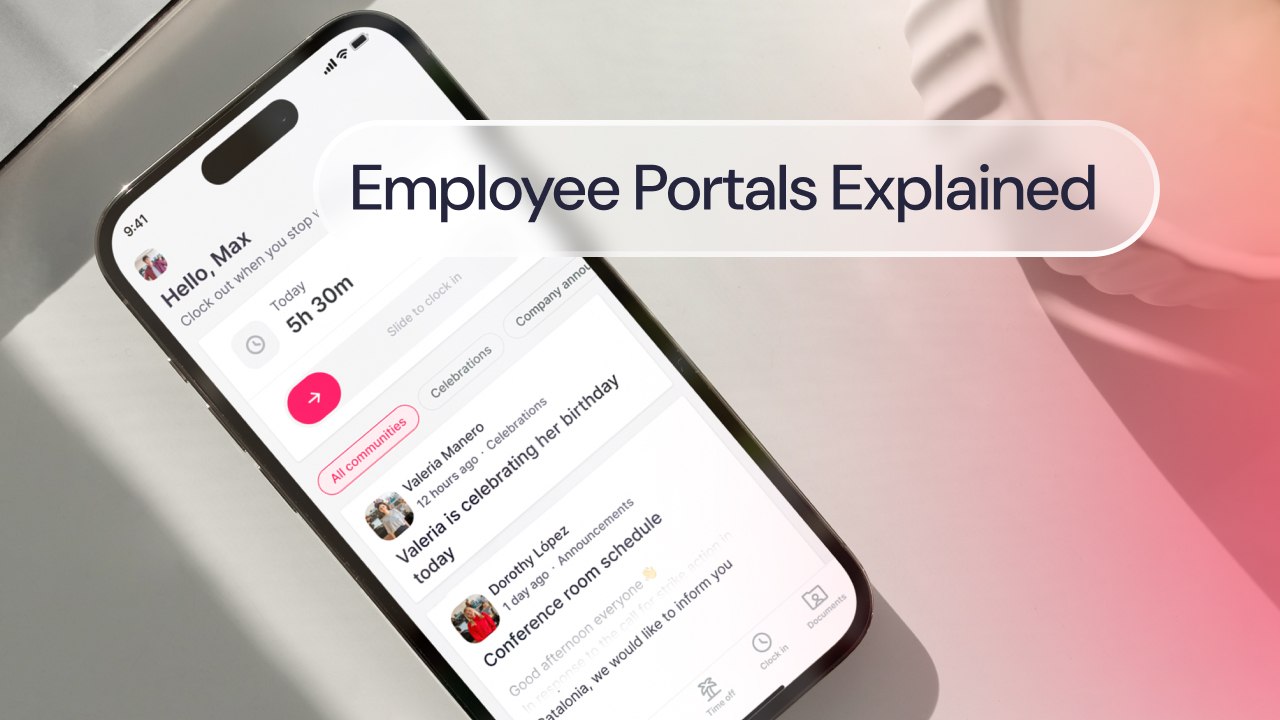
Employee portals mean employee self-service already reduces admin by giving employees more control over common HR tasks. AI makes this even better by letting employees ask questions in plain language instead of searching manually.
What are real examples of AI automation in HR?
Hiring and onboarding
Hiring and onboarding involve a lot of moving parts. HR needs to organise candidate information, coordinate with managers, prepare documents, and help new hires get set up.
UK Government guidance warns that AI recruitment tools can create risks around bias, digital exclusion, and discriminatory targeting if they are not properly assessed.
AI can support this process by:
- Helping draft job descriptions to attract the perfect candidate.
- Summarising and organising information about candidates.
- Triggering onboarding workflows after a hire is confirmed.
- Supporting access setup and document sharing.
Other AI-supported features, such as independently sorting IT access for new and existing staff, are also very useful. That kind of automation saves time and reduces delays during onboarding and internal changes.
Read more about hiring with AI and recruitment in the UK.
Time off, scheduling, and coverage
Time off management is another area where AI can make a big difference. A digital tool may let employees submit requests online, but managers still need to review calendars, check policy, and think about coverage.
AI can flag policy conflicts, staffing gaps, and potential rota issues, but managers should remain responsible for approving requests and assessing operational context. This is particularly important where absence decisions may affect employee wellbeing, contractual rights, or compliance with working-time rules.
AI can help by:
- Checking requests against policy.
- Showing who else is off.
- Highlighting potential coverage issues.
- Looking ahead for possible scheduling conflicts.
When you are building rotas, AI can also identify who might be able to cover if someone is out and even reach out automatically, a clear example of AI automation in HR that solves a real operational problem in a way that was not possible a few years ago.
Employee questions and document access
Employees often ask the same kinds of questions:
- What expenses can I submit?
- How many PTO days do I have left?
- What is the process for parental leave?
AI can search company documents, policies, and records and answer many of these questions instantly.
Factorial’s AI Agent, One, can retrieve information from company resources you connect to it and provide answers quickly. People can simply ask instead of needing to search for documents themselves.
Reporting and analytics
One of the clearest benefits of AI automation in HR is better reporting and AI-powered HR workflows. Instead of manually exporting data and building reports, teams can ask for what they need directly. AI can turn questions into real-time reports, helping HR and business leaders get insights faster. This works well alongside HR analytics software, which helps centralise workforce data and make it easier to analyse.
For teams already centralising HR data and focusing on HR data quality, Factorial’s AI Agent, One provides a practical way to turn plain-language questions into a starting point for workforce analysis. HR teams should still validate outputs before using them for decisions that affect employees.
For example, HR could ask:
- Show PTO trends by department.
- Summarise turnover for the last 12 months.
- Create a headcount overview by location.
AI interprets the question and provides an answer based on the organisation’s data. This saves time and makes data easier to use in everyday scenarios.
Performance and coaching
Performance management often depends on having conversations regularly, setting clear goals, and following up on progress. AI can help managers stay organised and prepare more effectively for these conversations. AI adds context during one-to-one meetings and gives guidance for everyone involved.
AI can also help create training through role-play for new sales and customer experience employees, another good example of how HR automation can help during onboarding. It supports learning and development by giving employees a simple way to practise important conversations and improve faster.
What are the benefits of AI automation in HR?
When you look at the use cases above together, the value of automating HR with the help of AI becomes very clear.
- AI saves time: Routine work takes up a surprising amount of the HR team’s day. AI helps reduce time spent on repetitive tasks like answering questions, preparing reports, and checking requests.
- AI improves the employee experience: Employees get faster support, clearer answers, and easier access to information. That makes HR processes feel more helpful and less frustrating.
- AI gives managers better support: Managers can prepare for conversations, review requests, and understand team issues more easily when AI helps surface the right information at the right time.
- AI connects separate processes: One of the biggest benefits is that AI can connect hiring, onboarding, performance, scheduling, reporting, and employee support in one experience.
- AI helps teams act sooner: It can highlight patterns, risks, or conflicts before they become bigger problems. That helps HR and managers take action earlier instead of reacting after the fact.
How to get started with AI automation in HR
AI can sound complex, but getting started does not have to be. The best approach is to begin small, prove the value, and then expand.
Choose one or two high-impact areas
Start where the pain is strongest and the benefits are easy to see. For many HR teams, that might be time off approvals, employee questions about policies, or basic HR reporting. Focusing on one or two use cases keeps the first phase clear and manageable.
Make sure your HR data is in one place
AI automation works best when it can access accurate, up-to-date information, which emphasises the importance of HR data quality. If your employee records, time off, and performance data are scattered across different tools and spreadsheets, consider centralising them in an all-in-one HR platform first. This creates the foundation that AI can build on.
Introduce AI as a helper, not a replacement
Be clear with employees and managers that AI is there to support them, not to make decisions on its own, which reinforces the need for human oversight in AI. For example, Factorial’s AI agent, One, can suggest actions, surface insights, and draft content, but HR and managers still stay in control of approvals and final decisions. Although the UK does not yet have anything similar to the EU AI Act, there are still many resources available that give guidelines on AI adoption in the workplace, for example in the Commons Library.
The Information Commissioner’s Office explains that Article 22 of the UK GDPR provides safeguards where solely automated decisions have legal or similarly significant effects, including the right to seek human intervention and challenge a decision, which highlights the need for responsible AI governance.
Show quick wins to build trust
Early success makes adoption much easier. Highlight simple improvements, like faster time off approvals, fewer repetitive questions in HR’s inbox, or reports that used to take hours now being available in moments.
Measure each pilot against a defined baseline, such as average approval time, report-production time, HR query volume, or manager completion rates. CIPD’s 2026 research found that around 42% of organisations experimenting with AI fell into the lowest organisational-readiness group, which shows why measurable pilots and clear governance matter.
When people see real benefits, they are more willing to try more advanced features.
Expand gradually into new workflows
Once AI is working well in one area, extend it to others: onboarding, performance conversations, training support, or shift coverage. Over time, this turns AI from a single feature into a natural part of how HR, managers, and employees work every day.
Get started automating HR with AI
AI automation in HR is not about replacing the human side of HR. It is about removing the repetitive work that gets in the way of it. When HR teams spend less time answering the same questions, chasing approvals, and building reports by hand, they have more time to support employees, guide managers, and improve the way work gets done. Employees get faster answers, and managers get better support. Everyone in the organisation gets clearer information and smoother processes.
Factorial’s AI agent, One, is built to act like a digital co-worker that helps teams retrieve information, generate reports, reduce manual work, and support decisions across HR and other business areas. One helps turn HR software into a system that does not just hold information, but helps people act on it.
FAQs
What is AI and automation in HR?
AI and automation in HR use artificial intelligence to complete routine tasks, answer questions, and connect information across different processes. Unlike basic digital tools that just store data, AI actively uses that information to reduce admin, speed up approvals, and help HR teams focus more on people and strategy.
How is AI being used in HR?
AI is used in HR to automate tasks like answering common employee questions, generating reports, and checking time-off requests against company policy. It also supports hiring by helping draft job descriptions and assists managers in preparing for performance reviews by summarising key information and centralising feedback.