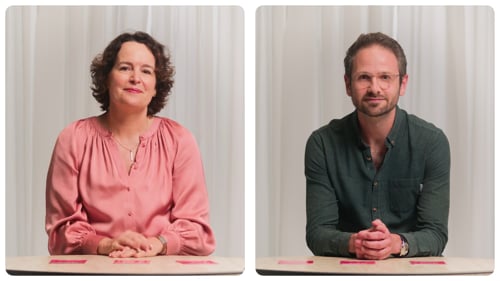
Transcription
Question two.What approach should you take with an employee who is raising a child alone?
A: Adapt significantly.B: Apply the same rules.C: Adjust on a case-by-case basis. D: The Joker.
I'll go with a guiding principle that shapes my actions, and I'll choose B: Apply the same rules to everyone.
With a small caveat, but we can talk about that afterward.
Once again, it's not easy — my heart is torn,but I think I'll go with C, adjusted on a case-by-case basis.
We could talk here about equality versus equity.I prefer equity — meaning adapting to everyone's situation.
That said, I think it's important — and this is a bit of the twist in my answer — that the rules are defined by stating that we will treat every case with as much equity as possible.
And for that, we need a framework.And that framework must be defined and known to everyone.
So for me, it's about having rules that are stated from the outset, with a framework that can also be made as flexible as possible.
But it's important that the rules are clearly stated.
For me, it's once again a blend of both — it's that we are effectively in a collective.
So there are rules, there is a framework and a structure to respect.
At the same time, we're dealing with individual situations.
And that's why ultimately I chose adjust on a case-by-case basis — always in that spirit of listening and support, trying to find the best solution for the individual situation within the collective framework of the company.
It ranges from: I'm having trouble conceiving, I need some support or time off to be able to go to my injections, for example,to: My three-year-old isn't sleeping.
I feel like I'm about to lose it and we need to find a solution right now. How can you help me?
Because as you said, it affects both personal and work life.
My teenager doesn't respect me, or my teenager has learning difficulties, for example, all the way through to My child has to move back home at 26 because they haven't found a job, for example.
How do we manage to help everyone?The challenges aren't the same with a child who can't fend for themselves versus a 26-year-old.
There's a huge difference.But parenthood also passes through all of those phases.
And that's why I appreciate the idea of opening it up, as you said,to all those phases, and moving beyond just the idealized image of mom, dad, baby.
Third question.How should my company position itself on the question of parenthood?