For HR teams, payroll compliance goes beyond processing salaries and submitting monthly declarations. Accurate employee data, remuneration changes and payroll information all need to come together. The Skills Development Levy (SDL) is an important part of this process. Administered by the South African Revenue Service (SARS) and distributed through Sector Education and Training Authorities (SETAs), the levy supports South Africa’s wider skills-development system.
This guide covers what HR teams need to know about Skills Development Levy, including who must pay it, how it is calculated and paid, and how better HR processes can make compliance easier to manage.
What is the Skills Development Levy?
The Skills Development Levy (SDL) is a levy imposed to encourage learning and development in South Africa. SARS describes it as a levy determined by an employer’s salary bill, with the funds used to develop and improve employees’ skills.
The levy forms part of South Africa’s broader skills-development framework. SDL is collected through SARS, while the levies are distributed through Sector Education and Training Authorities (SETAs).
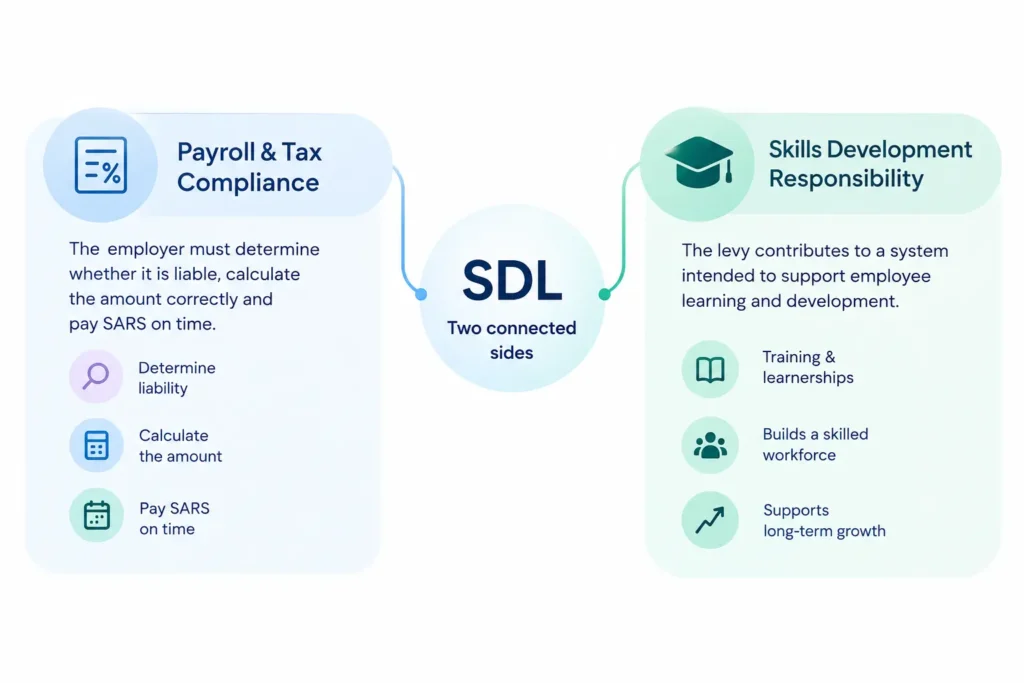
For employers, this means SDL has two connected sides:
- A payroll and tax compliance responsibility: the employer must determine whether it is liable, calculate the amount correctly and pay SARS on time.
- A skills-development responsibility: the levy contributes to a system intended to support employee learning and development.
This distinction matters. Paying SDL does not mean HR can simply tick a box and forget about skills development. The levy sits within a wider system in which SETAs play a role.
Who Must Pay Skills Development Levy?
An employer becomes liable for Skills Development Levy (SDL) when it expects its total salaries to be more than R500,000 over the next 12 months. South African Revenue Service (SARS) refers to the relevant remuneration as the amount subject to SDL.
The R500,000 threshold is therefore an important figure for HR and finance teams to monitor.
For example, imagine a growing South African business with 20 employees. At the start of the financial year, its expected salary bill may have been below the threshold. After several new hires and salary increases, its projected remuneration moves above R500,000.
The organisation should not wait until the end of the year to deal with SDL. Once it becomes liable, SARS says the employer needs to register for SDL.

Which employers are exempt?
South African Revenue Service (SARS) identifies several categories of employers that are exempt from paying Skills Development Levy, including:
- Public service employers in the national or provincial sphere of government.
- Certain national or provincial public entities where 80% or more of expenditure is paid directly or indirectly from funds voted by Parliament.
- Certain qualifying public benefit organisations (PBOs) that meet the requirements specified by SARS.
- Municipalities that have been issued with a certificate of exemption by the Minister of Higher Education and Training.
- Employers whose total remuneration subject to SDL over the next 12 months will not exceed R500,000.
There is an important practical distinction here. Where an employer is exempt because its remuneration subject to SDL will not exceed R500,000, SARS states that it does not need to register to pay SDL. Other exempt categories may have different administrative requirements.
HR and finance teams should therefore establish the organisation’s actual SDL status rather than assuming that an exemption applies based simply on its size or legal structure.
What Steps Must the Employer Take?
Once an employer becomes liable for Skills Development Levy (SDL), there is a straightforward compliance process to follow.
1. Determine whether the organisation is liable
Start with the organisation’s expected salary bill over the following 12 months. If the employer expects total salaries to exceed R500,000, SDL liability arises. For HR teams, this means SDL liability should be considered when there are significant changes to the workforce, such as:
- Hiring several new employees.
- Annual salary increases.
- Expanding into new teams or locations.
- Changes to remuneration structures.
- Rapid workforce growth.
2. Register for SDL with SARS
If the employer becomes liable, it must register for SDL with SARS. SARS states that employers can register once for different tax types through its client information system.
SARS also provides an EMP101e application for registration for PAYE, SDL and UIF, alongside other employer-registration processes.
3. Set up the payroll process
Skills Development Levy needs to be incorporated into the employer’s monthly payroll process. The payroll team should have a clear process for:
- Identifying the salary amounts relevant to SDL.
- Calculating the levy.
- Reviewing the calculation before submission.
- Including SDL in the EMP201.
- Making the payment by the deadline.
- Retaining the relevant records.
4. Maintain the supporting information
Skills Development Levy (SDL) calculations ultimately depend on accurate payroll information. If salary data is incorrect or incomplete, the SDL calculation can also be affected. This is why SDL should not sit solely with one person in payroll. HR, payroll and finance should have clear ownership of the information each team provides and reviews.
How is Skills Development Levy calculated?
SARS states that SDL is calculated at 1% of the total amount paid in salaries to employees. This includes:
- Wages
- Overtime payments
- Leave pay
- Bonuses
- Fees
- Commissions
- Lump-sum payments
A simple example
If an employer’s applicable salary amount for a month is R2,000,000, the SDL calculation at 1% would be:
R2,000,000 × 1% = R20,000
The employer would therefore include the applicable R20,000 SDL in its monthly declaration and payment to SARS.
For HR leaders, the important lesson is that the calculation itself is simple. The quality of the underlying payroll data is what makes the process reliable. If overtime, bonuses, leave pay or other salary components are processed separately or manually, the organisation needs controls to make sure the relevant information is captured correctly.
How to Register for Skills Development Levy (SDL)
Skills Development Levy registration sits within the employer’s wider SARS registration process. SARS states that employers can register once for the different tax types using its client information system. For SDL specifically, an employer that becomes liable must register.
How and when must SDL be paid?
SDL is paid to SARS monthly through the employer’s Monthly Employer Declaration (EMP201). The EMP201 includes the employer’s allocations for PAYE, SDL, UIF and/or ETI, where applicable.
SARS states that SDL must be paid within seven days after the end of the month during which the amount was deducted.
If the payment deadline falls on a weekend or public holiday, payment must be made on the last business day before the weekend or public holiday.
The monthly SDL process
For an HR and payroll team, the process can be thought of as:
Payroll → Review → EMP201 → Payment → Records
For example:
- The month’s payroll is finalised.
- The salary information relevant to SDL is reviewed.
- The SDL amount is calculated at 1%.
- SDL is included in the EMP201.
- The employer makes the payment using the relevant SARS payment process.
- The organisation retains the payroll and declaration information needed for its records.
SARS states that a unique Payment Reference Number (PRN) is pre-populated on the EMP201 and is used to link the actual payment to the relevant EMP201 declaration. SARS provides payment options including eFiling, electronic payments and payments at specified banks.
What HR teams Need to Manage Around SDL
The biggest challenge with SDL is rarely the 1% calculation. It is making sure the information feeding into the calculation is accurate, complete and easy to verify.
This is particularly relevant as organisations grow.
A business might have employee information in an HR system, overtime records in a timesheet, bonuses in a spreadsheet and payroll calculations in another platform. When payroll closes, someone then has to bring all of those pieces together.
A stronger process gives HR and payroll teams a clear information trail.
1. Keep employee and payroll data accurate
Employee information should be kept up to date when people join, leave, change roles or have changes to their remuneration. Payroll should also have access to the information needed to process relevant salary components accurately. This becomes especially important when the organisation has a large workforce or several teams making changes to employee records.
2. Build internal checks
A simple review before the EMP201 is submitted can help catch discrepancies. For example, HR and payroll can check:
- Whether all new starters are included.
- Whether terminated employees have been processed correctly.
- Whether salary changes have been captured.
- Whether bonuses or overtime have been processed.
- Whether the SDL calculation agrees with the payroll data.
- Whether the EMP201 is ready before the payment deadline.
These checks do not replace professional payroll or tax advice, but they can make the internal process more controlled and repeatable.
3. Keep the SETA relationship organised
SARS confirms that SDL levies are distributed via SETAs.
For HR teams, the relevant SETA relationship can therefore sit alongside the payroll side of SDL. Skills-development administration may involve maintaining information about training and development activities and working with the relevant SETA on applicable processes.
The important operational point is to avoid treating skills development as something that only needs attention when a submission is due. Maintaining reliable records throughout the year makes it easier for HR teams to report on what the organisation has actually done.
4. Keep records accessible
When HR needs to answer a payroll or compliance query, the question is often not simply “What was the amount?”
It can be:
“Where did this figure come from?”
That is why keeping employee, payroll and supporting documents organised matters. The easier it is to trace information back to the relevant employee or payroll period, the easier it is for HR and finance teams to review discrepancies.
How Factorial Supports the HR processes Behind SDL Compliance
Factorial does not replace SARS requirements or make an organisation automatically compliant. The employer remains responsible for determining its SDL liability, calculating the correct amount and meeting its SARS obligations.
What HR technology can do is make the underlying people data and processes easier to manage.
Factorial brings employee information, time tracking, documents, reporting and integrations into one HR platform, helping teams reduce the amount of manual administration involved in managing employee data.
1. Centralise employee information
Instead of maintaining employee information across multiple spreadsheets, Factorial provides a central employee record where HR teams can manage relevant employee and employment information. This gives HR teams a more consistent source of employee data when working with payroll and finance teams.
2. Connect time and attendance information
Overtime and working-time information can be an important payroll input.
Factorial provides time tracking and attendance reporting, including detailed records of shifts and time worked that can be exported for further processing. For example, rather than asking managers to email overtime spreadsheets to HR at the end of the month, HR can work from structured time-tracking data.
3. Keep employee documents together
Factorial’s employee portal allows employees to access personal information and documents, while its document management functionality supports centralised access to documents such as contracts and payslips. That can reduce the familiar HR problem of searching through email threads or shared folders for a particular employee document.
4. Generate reports when HR needs them
Factorial supports employee data, time tracking, absence, training and payroll-related exports, as well as dashboards and advanced reports. For HR teams, this means information can be pulled from the platform for review rather than manually rebuilding reports from different spreadsheets.
5. Connect with payroll and other systems
Factorial provides integrations with payroll and other business systems, allowing organisations to connect employee and payroll-related information rather than relying entirely on manual data transfer. Its integration framework supports the synchronisation of employee information and other HR data with external systems.
The specific payroll integration available depends on the organisation’s payroll provider and setup, so HR teams should confirm the relevant integration before implementation.
6. Create a more consistent compliance process
The real value for HR leaders is not simply automating one SDL calculation.
It is reducing the number of places where employee information can become fragmented. When employee records, time information, documents and reports are managed through connected HR processes, HR and payroll teams have a clearer information trail to work from.
That can make monthly payroll administration more manageable and give HR better visibility when it needs to review or verify information.
Conclusion
SDL may be only 1% of payroll, but compliance depends on accurate employee data, reliable payroll inputs and timely reporting.
SARS requires liable employers to register, declare SDL through the EMP201 and pay it within seven days after month-end. With the right systems and processes, HR teams can reduce manual admin and spend less time reconciling payroll information.
See how Factorial can help centralise your HR processes