


Factorial is now ISO/IEC 42001 certified. The certification independently assesses Factorial’s processes for managing AI, including how it identifies risks and oversees the technology behind One, your personal AI agent at work.
As more people use One in their daily work, businesses need to know what happens to their information and who stays responsible for decisions. This article explains how One uses company data, the permissions it follows, and the controls available to your team.
An international standard for responsible AI
ISO/IEC 42001 sets requirements for how companies manage AI. According to ISO, it is the world’s first AI management system standard. The standard covers the processes a company puts in place around AI. That includes assigning responsibility for oversight and checking how risks are addressed. Companies also need to review their processes and improve them over time.
For Factorial, the certification adds an AI-specific assessment alongside its existing security and assurance work. Factorial also holds ISO/IEC 27001 certification and has a SOC 2 Type II report, which address different aspects of information security and controls.
As ISO explains, independent certification bodies carry out certification assessments. ISO writes the standard but does not certify companies itself.
Customers can request Factorial’s certificate to check which activities were assessed. This is the certificate’s scope. Certification applies to that scope; it does not certify every answer One produces or replace the rules your business must follow.
How One helps with everyday work
One helps people use company information and carry out supported tasks. Factorial also includes AI features within products such as Recruitment and Expenses.
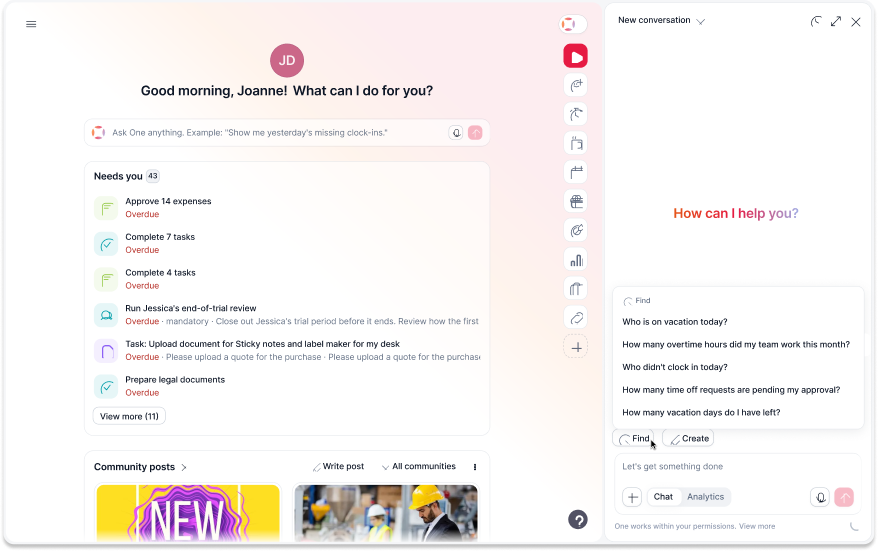
Factorial is AI for business, connecting company information with the work your team needs to do. One, your personal AI agent at work, lets you ask questions and request help using information available to you. For example, someone in HR could ask One to prepare a draft memo using an existing company policy. A manager could ask about their team’s time off.
AI is also built into individual products, including Shifts and Performance. These features support work inside those products rather than requiring someone to start every task through a conversation with One. Both use the same approach to permissions and audit records. The data handling arrangements explained below apply across these uses.
The announcement introducing One, your personal AI agent at work explains how Factorial is bringing this approach into everyday work. Its AI in HR product updates show how AI features also fit into individual workflows.
One replies in the language you use
One can reply in the language you write in, both on the web and in the mobile app. People can ask questions in the language they use at work. If you use One to draft or translate an important document, review the wording before sharing it, just as you would review any other draft.
What information does One use?
One starts with your company’s information. It can also use supported connections to other tools and read public web pages.
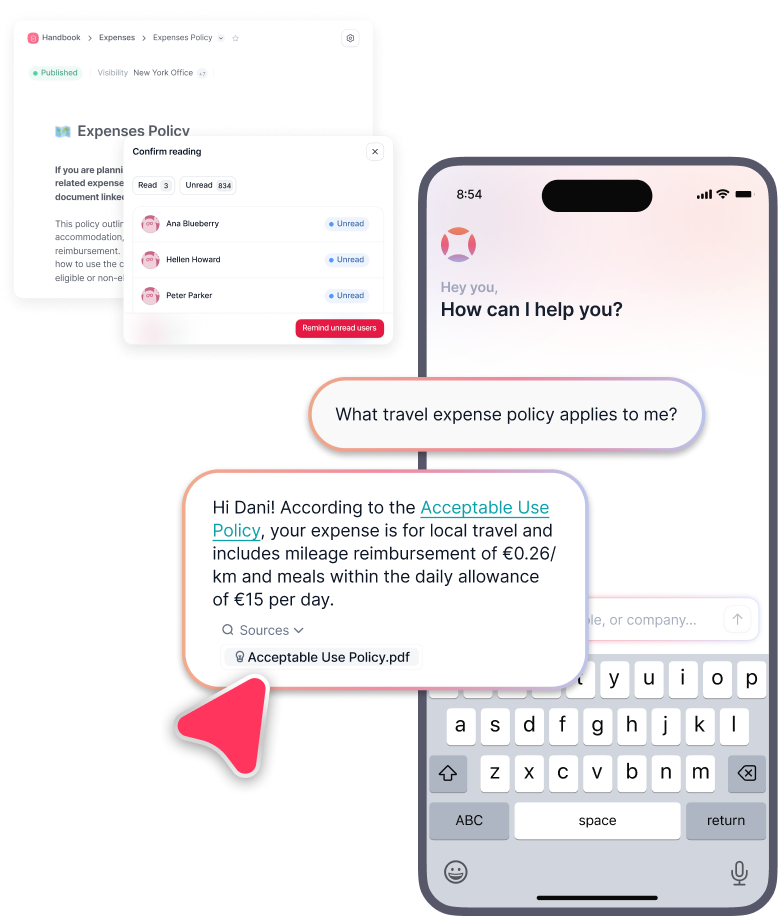
When answering a question, One looks first at company policies and documents, then at the relevant Factorial records the person can access. If an administrator has installed a supported connector, One can use information available through that connection. Public web pages are another source. One does not need a connector to read a public page.
These sources serve different purposes. Your company’s expense policy explains your own rules. A public website might provide background information, but it does not change the policy your company has approved. Keeping documents current helps your team work from the right information. Our guide to document management software explains how to organize company records and manage access to them.
Administrators control connections to other tools
A company administrator must install a supported connector before your team can use it. The connector signs in as the person using it and follows their access in that service.
Connecting a tool does not give someone extra access to it. If they cannot see a record in the connected service, the connection does not grant them permission to view it. A connected provider may store or process data outside the EU. Your team should review that provider’s arrangements before installing the connection.
One follows the permissions you set
One follows permissions you set not only by role, but also by team. It does not have the power to widen those permissions. Permissions can also reflect reporting relationships and access to individual products. If someone cannot view a field in Payroll or Performance, One cannot reveal that field to them.
For example, a manager who can only view salary information for their own team cannot ask One to reveal salaries across the company. Their access stays the same, however they ask the question. This makes existing permissions an important part of your setup. Review them when someone changes roles or takes on new responsibilities.
During digital onboarding, explain which information a new team member can access and where they should ask for help. Introduce One as part of that process, with examples of tasks they are allowed to carry out.
Single sign-on can support your access setup
Where single sign-on is enabled, your company’s identity provider handles sign-in. This lets people access Factorial through the sign-in system your business uses. Sign-in and permissions are different: signing in confirms who someone is; their permissions determine what they can see and do after they enter.

You set the rules. One follows them.
One works within the permissions of the person requesting an action. Routine, reversible changes can happen immediately. Sensitive or irreversible changes require confirmation first.
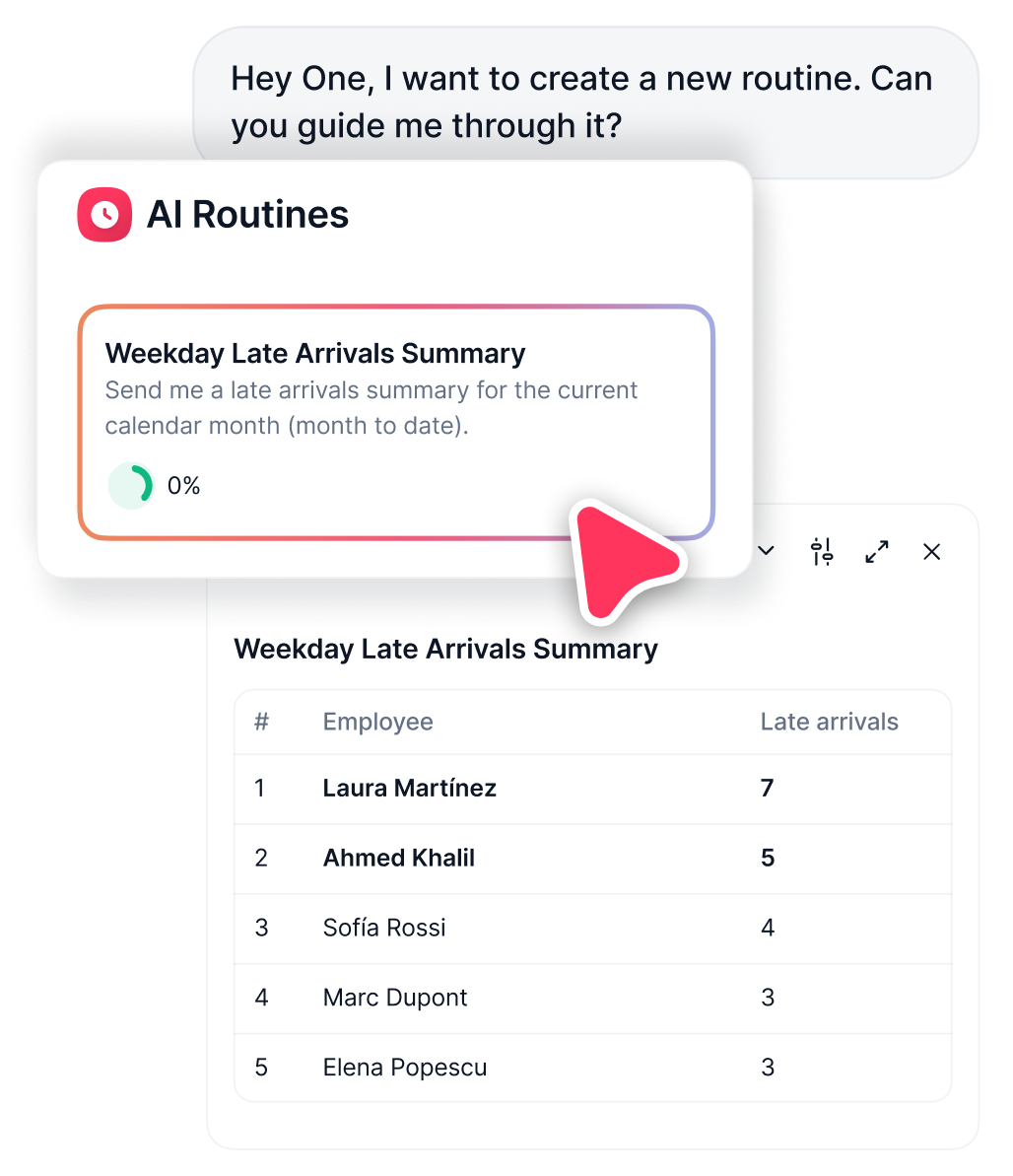
Your team should understand which requests change records and which ones only return information.
Routine actions made easier
A manager authorized to approve time off could ask One to approve a request. One can complete that action, and the manager is recorded as the approver.
The manager can reverse the approval if needed. One carries out the request using the access the manager already has.
Asking One to explain a time-off policy is different from asking it to approve time off. Show your team that difference when introducing the feature.
Sensitive changes pause for confirmation
Before a sensitive or irreversible change, One shows an approval card explaining what will change. Nothing is saved until the person confirms. Read the card before approving it. Check that the request affects the intended records and that you understand the result.
Both action routes are logged. The record shows what changed, that One proposed the action, who ran it, and when.
People make decisions about people
Hiring, promotion, and disciplinary decisions stay with people. One supports judgment rather than replacing it.
A manager using AI in HR could ask One to summarize feedback before a performance conversation. They should still review the original feedback and speak with the person before reaching a conclusion. A summary can help someone prepare. The person making the decision remains responsible for understanding the information and considering the circumstances.
Which AI models does One use?
One uses closed-source enterprise models through Azure OpenAI. These support text processing, image generation, and the technology used to find relevant information.
Closed-source means the model’s underlying code and trained parameters are not publicly available. Factorial accesses these models through Microsoft’s enterprise service.
Factorial does not send customer data to public model services with which it has no contract. It also does not use unaudited open-source models for One.
Is customer data used to train models?
No. Customer data is not used to train shared or third-party models. Factorial does not train an external model on that information.
Processing information to answer a question is different from using it to train a model. One may need relevant company information to respond to a request, but that does not make the information training material.
Data retention is a separate question. The following sections explain where information is handled and which records are kept.
Where is your data stored and processed?
Factorial stores personal and AI-related data in the European Union. When One sends a request to a model, processing may happen outside the EU.
The distinction is important for businesses with requirements about where information can be handled.
| Part of the service | Where information is handled |
| Factorial platform data | Personal and AI-related data is stored in the EU. Platform hosting includes AWS in Frankfurt and Microsoft Azure in European regions. |
| AI model resources | Model resources are hosted in European Azure regions. |
| Processing a model request | Azure Global Standard deployments may process a request outside the EU. |
| Connected services | Locations depend on the provider your administrator connects. |
A European storage location does not mean every processing step stays in Europe. Your legal and IT teams can review the arrangements against your requirements.
Which providers are involved?
Microsoft provides AI model processing through Azure OpenAI. Amazon Web Services and Microsoft Azure provide platform hosting.
Factorial also uses a provider for interaction monitoring. Information about that provider can be shared under a nondisclosure agreement.
The full subprocessor list is included in the data processing agreement. A subprocessor is another company that processes data on Factorial’s behalf.
What does One record, and who can see it?
One stores questions and answers, while Factorial keeps separate records for monitoring and changes to company information. Access depends on the type of record.
Your questions are not visible to your manager
Within the platform, only the person who asked can view their questions and One’s answers. Managers cannot read individual team members’ questions.
Factorial logs interactions for monitoring
Factorial records AI interactions in internal monitoring systems. These records support investigation of product behavior and are also used for security, compliance and legal purposes.
This does not give managers a view of individual conversations.
Changes leave an audit record
When One changes a record, the action is logged. Administrators can review the relevant write-action records to check what happened.
This helps a team answer a specific question, such as who approved a request or when information was changed.
How long are records kept?
Retention periods are set out in the data processing agreement. Check the terms for the records your business needs to review, including conversation history and action records.
Administrators can control how One is used
Administrators can restrict access and switch off AI features. Your team can choose the controls needed for its setup and change them when requirements change.
Available controls include:
- Company-wide access: Turn AI on or off across the company.
- Permission groups: Block AI access for specific groups.
- External model requests: Stop requests to external models, including during a security incident.
- Individual features: Switch off supported experiences such as AI calling or ticket resolution.
- Recruitment controls: Switch off candidate scoring and candidate summaries.
These settings let your team decide where to start. Introducing One to answer policy questions does not require you to enable every other AI feature. Our guide to AI in the workplace provides more context for introducing AI into everyday work.
How Factorial approaches the EU AI Act
According to the European Commission, an AI system’s intended purpose helps determine whether it is high-risk. Certain recruitment and people-management uses fall within the Act’s high-risk categories.
For example, using AI to analyze applications or evaluate candidates can require stricter controls. Human involvement does not automatically remove that classification. Factorial does not design One’s features for uses prohibited under the EU AI Act.
For a US business, consider EU rules where they apply to your activities. If your company operates across borders, ask your legal team to assess the features and uses involved. ISO/IEC 42001 certification does not replace that assessment.

Where to find security and compliance information
The Factorial Trust Center provides security and compliance information and lets customers request supporting documents. Some materials require approval before access is granted.
You can ask for the ISO/IEC 42001 certificate and review its scope with your legal or IT team. Information about ISO/IEC 27001 and SOC 2 assurance is also available through the Trust Center.
For questions about data handling, request the current data processing agreement and subprocessor list. These provide the contractual details that apply to your service. If your review includes a security questionnaire, send it to your Factorial contact or email [email protected] for written answers.
Responsible AI as part of everyday work
Factorial is building One into work people already do across HR, finance and IT. The aim is to reduce time spent searching for information and repeating administrative tasks, while people remain responsible for decisions.
ISO/IEC 42001 certification ensures an independent assessment of the processes behind Factorial. Your team can request the certificate and check how the available controls apply to the work you want One to support. Request a Factorial demo to get a personalized tour and a quote tailored to your company.
FAQs about ISO/IEC 42001 certification
Yes. An independent certification body can assess a company against ISO/IEC 42001 and issue a certificate if it meets the requirements. Factorial has achieved this certification. The standard is by ISO, but it does not certify companies itself.
There is no fixed price. The cost depends on your company’s size, the AI activities being assessed and the work needed to prepare. Ask a certification body for a quote, and budget for your team’s preparation time too.
It can be useful if your business builds or uses AI and customers want proof that you manage it responsibly. Certification provides an independent check of your processes. Whether it is worth the cost depends on your risks and customer requirements.
ISO/IEC 42001 is an international standard for managing AI responsibly. It sets requirements for overseeing AI, including how a company manages risks and checks its processes. It assesses how AI is managed, rather than guaranteeing that every answer is correct.
Your timeline depends on how much preparation is needed and how complex your AI activities are.
