The Indiana Worker Adjustment and Retraining Notification (WARN) Act is vital legislation, safeguarding workers, families, and communities during workforce changes, such as plant closings and mass layoffs. This article provides an overview of its components and enforcement, ensuring compliance and employee rights. Read on to learn how to issue a WARN notice in Indiana and everything else you need to know about the WARN Act in IN.
Key Facts
- Indiana has no separate mini-WARN law, covered employers follow federal WARN requirements administered through Indiana DWD.
- Indiana DWD lists 26 WARN notices dated in 2026, affecting 3,868 workers.
- Violations can trigger back pay and benefits for affected employees for up to 60 days, plus a civil penalty of up to $500 per day for failure to notify the local government.
- The eCFR instructs employers to test both 30-day and 90-day aggregation windows before concluding that notice is unnecessary.
Table of Contents
- Does Indiana have WARN Act?
- What is the Indiana WARN Act?
- WARN notices in Indiana
- What Triggers the WARN Act in Indiana?
- Indiana WARN Act Requirements
- How is the WARN Act Enforced in Indiana?
- Offboarding your workforce during a layoff
- Offboarding solutions 🚀
Does Indiana have WARN Act?
Indiana does not have a separate state-level mini-WARN law, but covered employers in Indiana must still follow federal WARN. Indiana DWD says employers should submit WARN or Non-WARN notifications through the state Employer Portal, and federal WARN notice must go to affected workers or representatives, the Workforce Transition Unit, and the appropriate local government.
Some states are not only regulated by the federal WARN Act, like Ohio, Pennsylvania, Georgia, North Carolina, Arizona, and Florida, but have their own requirements and regulations specified in their so-called mini-WARN Acts. These states include: California, New York, New Jersey, Illinois, and more.
What is the Indiana WARN Act?
In Indiana, the operative rule is the federal WARN Act, not a separate Indiana statute. The eCFR states that covered employers planning a covered plant closing or mass layoff must give affected employees at least 60 days’ notice, subject to statutory thresholds and exceptions.
On a similar note, however, Indiana holidays are determined both federally, and locally per state. More importantly, for an updated list of all Indiana HR compliance dates, check out our HR calendar!

WARN notices in Indiana
Indiana WARN notices follow the federal 60-day written-notice rule. If represented workers are affected, notice generally goes to the representative rather than each individual worker. The eCFR says WARN notices must be specific and should include:
- the employment site name and address,
- a company contact name and phone number,
- whether the action is permanent or temporary,
- the expected first separation date and schedule,
- affected job titles and employee counts by classification,
- bumping-rights information, where applicable,
- union details, if affected workers are represented.
See previously issued WARN notices for the state of Indiana here.
Who do Indiana employers have to give a WARN notice?
Covered employers must provide written notice to affected workers or their representatives, the Indiana DWD Workforce Transition Unit, and the chief elected official of the local government where the employment site is located. Indiana DWD identifies the Workforce Transition Unit as the state recipient for WARN notices.
This notice should be delivered at least 60 days before the anticipated plant closing or mass layoff.
For documentation control, store the planned separation date, notice delivery date, recipient list, and proof of delivery in one HR record. Factorial can help HR teams centralize layoff-related documents, assign offboarding tasks, and keep notice evidence accessible if a dispute arises.
What Triggers the WARN Act in Indiana?
Certain situations trigger federal WARN obligations in Indiana:
| Trigger | Federal WARN threshold |
|---|---|
| Plant closing | Shutdown of a single site, facility, or operating unit causing employment loss for 50 or more employees in a 30-day period. |
| Mass layoff | Employment loss for 500 or more employees, or 50 to 499 employees if they represent at least 33% of the active workforce at the single site. |
| Aggregated losses | Separate employment losses may be counted together over a 90-day period unless the employer can show separate and distinct causes. |
| Employment loss | eCFR defines employment loss to include termination, a layoff exceeding 6 months, or a reduction in hours of more than 50% in each month of a 6-month period. |
What is a plant closing?
When an employment site or facility is shut down, resulting in an employment loss for 50 or more employees during a 30-day period.
What are mass layoffs?
When a mass layoff occurs that does not result from a plant closing, but leads to an employment loss for 500 or more employees during a 30-day period, or for 50-499 employees if they constitute at least 33% of the employer’s active workforce.
What are extended layoffs?
Extended or staggered layoffs can trigger WARN when cumulative employment losses that fall below the threshold separately reach the plant-closing or mass-layoff threshold during any 90-day period. The eCFR instructs employers to look 90 days ahead and 90 days behind when testing aggregation.

Indiana WARN Act Requirements
In Indiana, federal WARN generally covers a business enterprise with 100 or more employees excluding part-time employees, or 100 or more employees including part-time employees who together work at least 4,000 hours per week, excluding overtime. The eCFR defines part-time status as fewer than 20 hours per week on average or fewer than 6 of the prior 12 months of employment.
Employees entitled to notice under the WARN Act include hourly and salaried workers, as well as managerial and supervisory employees. However, business partners are not entitled to notice.
The core focus of WARN Act requirements in Indiana is on notification. Employers must provide advance notice before a change in employment affecting many employees.
Federal WARN regulations encourage employers to provide advance notice in ambiguous situations, even when coverage is uncertain. Disputes over notice can lead to expensive and time-consuming litigation. The eCFR states that the Department encourages employers to give notice in all circumstances.
When can an Indiana employer give less than 60 days’ notice?
Federal WARN allows reduced notice only in limited circumstances. The eCFR identifies three conditions for a shortened notice period, and the employer bears the burden of proving the exception applies while still giving as much notice as practicable.
How is the WARN Act Enforced in Indiana?
Federal WARN enforcement in Indiana is carried out through the United States District Courts. The eCFR states that employees, their representatives, and units of local government may initiate civil actions, and that the U.S. Department of Labor has no legal standing in WARN enforcement actions.
Violations of the WARN Act may result in back pay and benefits for affected employees for the period of violation, up to 60 days. The U.S. Department of Labor WARN Advisor also states that failure to notify the local government can trigger a civil penalty of up to $500 per day, although that penalty may be avoided if the employer satisfies liability to each affected employee within three weeks after the closing.
Indiana WARN compliance checklist for HR teams
- Confirm employer coverage and employee counts.
- Identify whether the event is a plant closing, mass layoff, or aggregated 90-day loss.
- Calculate the first separation date and 60-day deadline.
- Prepare written notices for each required recipient.
- Submit the notice to Indiana DWD and retain proof of delivery.
Why is the Indiana WARN Act important?
Understanding the intricacies of the Indiana WARN Act is essential for HR managers to navigate workforce changes compliantly and ensure the rights of employees are upheld during significant transitions. This guide covers key aspects, providing a foundation for effective compliance and transparent communication during challenging times.
Related: Compliance calendar for HR
Offboarding your workforce during a layoff
Before offboarding begins, confirm that WARN documentation, final pay timing, benefits notices, return-of-property records, and system-access changes are assigned to specific owners. This reduces the risk of missed steps during a high-volume separation event.
Once you’ve followed all the required steps mandated by Indiana during plant closings and mass layoffs, it’s time to begin the offboarding process at your company. Offboarding so many employees at the same time can be a time consuming and costly process, but with the right HR software, it can be easy.
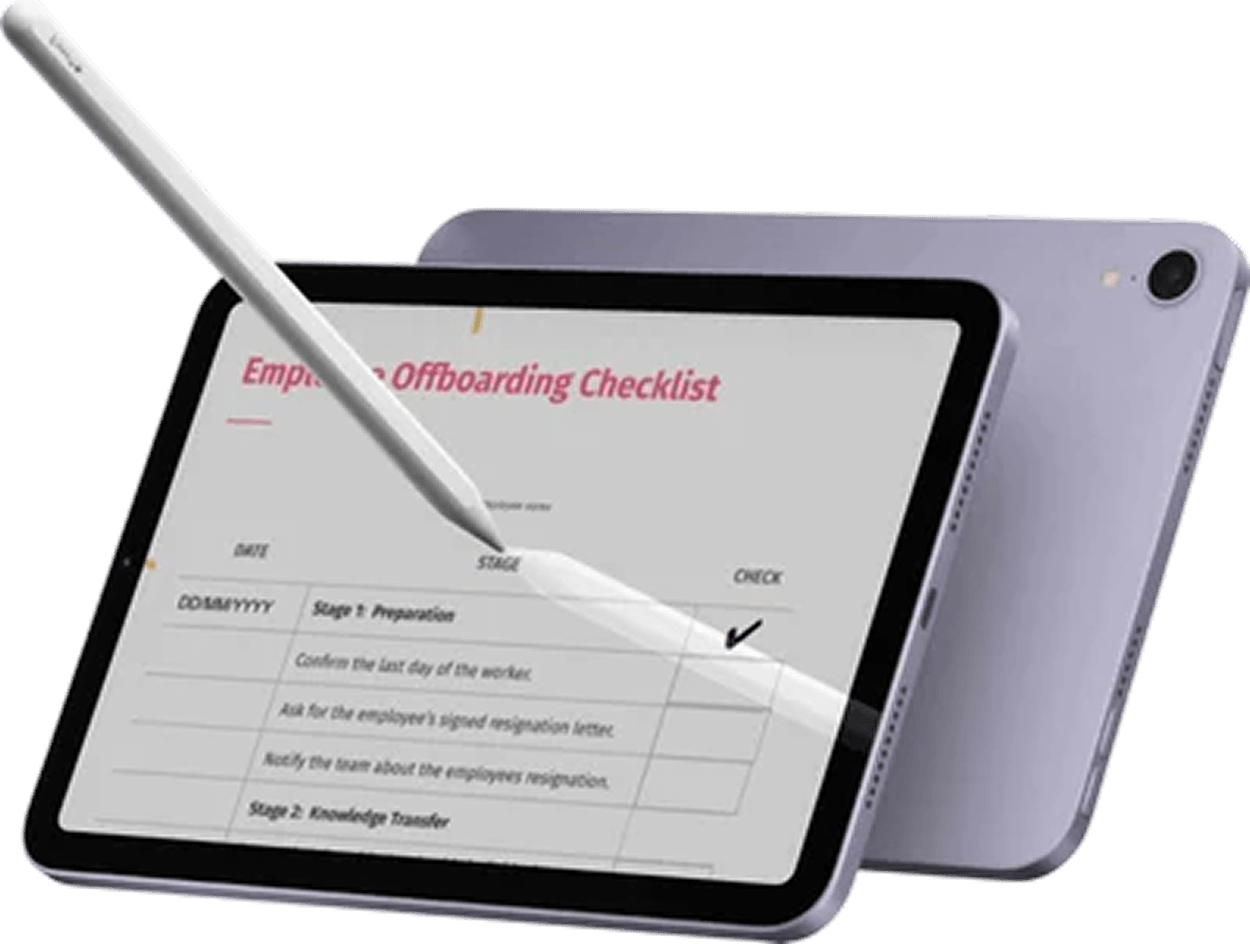
How to offboard employees with HR software
Factorial simplifies the offboarding process, simplifying tasks and ensuring a smooth transition for departing employees. With Factorial, you can efficiently manage exit procedures, such as collecting company assets, updating access permissions, and conducting exit interviews. Offboarding software simplifies the entire process from start to finish.
Key Features for offboarding during layoffs:
1. Clear Communication: Easily communicate departure details to the departing employee, including the last day of work, return of company property, and other essential information.
2. Task Automation: Automate offboarding tasks, such as revoking system access, updating records, and notifying relevant departments, saving time and minimizing the risk of oversight.
3. Documentation and Compliance: Ensure compliance by generating necessary documentation, such as termination letters and exit surveys, helping you maintain a comprehensive record of the offboarding process.
4. Access Control: Centralize access control management, making it simple to revoke access to company systems and confidential information, safeguarding your organization’s data.

By utilizing Factorial for offboarding, HR managers can enhance efficiency, maintain compliance, and provide a positive experience for departing employees.
Book a free demo call to learn more!
FAQ
Does Indiana have a WARN Act?
Indiana does not have its own state-level WARN Act. However, employers in the state are still covered by and must comply with the regulations of the federal WARN Act.
Is the WARN Act still in effect?
Yes, the federal WARN Act is still in effect across the United States, including Indiana. It requires employers to provide a 60-day advance notification to employees before a plant closing or mass layoff.
Does WARN apply to layoffs?
Yes, the WARN Act applies to mass layoffs. It is triggered by layoffs involving 500 or more full-time employees, or 50-499 employees if they constitute at least 33% of the employer’s active workforce.
How many employees have to be laid off for a warn notice?
A WARN notice is required for plant closings affecting 50 or more employees. For mass layoffs, a notice is triggered when 500 or more employees are affected, or 50-499 employees if they represent at least 33% of the workforce.
What information must be included in a warn notice?
A WARN notice must be a written document that includes the site and date of the closure or layoff, the reason for the action, and whether the job losses are permanent or temporary. It must also specify affected job titles and provide follow-up contact information.