Skip to content

Secrets worth millions, for free.

Everyone wants to know Coca-Cola's secret. But what about Microsoft's, Mercedes-Benz's, or L'Oréal's? Receive a monthly selection of the stories, insights, and playbooks from Europe's most successful companies.

Want to know how Microsoft, L'Oréal, and other leading companies do it?

Get their stories, insights, and playbooks every month.

Transcription

00:08

Question 1: Why bet on "slow work" in the workplace?

00:13

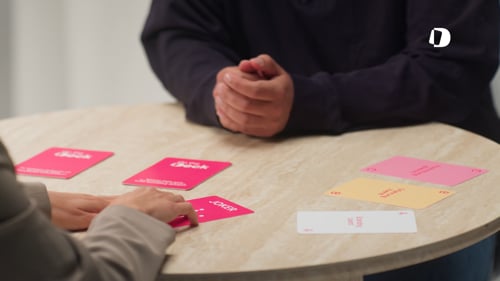
A) Worker well-being.B) More creativity.C) Sustainable results.

00:18

D) None of the above.Could you show me the card you chose?

00:24

All of the above.Alright, I believe employee well-being is the main reason.

00:40

Would you like to go first and explain why, intuitively,you chose card A?

00:46

Yes — the concept of "slow work," which I also learned from you,makes a lot of sense, given all the context you provided, which I was already familiar with regarding sustainable fashion and making more sustainable choices — and work is those 8 hours of our daily lives, where we also spend the majority of our time.

01:07

And I agree that all of them are the reason why we embrace "slow work." It will provide greater well-being for workers and it will also bring us more creativity as a result, and of course, better sustainable results in the long run."Slow work" is based on a set of principles, one of which is respect for our own rhythms of work, our human work rhythms, and there must be a balance between what the worker is able to contribute in terms of performance, and the organization's objectives.

01:41

And that's why, yes, your option A, focused on worker well-being,makes complete sense.

01:47

And in turn, when we improve workers' well-being, we are also improving their task performance, which will translate into the quality of the work done, the organization's productivity,and sustainable results.

02:07

And for option B, therefore, I also checked the "joker" box, since I agreed with all of the More options, more creativity — why?

02:15

Because "slow work" defends that we should have time for reflection,as opposed to autopilot, to the constant reactive capacity that has prevailed in organizations.

02:28

We must dedicate time to reflection to think and foster creativity,to foster innovation.

02:37

For automated processes we already have robotics,automation, and artificial intelligence — and we cannot ignore what distinguishes us as humans, which remains our creative processes, right?

02:54

Question 2: To have a healthier and more efficient team,what would you adjust first?