As businesses grow, managing HR manually becomes harder, and more expensive. Payroll, onboarding, leave, employee records and compliance all require time, while errors and missed deadlines can create additional costs. With Kenya’s modern-sector wage employment reaching 3.3 million in 2025, businesses are managing increasingly complex workforces. HR software can help automate these processes, but getting leadership buy-in requires more than listing its features.
The starting point is simple: understand what manual HR is costing your business, then compare it with the cost of automating it.
How Much Does Manual HR Cost Your Business?
The cost of manual HR isn’t always visible on your Profit and Loss (P&L). It can be spread across staff time, errors, compliance risks and work that HR teams don’t have time to do.
1. Time spent on repetitive administration
Consider how many hours your HR team spends each week on:
- Processing payroll
- Managing leave and attendance
- Updating employee records
- Preparing HR reports
- Responding to routine employee questions
- Tracking compliance requirements
The HR Software Business Case Toolkit uses an illustrative example of 18 hours of manual HR work per week at a loaded cost of KES 1,200 per hour.
That’s:
- KES 21,600 per week
- KES 1,123,200 per year
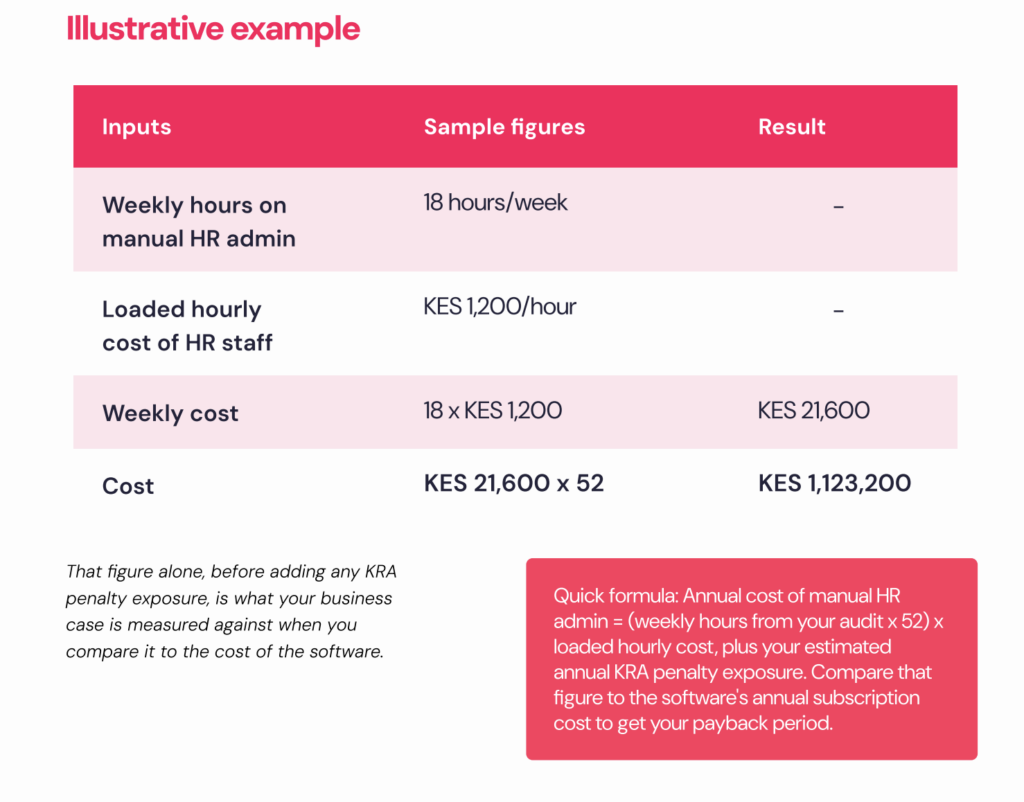
That is the estimated cost of the manual HR work alone — before considering other risks and costs.

2. Payroll and compliance risks
Payroll is an area where manual processes can create both extra work and financial risk.
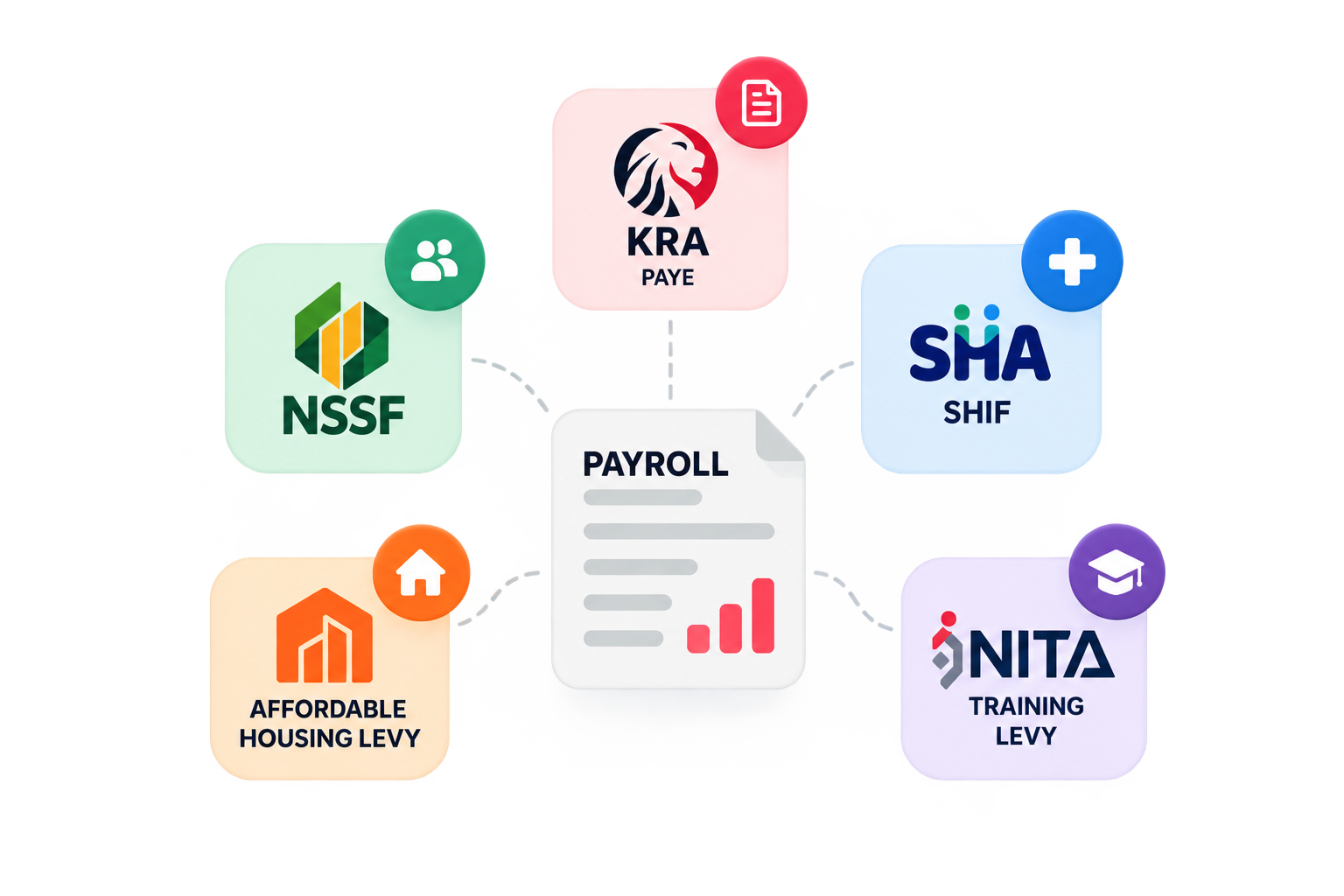
In Kenya, PAYE returns and payments are due by the 9th of the following month. KRA states that late filing can attract a penalty of the higher of 25% of the tax due or KES 10,000, while late payment attracts a 5% penalty plus 1% interest per month.
For businesses managing payroll manually, the risks include:
- Incorrect tax calculations
- Missed filing deadlines
- Incorrect statutory deductions
- Time spent checking and correcting payroll
- Potential penalties and interest
The cost of compliance therefore needs to be considered when calculating the cost of staying manual.
3. Errors and rework
Manual HR processes also create more opportunities for errors. Common examples include:
- Incorrect employee information
- Payroll mistakes
- Missing approvals
- Duplicate or outdated records
- Errors that require additional checks
The original mistake may be small, but correcting it takes additional HR and management time.
4. Manual onboarding costs
Hiring a new employee also comes with administrative work. The HR Software Business Case Toolkit cites research estimating the cost of manual onboarding at US$58.79 per new hire, which the ebook converts to approximately KES 7,600. This includes activities such as updating employee information, preparing employment agreements and completing employment eligibility checks.
For companies hiring regularly, these costs can add up.
5. Opportunity cost
There is also the cost of what HR could be doing instead. Time spent on repetitive administration is time that could have gone towards:
- Employee retention
- Workforce planning
- Employee engagement
- Learning and development
- Supporting managers
- Improving the employee experience
The question is therefore not just how much manual HR costs, but what your HR team could achieve if more of that time was freed up.
How to Build a Business Case for HR Software
Once you understand the cost of your current HR processes, you can build a stronger case for implementing HR software.
The goal isn’t to show leadership a long list of software features. It is to demonstrate how the investment can solve a business problem and deliver measurable value.
1. Calculate the cost of staying manual
Start by auditing the time your HR team spends on manual work.
Look at:
- Payroll processing
- Leave management
- Employee onboarding
- Compliance tracking
- Employee queries
- Employee record management
Then calculate the cost of those hours using your team’s actual loaded hourly cost.
2. Compare the cost of manual work with the software investment
Once you have your annual manual HR cost, compare it with the total cost of the HR software you’re considering.
Consider:
- Annual subscription costs
- Implementation costs
- Training costs
- Current HR administration costs
- Potential time savings
- Potential reduction in errors and rework
This gives leadership a clearer picture of the investment rather than simply presenting software as another expense.
3. Consider compliance and risk
Your business case should also account for risks that may not happen every month but can still have a financial impact.
Consider:
- Payroll errors
- Missed statutory deadlines
- Incorrect deductions
- Data security
- Lost or duplicated employee records
- Compliance-related rework
This is particularly relevant in Kenya, where businesses must keep up with changing tax and statutory requirements. KRA’s current guidance and 2026 tax-amnesty programme also demonstrate how important accurate tax records and compliance remain for businesses.
4. Show potential time savings
Avoid simply saying that HR software will “save time.” Put a number behind it.
For example:
If your HR team currently spends 18 hours a week on manual administration, how many of those hours could be reduced through automation?
Then calculate what those recovered hours are worth. This turns “HR software saves time” into a financial argument leadership can understand.
5. Show what matters to each decision-maker
Your business case should also be tailored to the people approving the investment.
- CFO: Cost per employee, compliance exposure, total cost and expected payback.
- CEO: How HR technology can support business growth without increasing administrative workload at the same rate.
- COO: Faster processes, fewer errors and a smoother employee experience.
This approach is particularly relevant as Kenyan business leaders continue to prioritise technology-enabled investment and business reinvention. PwC’s 2026 Kenya CEO Survey found that CEOs are focused on technology-enabled investment while navigating regulatory demands, skills shortages and technological disruption.
Want to Put These Calculations Into Practice?
Building a business case doesn’t have to start with a blank page. The HR Software Business Case Toolkit gives you a practical framework to:
- Calculate the hidden cost of manual HR
- Estimate the cost of your current HR administration
- Build a business case for leadership
- Calculate potential time and cost savings
- Compare HR software options
- Evaluate vendors using a practical checklist
Conclusion
The question to ask isn’t simply “How much does HR software cost?” It’s “How much is our current way of managing HR already costing us?”
Once you understand the time, errors, compliance risks and administrative costs involved, you can have a more informed conversation about whether HR software makes business sense. See what that could look like for your business. Book a demo to take a guided tour of Factorial and explore how it can simplify your HR processes.