Choosing the right HR software in Kenya can be challenging when your team needs to manage employee records, payroll, recruitment, leave, attendance, performance, compliance and more from different systems. Factorial vs HONO is a comparison worth considering for businesses looking for a more connected way to manage their people operations.
Both platforms offer core HR capabilities, payroll-related functionality, employee self-service, attendance and talent management. HONO also offers Kenya-specific payroll functionality covering areas such as NSSF, PAYE and KRA iTax reporting.
Factorial, meanwhile, combines HR management with time management, talent management, payroll management, expenses, finance, IT, document management, analytics and integrations, giving businesses a broader platform for managing employee operations.
So, Factorial vs HONO: which HR software is the better fit for your business in Kenya?
Let’s compare them.
Factorial vs HONO: At a Glance
| Feature | Factorial | HONO |
| AI-powered HR | ✓ | ✓ |
| Employee records | ✓ | ✓ |
| Recruitment & ATS | ✓ | ✓ |
| HR-connected IT onboarding/off-boarding | ✓ | — |
| Time tracking | ✓ | ✓ |
| Payroll management | Payroll management + payroll integrations | ✓ |
| Kenya statutory compliance | ✓ | ✓ |
| Performance management | ✓ | ✓ |
| Leave management | ✓ | ✓ |
| Expenses management | ✓ | ✓ |
| IT management | ✓ | — |
| Finance capabilities | ✓ | — |
| Multi-country HR | ✓ | ✓ |
| Multi-OS device management (MDM) | ✓ | — |
Specific payroll calculations, filings and statutory workflows can depend on the payroll provider or integration used. Factorial provides payroll management integrations through its platform.
What Is Factorial?
Factorial is an all-in-one HR and business management platform that brings together HR, time, talent, payroll management, expenses, finance, IT and integrations.
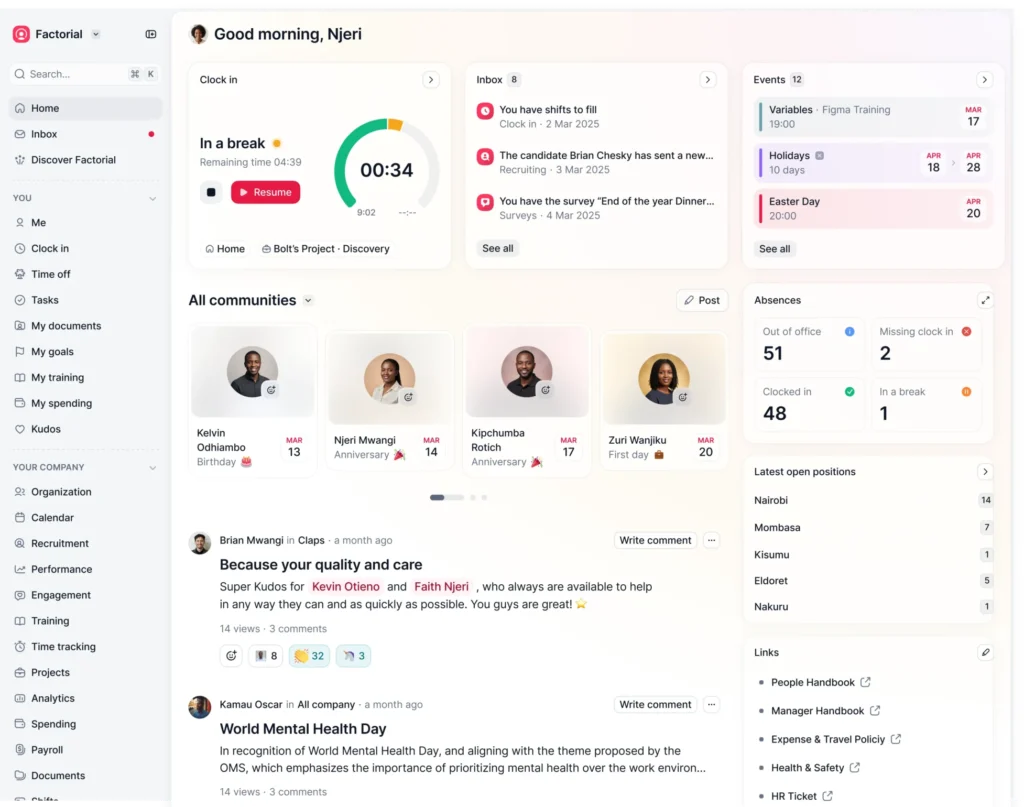
Instead of managing employee information across disconnected spreadsheets and applications, businesses can centralise key people processes in one platform. Factorial covers the employee lifecycle from recruitment and onboarding/Off-boarding to time management, performance, payroll, and expenses, while also providing tools for documents, e-signatures, analytics and employee self-service.
Its integration capabilities are another important distinction. Factorial can connect with existing business applications and payroll providers, allowing companies to build their HR ecosystem around the systems they already use rather than replacing everything at once.
What Is HONO?
HONO is an AI-powered HR and payroll platform designed to manage the employee lifecycle, from recruitment and onboarding to payroll, attendance, performance and separation.
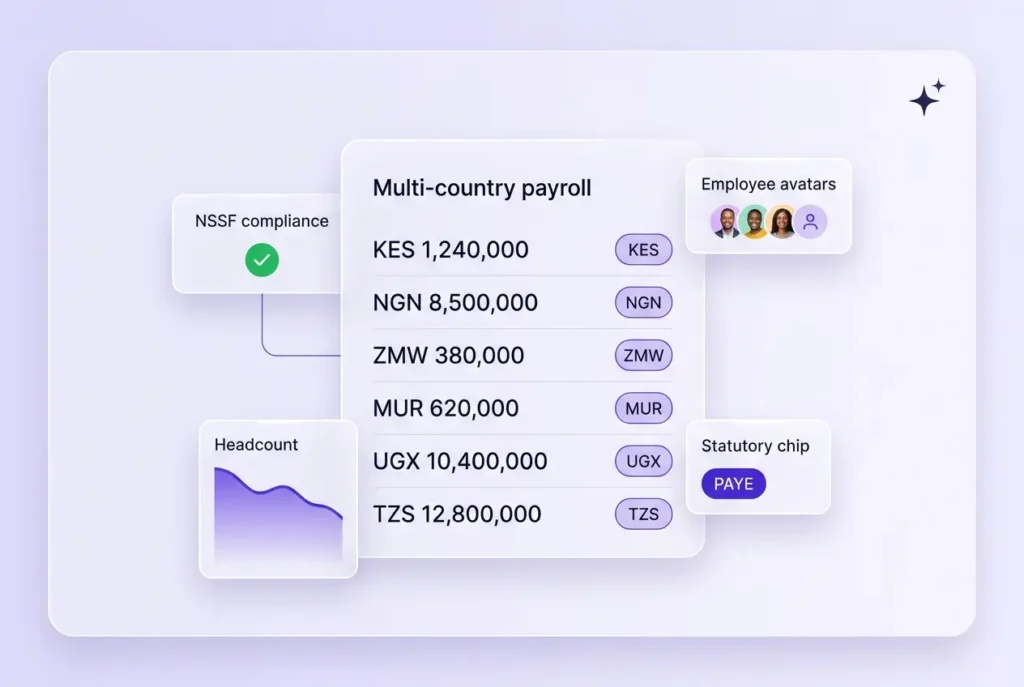
For Kenyan businesses, HONO provides country-specific payroll capabilities. HONO also brings together core HR, payroll, attendance and leave, performance and employee self-service in one platform. Its broader platform includes capabilities such as recruitment, onboarding, performance management, learning, employee engagement, analytics and AI-powered HR assistance.
Factorial vs HONO: Feature Comparison
1. Core HR and Employee Management
Both platforms provide a central place for managing employee information. HONO provides a central employee record with employee details, documents, organisational information and lifecycle events.
Factorial goes beyond employee records by connecting HR information with other people-management processes, including time, talent, documents, payroll, expenses and employee workflows.
With Factorial, HR teams can manage areas such as:
- Employee records
- Employee documents
- Digital signatures
- Onboarding
- Offboarding
- Employee self-service
- Organisational structures
- Time and attendance
- Leave
- Expenses
- Payroll management
- Talent management
This makes Factorial particularly useful for companies that want to manage more than employee data from one system.
Advantage: Factorial
2. Recruitment and Onboarding
Recruitment is often the starting point of the employee lifecycle, so connecting recruitment with HR can reduce duplicate data entry.
HONO offers recruitment and onboarding capabilities, including candidate identification, screening and digital onboarding.
Factorial also provides recruitment and onboarding tools, allowing companies to manage candidates and transition new hires into their employee records. Factorial can also connect with recruitment and other business applications through its integrations ecosystem, including platforms such as Teamtailor and Recruitee.
For businesses that already use different recruitment tools, this integration-first approach can make it easier to connect the hiring process with the wider HR system.
Advantage: Factorial

3. Payroll and Payroll Integration
Payroll is one of the biggest considerations for Kenyan businesses.
HONO has a native payroll solution designed to handle Kenyan payroll requirements, including NSSF, PAYE, KRA iTax reporting, HELB and pension contributions.
Factorial takes a different approach. Its payroll management capabilities allow businesses to manage payroll-related information, compensation changes, supplements, overtime and payroll documents, while its open API enables integration with existing payroll providers.
Factorial specifically supports integrations with payroll providers and applications, including Sage 50 Payroll and Payflow.
This distinction matters.
A company that already has a payroll provider does not necessarily need to replace it to introduce Factorial. Instead, it can connect payroll with its HR data and workflows.
Best fit depends on your payroll setup:
- Choose HONO if native payroll processing is your basic requirement.
- Choose Factorial if you want an HR platform that can integrate with your existing payroll infrastructure while connecting payroll data with wider HR processes.
For businesses looking to avoid replacing existing systems unnecessarily, Factorial’s integration approach provides greater flexibility.
4. Kenya Payroll Compliance
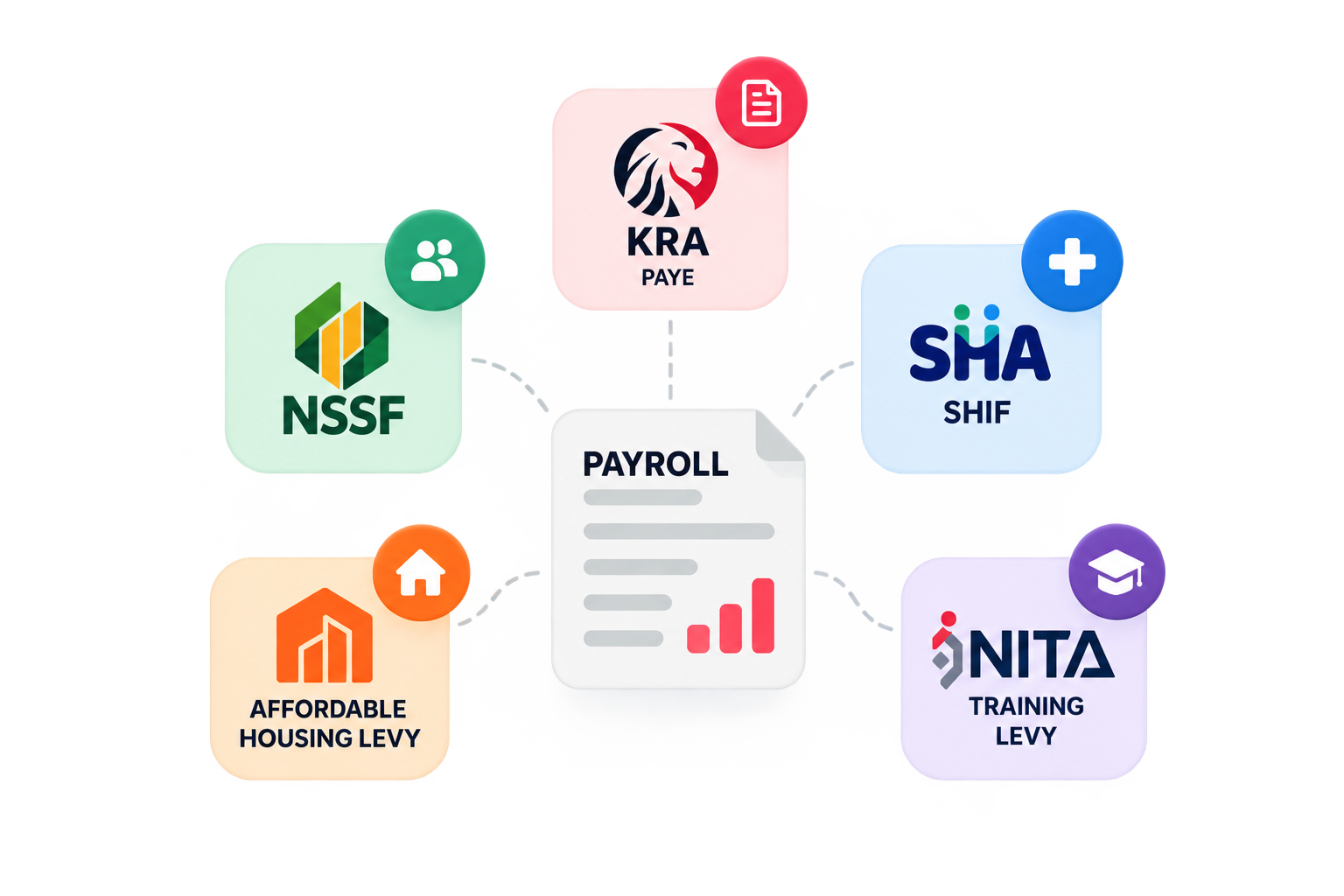
Kenyan employers need to manage multiple statutory obligations and keep accurate employee and payroll records.
HONO’s Kenya payroll solution is specifically configured around Kenyan requirements, including NSSF, PAYE, KRA iTax, HELB and pension contributions.
Factorial also supports payroll management and integrations for businesses operating in Kenya. Its Kenya offering addresses payroll and HR requirements while connecting with payroll providers through its integration capabilities.
The important consideration is how your business wants compliance managed.
With Factorial, HR teams can centralise employee information, documents, time, leave, compensation and other payroll inputs while connecting these processes to payroll. That creates a more connected HR workflow rather than treating payroll as an isolated monthly activity.
Advantage: Factorial for businesses prioritising an integrated HR ecosystem and payroll processing.
5. Time and Attendance
Time tracking, attendance and leave are closely connected to payroll and workforce management.
HONO offers attendance and leave management, including mobile employee self-service and workforce management capabilities.
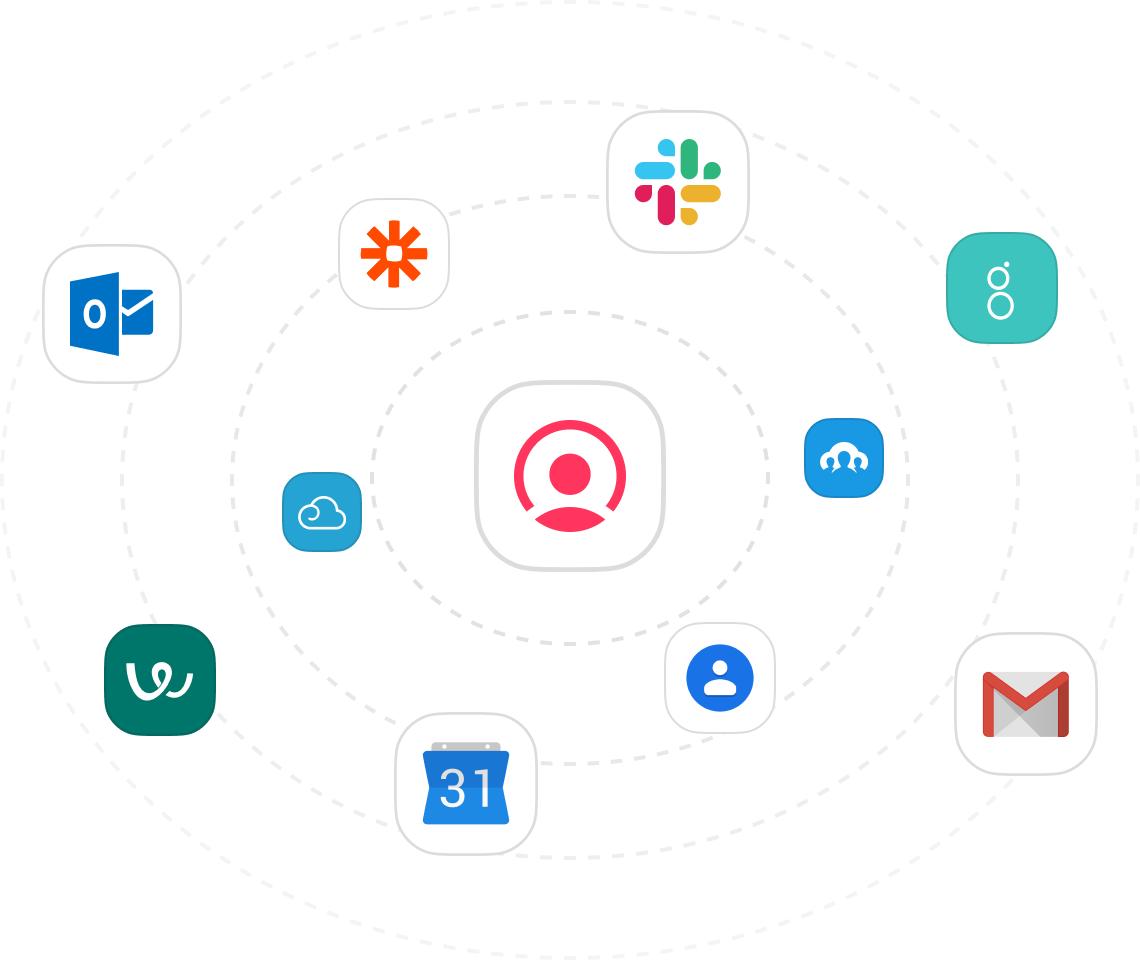
Factorial provides time management tools that allow businesses to manage working hours, attendance, leave and employee time-related information. Factorial can also connect time-tracking systems with other business applications. For example, its integration ecosystem includes ZKTeco for biometric and RFID time tracking.
For businesses that want flexibility around how attendance data enters the HR system, integrations can be particularly useful.
Advantage: Factorial
6. Performance and Talent Management
Managing employee performance requires more than annual appraisals.
HONO provides performance management, continuous feedback, goals, learning and career development capabilities as part of its wider employee-growth offering.
Factorial also offers a broader talent management environment covering areas such as performance reviews, 360-degree feedback, goals and OKRs, competency management and other employee development workflows. This allows businesses to connect employee performance with broader talent processes.
For organisations looking to make performance management an ongoing process rather than a once-a-year exercise, Factorial provides a comprehensive talent management toolkit.
Advantage: Factorial
7. Expenses and Finance
This is another area where the platforms differ.
HONO focuses primarily on the employee and HR lifecycle, with capabilities around payroll, expenses and workforce management.
Factorial extends beyond traditional HR with expense management and finance-related capabilities. Businesses can manage expense requests, approvals and reimbursements while connecting expenses with payroll processes. Factorial’s payroll solution can automatically reflect approved expenses as payroll supplements.
That means finance and HR teams can work from connected data instead of relying on separate spreadsheets and manual updates.
Advantage: Factorial
8. Document Management and E-Signatures
HR teams deal with contracts, policies, payslips, employee records and other documents throughout the employee lifecycle.
Factorial provides document management and digital signature capabilities, allowing businesses to send documents to employees for electronic signing and maintain important employee documentation digitally.
HONO also provides digital document management and document workflows as part of its employee lifecycle platform. Both platforms can reduce dependence on paper-based HR administration.
Advantage: Factorial
9. Integrations
Integrations are increasingly important because businesses rarely operate with one software platform.
Factorial has an extensive integration ecosystem designed to connect HR with the tools businesses already use. Available integrations include payroll, recruitment, productivity, finance, identity management, analytics and time-tracking tools.
Examples include:
- Sage 50 Payroll
- Payflow
- Microsoft Dynamics 365
- Microsoft Business Central
- Power BI
- Zapier
- Teamtailor
- Recruitee
- ZKTeco
- Okta
- Slack
- Google Workspace
This means businesses can build a connected HR technology stack without necessarily abandoning the tools they already rely on.
HONO also integrates different HR functions through its unified employee record and provides an ecosystem of capabilities across payroll, attendance, performance, recruitment and analytics.
However, Factorial’s integration-first approach is a significant advantage for businesses that need their HR platform to work alongside existing systems.
Advantage: Factorial
Why Choose Factorial for Your Business?
HONO is a capable HR platform with particularly good payroll and statutory functionality.
But businesses looking beyond payroll may need more.
Factorial brings HR, time, talent, payroll management, expenses, finance, IT, documents, analytics and integrations together in one platform.
That means you can use Factorial to:
- Centralise employee data
- Automate recruitment and onboarding
- Manage leave and attendance
- Track working hours
- Manage employee performance
- Set goals and OKRs
- Run talent management processes
- Manage expenses
- Digitise HR documents
- Collect electronic signatures
- Connect with payroll providers
- Integrate existing business software
- Access HR analytics
- Manage employee self-service
- Connect HR processes across the employee lifecycle
For businesses in Kenya, Factorial can also help HR teams maintain the employee and payroll information needed to support regulatory compliance, while payroll integrations allow organisations to connect their HR platform with the payroll infrastructure they use.
Factorial vs HONO: The Bottom Line
Both Factorial and HONO can help Kenyan businesses move away from manual HR administration.
HONO stands out for its native payroll capabilities and Kenya-specific statutory payroll functionality, including NSSF, PAYE and KRA iTax support.
Factorial takes a broader approach.
Instead of focusing primarily on HR and payroll, Factorial brings together the wider employee and business lifecycle — from recruitment and onboarding to time, performance, expenses, payroll management, documents, finance, IT and integrations.
For businesses that want more than a payroll or HR system, this broader ecosystem can mean fewer disconnected tools, less manual data entry and a more centralised way to manage people operations.
Want to see how Factorial can fit into your HR and payroll processes in Kenya? Book a demo and get a closer look at the platform, its integrations and the tools available for your business.

The information presented on this page is based on publicly available sources as well as on review sites, including Capterra. The comparisons between Factorial and other providers are intended solely to illustrate respective software features, pricing, and functionalities. All information regarding features, prices, and integrations may be subject to change without prior notice. Factorial assumes no liability for the accuracy, completeness, or timeliness of the information presented. We recommend contacting the respective providers directly to obtain the most accurate and up-to-date information. All applicable fair advertising and competition laws are fully observed. If you have any concerns, please reach out to us. The comparisons presented do not constitute a final evaluation or recommendation for any provider but serve solely as an informational source.