Managing payroll in Kenya involves more than calculating salaries and paying employees on time. Employers also need to keep track of statutory deductions, returns and remittance deadlines across different regulatory bodies.
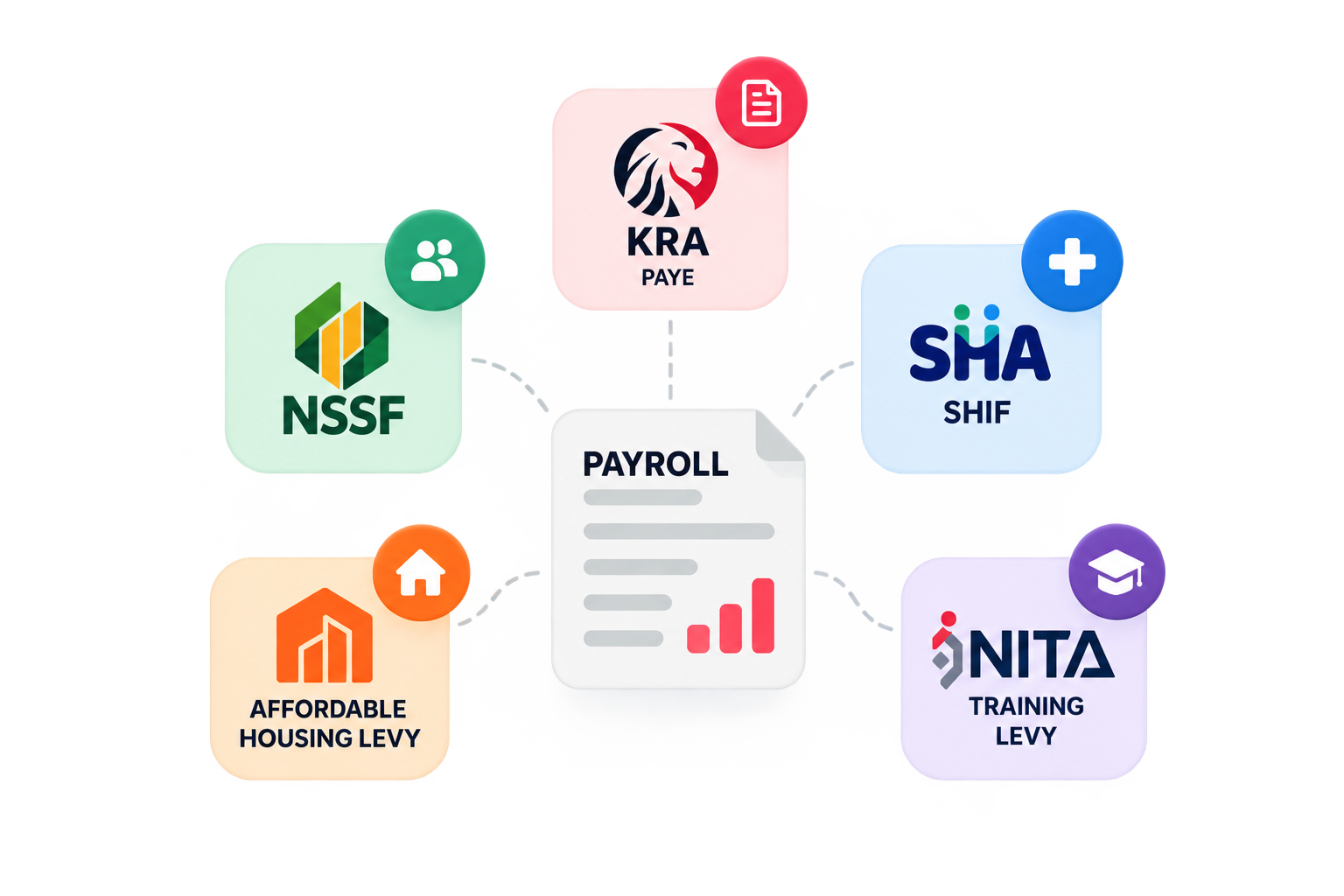
With PAYE, NSSF, SHIF, the Affordable Housing Levy and NITA requirements to manage, missing a deadline can result in penalties and additional administrative work. Kenya’s payroll environment has also changed significantly in recent years, making it important for employers to keep their compliance information up to date.
Here are the key payroll compliance deadlines Kenyan employers need to know.
What Are the Main Payroll Compliance Deadlines in Kenya?
Several statutory payroll obligations recur every month, but they do not all follow exactly the same deadline. Knowing which payment or return is due, when it is due and which regulator receives it can help payroll teams avoid missed obligations.
1. PAYE deadline in Kenya
PAYE is due by the 9th of the following month.
The Kenya Revenue Authority (KRA) requires employers to deduct PAYE from employees’ taxable emoluments and remit the amount to KRA on or before the 9th day of the following month. The PAYE return should also be filed through iTax by the same deadline.
For example, PAYE deducted from September payroll is due by 9 October.
2. NSSF deadline in Kenya
NSSF contributions are due by the 9th of the following month.
Employers are required to submit their NSSF returns and remit contributions for each month on or before the 9th day of the ensuing month. The National Social Security Fund (NSSF) states that payments made after the 9th attract penalties.
This means payroll teams need to account for both the employee and employer contributions when preparing monthly payroll.
3. SHIF deadline in Kenya
SHIF contributions are due by the 9th of each month.
The Social Health Authority (SHA) requires employers to deduct SHIF contributions from employee salaries and submit them by the 9th of each month. SHA also states that late remittance attracts a penalty of 2% of the outstanding amount for each month the payment remains unpaid.
4. Affordable Housing Levy deadline in Kenya
The Affordable Housing Levy is due by the 9th working day after the end of the month.
KRA states that both the employee and employer contribute 1.5% of the employee’s gross monthly salary, with the combined amount remitted within nine working days after the end of the month in which the salary was due.
The distinction between “9th of the month” and “9th working day after month-end” is important when managing payroll deadlines.

5. NITA Training Levy deadline
The NITA Training Levy is an employer-funded obligation and is currently stated by KRA as due by the 9th of the following month.
KRA issued a 2024 notice stating that the NITA Levy due date was amended from the 5th to the 9th day of every month following the month in which the levy is due.
The National Industrial Training Authority (NITA) currently lists the levy at KES 50 per employee per month and describes it as an employer payment rather than a payroll deduction. Its website currently gives a different payment-timing instruction, stating that it is payable on the last working day of the month.
For this reason, employers should confirm the applicable payment instruction with KRA or NITA when making their payment.
Don’t forget that payroll compliance goes beyond monthly deadlines
The monthly deductions are only part of the compliance calendar. Employers also have other important dates to track throughout the year.
For example, the 2026 Kenyan Payroll & Compliance Calendar includes:
- P9 tax deduction certificates due by 31 January
- Annual employer PAYE return due by 30 June
- NSSF quarterly returns
- NCPWD annual compliance reporting for qualifying employers
- Year-end payroll reconciliation and other compliance checks.
This is why relying on a single monthly payroll reminder may not be enough for a business managing its wider compliance obligations.

What Happens When Payroll Deadlines Are Missed?
Payroll compliance deadlines matter because late filing or payment can result in financial penalties.
For example, KRA states that late PAYE filing attracts a penalty of the higher of 25% of the tax due or KES 10,000. Late PAYE payment attracts a 5% penalty and interest of 1% per month or part of a month on the unpaid tax.
NSSF states that late mandatory contributions attract a 5% penalty for each month or part of a month that the payment is late.
For SHIF, SHA states that late remittance attracts a 2% penalty on the outstanding amount for each month the payment remains unpaid.
The Affordable Housing Levy also carries a late-payment penalty. KRA states that unpaid AHL attracts a 3% penalty for each month or part of a month that the amount remains unpaid.
The cost of missing a deadline therefore goes beyond the original payment. Payroll teams may also need to correct returns, reconcile records and resolve outstanding obligations with the relevant regulator.

Get the Kenyan Payroll & Compliance Calendar
Keeping track of payroll deadlines shouldn’t mean checking different regulatory requirements every month.
The Kenyan Payroll & Compliance Calendar brings key payroll and compliance obligations into one month-by-month reference for HR leaders, finance managers and business owners managing payroll in Kenya. The guide was last updated in August 2026.
What’s inside the ebook?
- A month-by-month compliance calendar with key payroll deadlines and obligations throughout 2026.
- Statutory deductions at a glance, covering PAYE, NSSF, SHIF, Affordable Housing Levy and NITA.
- 2026 public holidays and payroll considerations, including implications for shift-based and 24/7 teams.
- The 2026 minimum wage increase, including the changes that took effect from 1 May 2026.
- Additional compliance requirements beyond payroll, including data protection and PWD employment requirements.
- A penalty snapshot and employer checklist to help payroll teams keep track of key obligations.
Simplify Payroll Compliance With Factorial
Knowing your payroll deadlines is one thing. Keeping your payroll processes aligned with those requirements every month is another.
Payroll teams have to manage employee changes, salary calculations, statutory deductions, payments and payroll records while keeping up with regulatory changes. Bringing these processes together can make payroll administration easier to manage.
Factorial’s payroll solution is designed to bring payroll processes together, help businesses process payroll accurately and reflect changes in payslips.
Want to simplify payroll management? Book a demo to see how you can manage your payroll processes in one place.