If you run payroll in Kenya, the rulebook behind your monthly PAYE work changed on 18 September 2026. The Income Tax (Pay As You Earn) Rules, 2026 replaced PAYE Rules that had been in force since 1 January 1974.
The tax bands and personal relief you use every month have not changed. What has changed is the procedure: what you must deduct before calculating PAYE, what you must still remit when an employee’s pay runs short, how employee disputes are handled, and when your returns and P9 forms are due. This guide walks through each rule in plain terms so your HR, payroll and finance teams know exactly what to do from the next payroll run.
What are the new PAYE rules 2026?
The new PAYE Rules, 2026 are the official procedure every employer must follow when deducting income tax from employees’ pay and sending it to the Kenya Revenue Authority (KRA).
Here are the facts:
- Made by: John Mbadi Ng’ongo, Cabinet Secretary for the National Treasury, under section 130 of the Income Tax Act (Cap. 470).
- Made on: 12 August 2026.
- Published: 18 September 2026, as Legal Notice No. 185 in Kenya Gazette Supplement No. 229 (Legislative Supplement No. 126).
- In force from: 18 September 2026, the date of publication. The Rules do not set a separate start date.
- Replaced: the Income Tax (P.A.Y.E.) Rules, Legal Notice 257 of 1973, which Rule 15 revokes.
- What they do not do: set tax rates. Rule 4 points employers to the rates in the Third Schedule of the Income Tax Act, so the bands from 10% to 35% and the KES 2,400 (about USD 19) monthly personal relief stay as they are.
The Rules are short: 15 rules across five Gazette pages. You can read the full gazetted text on Kenya Law.
What has changed under Kenya’s new PAYE rules compared to the 1973 rules?
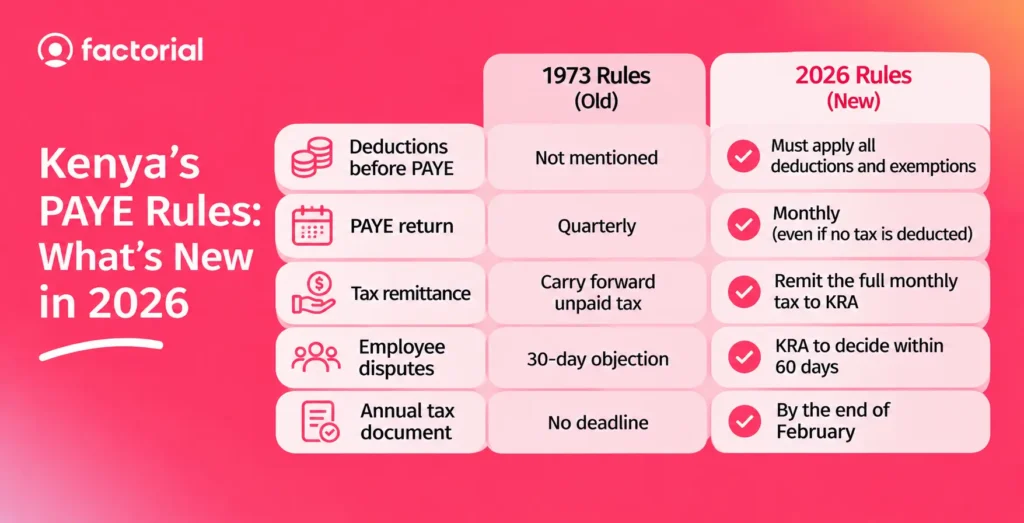
Some of what you will read about the 2026 Rules is not new at all. The written monthly pay statement, the dispute route and the directors’ deadline all existed in the 1973 Rules. The table below separates real changes from restatements, by comparing the old and new texts side by side.
|
Area |
1973 Rules (old) |
2026 Rules (new) |
| Deductions before PAYE | Not mentioned | Rule 4(2): you must grant all applicable deductions and exemptions before calculating tax |
|
Short last payment |
Carry the unpaid tax forward to later pay |
Rule 5(3) and (4): you may carry it forward, but you must still remit the full month’s tax to KRA now |
|
Monthly return |
Quarterly return, unless filed monthly online; a separate certificate in months with no tax (or under KES 100) deducted |
Rule 8(1): monthly return by the 9th, required even when no tax was deducted |
|
Tax under KES 100 |
Could be carried forward to the next month |
No such allowance |
|
Payment deadline |
Before the 10th day |
Rule 9: on or before the 9th day (same date in practice) |
|
Annual P9 |
No deadline in the Rules |
Rule 8(2): by the last day of the second month after the year of income |
|
Employee dispute window |
Employee had 30 days from receiving the employer’s statement to object to KRA |
No time limit stated |
|
KRA decision on a dispute |
“Forthwith” (no fixed period) |
Rule 7(3): within 60 days of receiving the required information |
|
Refund after a dispute |
KRA refunds the employee |
Rule 7(5): employer amends the return, or employee claims through the annual return |
|
Change of employer |
New employer takes over obligations |
Rule 13: new employer must notify KRA, and the old “after the change” limit on its duties is gone |
|
Penalties |
Fine up to KES 10,000, up to 6 months’ jail, or both |
Rule 14: penalties and interest under the Income Tax Act and Tax Procedures Act |
|
Casual workers |
Excluded from “emoluments” if KRA considered the work casual |
No exclusion |
The last row matters for employers who rely on casual labour. Under the old Rules, KRA could treat pay for casual work as outside PAYE. The 2026 definition of “emoluments” in Rule 2 has no such carve-out, so check how your casual payroll is treated with your tax adviser. Two other limits from 1973 are also gone. The Rules no longer set their own KES 3,000 monthly threshold for taxable benefits; the threshold now comes from the Act, which KRA puts at KES 5,000 a month (about USD 39). The exemption for employers whose staff all earned under KES 3,600 a year has also been dropped.
Your monthly PAYE duties, step by step
Every month, the new PAYE Rules 2026 expect the same sequence from you as a HR manager. Here it is in the order your payroll team will meet it.
- Deduct PAYE from every employee who is liable to tax (Rule 3). This covers anyone receiving emoluments, including directors, office holders and former employees receiving pension or past-employment pay. “Emoluments” means salary and other employment income, the value of housing you provide, and the value of benefits taxable under the Act.
- Apply every allowable deduction and exemption first (Rule 4(2)). Before you calculate tax, take off what the law allows. KRA’s guidance lists these, including the Affordable Housing Levy, SHIF contributions, registered pension contributions (up to KES 30,000, about USD 233, a month) and post-retirement medical fund contributions (up to KES 15,000, about USD 116, a month). KRA’s public notice of 6 October 2025 adds insurance relief, mortgage interest and exemption certificates, where the employee has given you supporting documents.
- Calculate the month’s tax using the Third Schedule rates, less personal relief (Rule 4(1)). An employee can claim personal relief from only one employer. If you are a second employer, do not apply it. Unused personal relief from earlier months in the same year can be carried into later months.
- Work it out at the last payment of the month (Rule 5(1)). If you pay in instalments, for example a mid-month advance and an end-month balance, the calculation happens at the final payment. Confirm the monthly pay, the deductions, the tax chargeable and the personal relief.
- Deduct the tax from that last payment (Rule 5(2)). If the last payment is too small to cover the tax, carry the balance forward to later pay (Rule 5(3)). But remit the full month’s tax to KRA anyway (Rule 5(4)). In effect, your business fronts the shortfall and recovers it from the employee later.
- Record it on the tax deduction form (Rule 5(5)). Keep a monthly record for each employee on the form KRA prescribes.
- Give each employee a written statement (Rule 6). At the last payment of the month, tell each employee in writing the total pay for the month, the total PAYE deducted and any other details KRA requires. A payslip does this, as long as it shows these figures.
- File the monthly PAYE return (P10) on iTax by the 9th (Rule 8(1)). File it even if no tax was deducted that month, for example because every employee earned below the taxable threshold. A month with staff on payroll is never a month with no return.
- Pay the tax to KRA by the 9th (Rule 9). KRA may set a different day by notice. You can pay through a payment slip generated on iTax, at the bank, or by M-PESA Paybill 222222 using the payment registration number as the account number.
Directors are the one exception on timing. PAYE on payments to a director is due by the 9th day after the month of payment, or by the last day of the fourth month after the company’s accounting date, whichever comes first (Rule 9 proviso).

|
Duty |
Rule |
Deadline |
|
File monthly PAYE return, including nil returns |
8(1) |
On or before the 9th of the following month |
|
Pay PAYE deducted |
9 |
On or before the 9th of the following month, or a day KRA notifies |
|
Pay PAYE on directors’ payments |
9 proviso |
The earlier of the 9th after the month of payment, or the last day of the 4th month after the accounting date |
|
Issue annual P9 to each employee |
8(2) |
Last day of the second month after the year of income (28 February 2027 for 2026) |
What happens when an employee disputes their PAYE
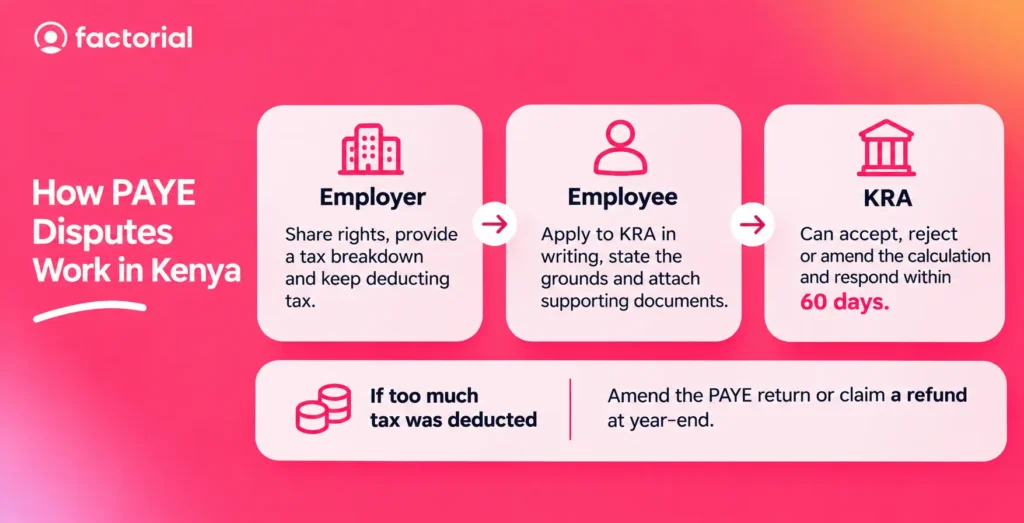
Rule 7 sets out what happens when an employee believes their PAYE is wrong and you cannot agree on it. Both of you have duties.
Your duties as the employer:
- Tell the employee about their rights under Rule 7. This duty starts once you and the employee cannot agree; you do not wait for them to ask.
- If they ask, give them a written statement showing how you calculated their tax.
- Keep deducting tax using your own calculation until KRA tells you otherwise (Rule 7(4)).
- Once KRA decides, apply its decision to every payment from then on (Rule 7(3)).
The employee’s route:
- Apply to the Commissioner in writing, asking KRA to amend or reject your calculation.
- State the exact grounds of the dispute.
- Attach your written statement and all relevant documents.
What KRA can decide (Rule 7(2)): accept the employee’s calculation and direct you to use it, reject the application and direct you to keep using yours, or amend the calculation and direct you to use the amended figure. KRA must notify both of you in writing within 60 days of receiving the required information.
If too much tax was deducted (Rule 7(5)): you may amend the relevant PAYE return, or the employee may claim a refund at the end of the year through their self-assessment return.
If the employee is still not satisfied (Rule 7(6)): they file their annual return using their own computation of tax on employment income. Where that produces a refund, they can apply for it under the Tax Procedures Act.
For HR, the practical lesson is simple, be ready to produce a clear, written breakdown of any employee’s PAYE on request. Good payroll records make these disputes short.
Annual P9s, changes of employer and the death of an employer
Annual tax deduction card (P9), Rule 8(2). Give every employee their tax deduction card, certificate or the form KRA prescribes for the year. The deadline is the last day of the second month after the year of income. For the 2026 year, that is 28 February 2027. Employees need the P9 to file their own annual returns by 30 June, so a late P9 becomes their problem too.
Change of employer, Rule 13. This applies where the business paying an employee changes but the job itself continues, for example after a sale, merger or transfer of a business. The new employer must notify KRA of the change under the Tax Procedures Act, and must do anything under the Rules that the previous employer would have had to do. The one limit is that the new employer does not have to pay tax that should have been deducted before the change. Unlike the 1973 version, Rule 13 no longer restricts these duties to matters arising after the change, so check what the previous employer left undone, such as unfiled returns.
Death of an employer, Rule 12. If an employer who is an individual dies, their personal representative must carry out the PAYE duties. Where the deceased paid wages on behalf of someone else, the duty passes to their successor or, if there is none, to the person on whose behalf the wages were paid.
What happens if HR teams get the new PAYE rules wrong?
Rule 10 gives KRA three tools, and the wording matters because two of them are mandatory:
- You don’t file a return: KRA may issue a default assessment, meaning it estimates the tax you owe.
- You don’t remit tax: KRA shall issue a written demand.
- You pay less than you should have: KRA shall issue an additional assessment for the difference.
Rule 11 lets KRA recover unpaid PAYE using the full powers of the Income Tax Act and the Tax Procedures Act. Rule 14 applies the penalties and interest in those Acts to anyone who fails to deduct, declare or remit.
The old 1973 penalty of a fine of up to KES 10,000, six months in jail, or both, is gone. In its place, KRA lists these penalties:
| Default | Penalty |
|
Late filing of PAYE return |
25% of the tax due or KES 10,000 (about USD 77), whichever is higher |
|
Late payment of PAYE |
5% of the tax due, plus interest of 1% per month or part of a month until paid |
|
Failure to deduct and account for tax |
25% of the tax involved or KES 10,000, whichever is higher |
Simplify payroll management with Factorial
Keeping up with monthly returns, payslip details and annual P9s is easier when your employee records live in one place. Factorial helps HR and payroll teams in Kenya organise employee information, manage HR admin and support accurate payroll workflows.
Explore Factorial’s payroll solution and see how your team can spend less time chasing records and more time on your people.

Sources
All sources accessed include:
- The Income Tax (Pay As You Earn) Rules, 2026, Legal Notice No. 185 of 2026, Kenya Law
- The Income Tax (P.A.Y.E.) Rules, Legal Notice No. 257 of 1973 (revoked), Kenya Law
- Income Tax Act, Cap. 470, Kenya Law
- Tax Procedures Act, Cap. 469B, Kenya Law
- Pay As You Earn (PAYE), Kenya Revenue Authority
- Guidance on Employer Obligations in Applying Income Tax Deductions, Reliefs and Exemptions, KRA public notice, 6 October 2025
- iTax portal, Kenya Revenue Authority
Frequently asked questions
The Income Tax (Pay As You Earn) Rules, 2026 were published on 18 September 2026 as Legal Notice No. 185, and apply from that date.
No. Rule 4 points to the rates in the Third Schedule of the Income Tax Act. The Rules set out procedure, not tax bands.
Yes. Rule 8(1) requires a return every month, even when no tax was deducted.
On or before the 9th day of the following month, for both the return and the payment. Directors have a separate rule.
Carry the unpaid tax forward to later pay, but remit the full month's PAYE to KRA by the 9th.