Bank holidays are different depending on where you work in the UK. Below, you’ll find the dates for England and Wales, Scotland and Northern Ireland for 2027, along with the 2025 and 2026 calendars.
We’ve also included ways to book annual leave around bank holidays, plus a guide to what employers need to know about time off and holiday allowances.
Table of Contents
- Key Facts
- Full List of UK Bank Holidays 2027
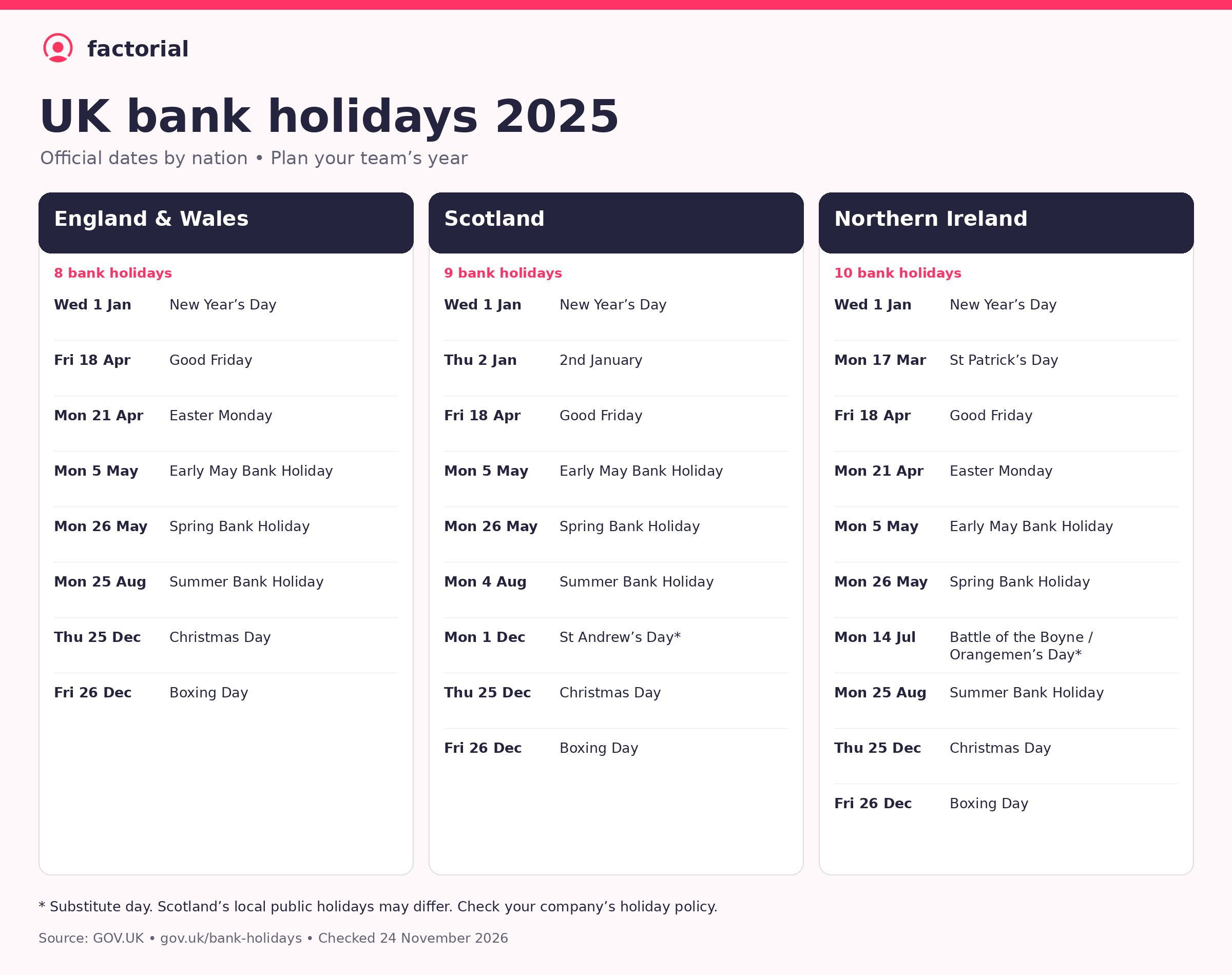
- Full List of UK Bank Holidays 2025 and 2026
- How do you maximise your annual leave?
- Employee Rights: Bank Holidays
- Part-Time Workers and Bank Holidays
- What holiday records should employers keep?
- Annual Leave Management with Factorial
- FAQs
Key Facts About Bank Holidays
- 2027 bank holiday totals: GOV.UK lists eight bank holidays in England and Wales, nine in Scotland, and ten in Northern Ireland.
- Easter is in March: Good Friday is on 26 March 2027. Easter Monday is on 29 March in England, Wales and Northern Ireland. It is not a nationwide bank holiday in Scotland.
- Christmas bank holidays move to weekdays: Christmas Day and Boxing Day fall on a weekend in 2027. Their bank holidays are Monday 27 December and Tuesday 28 December instead.
- Scotland has different dates: The Scottish Government lists Monday 4 January as the substitute holiday for 2 January 2027. Scotland’s summer bank holiday is on 2 August, rather than 30 August.
- Northern Ireland has two additional holidays: nibusinessinfo.co.uk lists St Patrick’s Day on Wednesday 17 March and the Battle of the Boyne on Monday 12 July 2027.
- Check your holiday allowance: According to GOV.UK, employers can count bank holidays towards statutory annual leave. They do not have to give them as extra days off.
- Plan around your working days: If you work Monday to Friday and have bank holidays off, booking Tuesday to Friday after a Monday bank holiday can give you nine days off in a row, including both weekends.
Full List of UK Bank Holidays 2027
Your bank holiday dates depend on where you work. Check the calendar for your part of the UK before booking leave or arranging cover for your team.
2027 Bank Holidays in England & Wales
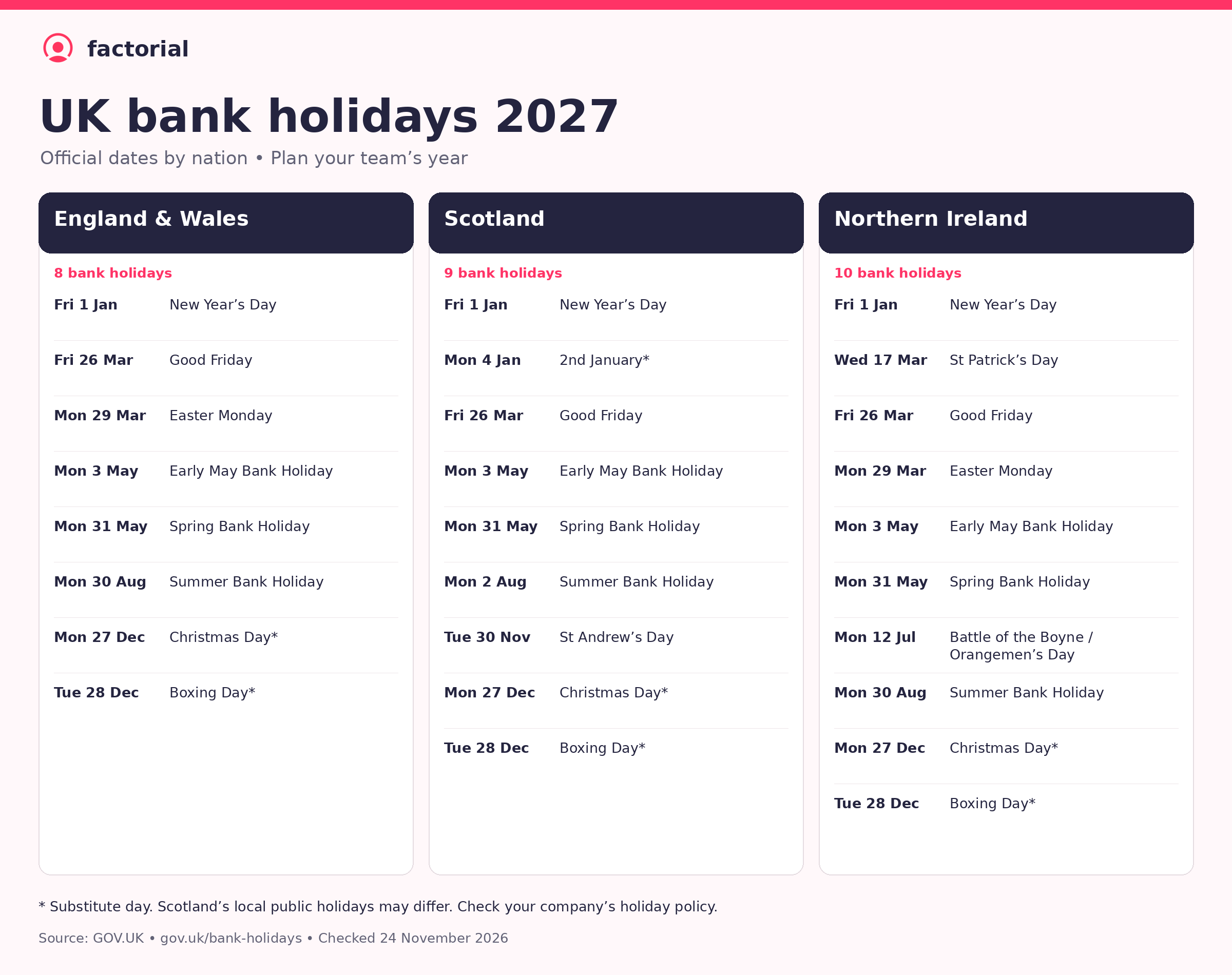
England and Wales have eight bank holidays in 2027, according to GOV.UK.
| Date | Holiday | Day |
| 1 January | New Year’s Day | Friday |
| 26 March | Good Friday | Friday |
| 29 March | Easter Monday | Monday |
| 3 May | Early May Bank Holiday | Monday |
| 31 May | Spring Bank Holiday | Monday |
| 30 August | Summer Bank Holiday | Monday |
| 27 December | Christmas Day (substitute day) | Monday |
| 28 December | Boxing Day (substitute day) | Tuesday |
Christmas Day falls on Saturday 25 December and Boxing Day falls on Sunday 26 December. Because they fall on a weekend, their bank holidays move to Monday 27 December and Tuesday 28 December. These are called substitute days.
2027 Bank Holidays in Scotland
Scotland has nine nationwide bank holidays in 2027. The Scottish Government lists the following dates.
| Date | Holiday | Day |
| 1 January | New Year’s Day | Friday |
| 4 January | 2nd January (substitute day) | Monday |
| 26 March | Good Friday | Friday |
| 3 May | Early May Bank Holiday | Monday |
| 31 May | Spring Bank Holiday | Monday |
| 2 August | Summer Bank Holiday | Monday |
| 30 November | St Andrew’s Day | Tuesday |
| 27 December | Christmas Day (substitute day) | Monday |
| 28 December | Boxing Day (substitute day) | Tuesday |
The holiday for 2 January moves to Monday 4 January because 2 January falls on a Saturday.
Easter Monday is not a nationwide Scottish bank holiday. Some employers still give it as a day off, so check your contract or company policy.
Scotland also has local public holidays that vary between council areas. Check your council’s calendar if your workplace follows local dates.
2027 Bank Holidays in Northern Ireland
Northern Ireland has ten bank holidays in 2027. These include St Patrick’s Day and the Battle of the Boyne, as listed by nibusinessinfo.co.uk.
| Date | Holiday | Day |
| 1 January | New Year’s Day | Friday |
| 17 March | St Patrick’s Day | Wednesday |
| 26 March | Good Friday | Friday |
| 29 March | Easter Monday | Monday |
| 3 May | Early May Bank Holiday | Monday |
| 31 May | Spring Bank Holiday | Monday |
| 12 July | Battle of the Boyne (Orangemen’s Day) | Monday |
| 30 August | Summer Bank Holiday | Monday |
| 27 December | Christmas Day (substitute day) | Monday |
| 28 December | Boxing Day (substitute day) | Tuesday |
St Patrick’s Day falls on a Wednesday in 2027. The Battle of the Boyne falls on Monday 12 July, so it does not need a substitute day. Read the official guide for more info on managing pay and time off on bank holidays in Norther Ireland.
Full List of UK Bank Holidays 2025 and 2026
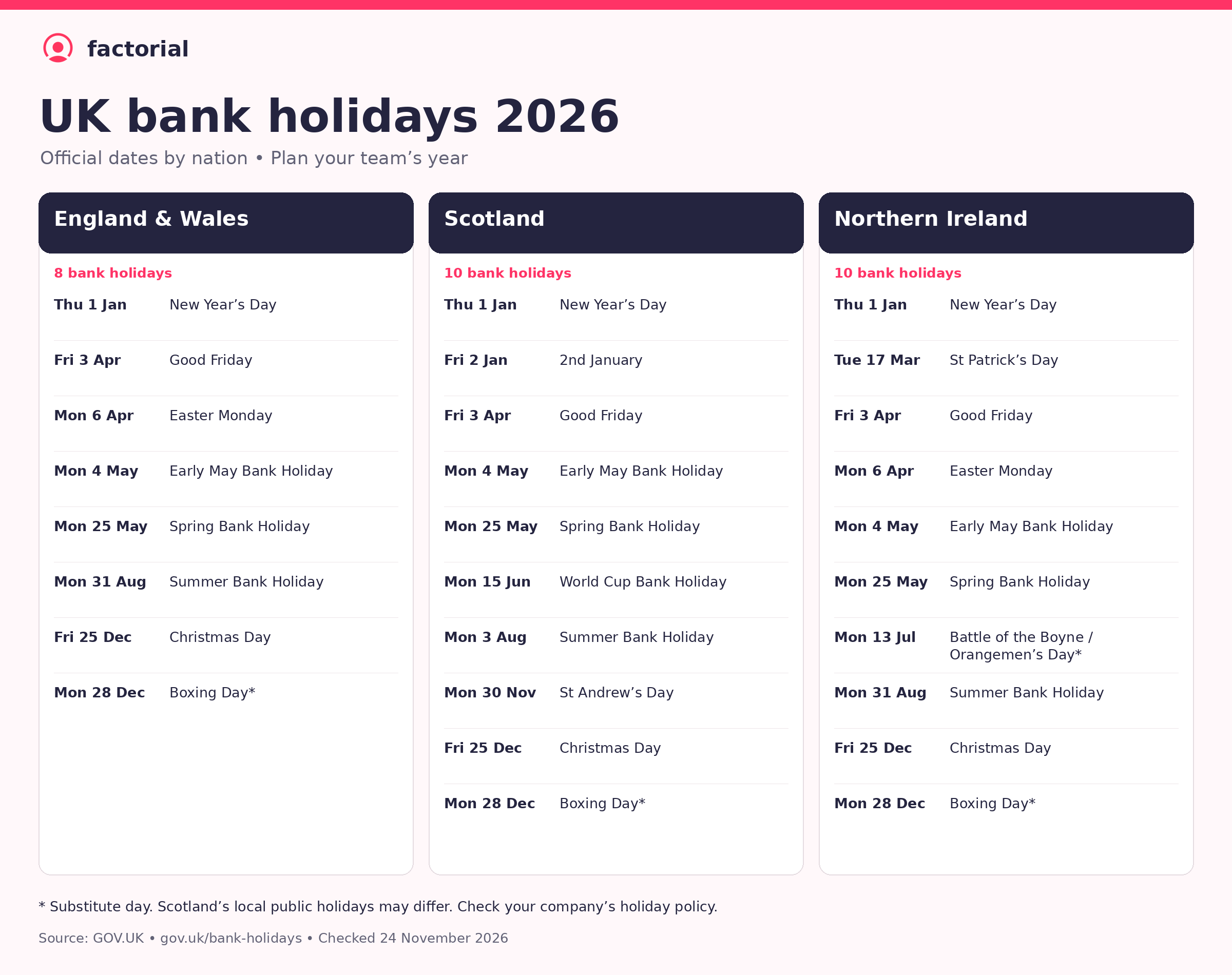
You can find the 2025 and 2026 dates below. The tables include substitute days and Scotland’s extra World Cup bank holiday in 2026.
England & Wales
2025 Bank Holidays in England & Wales
| Date | Holiday | Day |
| 1 January | New Year’s Day | Wednesday |
| 18 April | Good Friday | Friday |
| 21 April | Easter Monday | Monday |
| 5 May | Early May Bank Holiday | Monday |
| 26 May | Spring Bank Holiday | Monday |
| 25 August | Summer Bank Holiday | Monday |
| 25 December | Christmas Day | Thursday |
| 26 December | Boxing Day | Friday |
2026 Bank Holidays in England & Wales
| Date | Holiday | Day |
| 1 January | New Year’s Day | Thursday |
| 3 April | Good Friday | Friday |
| 6 April | Easter Monday | Monday |
| 4 May | Early May Bank Holiday | Monday |
| 25 May | Spring Bank Holiday | Monday |
| 31 August | Summer Bank Holiday | Monday |
| 25 December | Christmas Day | Friday |
| 28 December | Boxing Day (substitute day) | Monday |
Boxing Day falls on Saturday 26 December in 2026. Its bank holiday moves to Monday 28 December.
Scotland
2025 Bank Holidays in Scotland
| Date | Holiday | Day |
| 1 January | New Year’s Day | Wednesday |
| 2 January | 2nd January | Thursday |
| 18 April | Good Friday | Friday |
| 5 May | Early May Bank Holiday | Monday |
| 26 May | Spring Bank Holiday | Monday |
| 4 August | Summer Bank Holiday | Monday |
| 1 December | St Andrew’s Day (substitute day) | Monday |
| 25 December | Christmas Day | Thursday |
| 26 December | Boxing Day | Friday |
2026 Bank Holidays in Scotland
| Date | Holiday | Day |
| 1 January | New Year’s Day | Thursday |
| 2 January | 2nd January | Friday |
| 3 April | Good Friday | Friday |
| 4 May | Early May Bank Holiday | Monday |
| 25 May | Spring Bank Holiday | Monday |
| 15 June | World Cup Bank Holiday | Monday |
| 3 August | Summer Bank Holiday | Monday |
| 30 November | St Andrew’s Day | Monday |
| 25 December | Christmas Day | Friday |
| 28 December | Boxing Day (substitute day) | Monday |
Scotland had an extra bank holiday on Monday 15 June 2026 to mark its participation in the men’s football World Cup. This brought its total to ten for the year.
Northern Ireland
2025 Bank Holidays in Northern Ireland
| Date | Holiday | Day |
| 1 January | New Year’s Day | Wednesday |
| 17 March | St Patrick’s Day | Monday |
| 18 April | Good Friday | Friday |
| 21 April | Easter Monday | Monday |
| 5 May | Early May Bank Holiday | Monday |
| 26 May | Spring Bank Holiday | Monday |
| 14 July | Battle of the Boyne (Orangemen’s Day) (substitute day) | Monday |
| 25 August | Summer Bank Holiday | Monday |
| 25 December | Christmas Day | Thursday |
| 26 December | Boxing Day | Friday |
2026 Bank Holidays in Northern Ireland
| Date | Holiday | Day |
| 1 January | New Year’s Day | Thursday |
| 17 March | St Patrick’s Day | Tuesday |
| 3 April | Good Friday | Friday |
| 6 April | Easter Monday | Monday |
| 4 May | Early May Bank Holiday | Monday |
| 25 May | Spring Bank Holiday | Monday |
| 13 July | Battle of the Boyne (Orangemen’s Day) (substitute day) | Monday |
| 31 August | Summer Bank Holiday | Monday |
| 25 December | Christmas Day | Friday |
| 28 December | Boxing Day (substitute day) | Monday |
How do you maximise your annual leave?
Booking leave around bank holidays can give you a longer break without using as much of your holiday allowance. The examples below show which days to book and how long you could be away.
They assume you work Monday to Friday, have weekends and the relevant bank holidays off, and get approval for your leave. The total days off include weekends. They are not extra days added to your paid holiday allowance.
Making the most of 2027 bank holidays
England & Wales
- Easter: book 22-25 March and 30 March-2 April. Eight days of annual leave give you 16 days off, from 20 March to 4 April.
- Early May: book 4-7 May. Four days of annual leave give you nine days off, from 1 to 9 May.
- Spring Bank Holiday: book 1-4 June. Four days of annual leave give you nine days off, from 29 May to 6 June.
- Summer Bank Holiday: book 31 August-3 September. Four days of annual leave give you nine days off, from 28 August to 5 September.
- Christmas and New Year: book 29-31 December. Three days of annual leave give you ten days off, from 25 December to 3 January 2028. This includes the substitute bank holiday for New Year’s Day.
Scotland
- New Year: book 5-8 January. Four days of annual leave give you ten days off, from 1 to 10 January.
- Easter: book 22-25 March. Four days of annual leave give you nine days off, from 20 to 28 March.
- Early May: book 4-7 May. Four days of annual leave give you nine days off, from 1 to 9 May.
- Spring Bank Holiday: book 1-4 June. Four days of annual leave give you nine days off, from 29 May to 6 June.
- Summer Bank Holiday: book 3-6 August. Four days of annual leave give you nine days off, from 31 July to 8 August.
- St Andrew’s Day: book 29 November and 1-3 December. Four days of annual leave give you nine days off, from 27 November to 5 December.
- Christmas and New Year: book 29-31 December. Three days of annual leave give you 11 days off, from 25 December to 4 January 2028. This includes Scotland’s two New Year substitute holidays.
Northern Ireland
- St Patrick’s Day: book 15-16 March and 18-19 March. Four days of annual leave give you nine days off, from 13 to 21 March.
- Easter: book 22-25 March and 30 March-2 April. Eight days of annual leave give you 16 days off, from 20 March to 4 April.
- Early May: book 4-7 May. Four days of annual leave give you nine days off, from 1 to 9 May.
- Spring Bank Holiday: book 1-4 June. Four days of annual leave give you nine days off, from 29 May to 6 June.
- Battle of the Boyne: book 13-16 July. Four days of annual leave give you nine days off, from 10 to 18 July.
- Summer Bank Holiday: book 31 August-3 September. Four days of annual leave give you nine days off, from 28 August to 5 September.
- Christmas and New Year: book 29-31 December. Three days of annual leave give you ten days off, from 25 December to 3 January 2028.
2025
England & Wales
- Easter: booking 14-17 April and 22-25 April used eight days of annual leave for 16 days off, from 12 to 27 April.
- Early May: booking 6-9 May used four days of annual leave for nine days off, from 3 to 11 May.
- Spring Bank Holiday: booking 27-30 May used four days of annual leave for nine days off, from 24 May to 1 June.
- Summer Bank Holiday: booking 26-29 August used four days of annual leave for nine days off, from 23 to 31 August.
- Christmas: booking 22-24 December and 29-31 December used six days of annual leave for 13 days off, from 20 December to 1 January 2026. Booking 2 January as well extended the break to 16 days, ending on 4 January.
Scotland
- Easter: booking 14-17 April used four days of annual leave for nine days off, from 12 to 20 April. Booking 21-25 April as well required five more days of leave because Easter Monday was not a nationwide Scottish bank holiday.
- Early May: booking 6-9 May used four days of annual leave for nine days off, from 3 to 11 May.
- Spring Bank Holiday: booking 27-30 May used four days of annual leave for nine days off, from 24 May to 1 June.
- Summer Bank Holiday: booking 5-8 August used four days of annual leave for nine days off, from 2 to 10 August.
- St Andrew’s Day: booking 2-5 December used four days of annual leave for nine days off, from 29 November to 7 December.
- Christmas and New Year: booking 22-24 December and 29-31 December used six days of annual leave for 16 days off, from 20 December to 4 January 2026. This included Scotland’s bank holidays on 1 and 2 January.
Northern Ireland
- Easter: booking 14-17 April and 22-25 April used eight days of annual leave for 16 days off, from 12 to 27 April.
- Early May: booking 6-9 May used four days of annual leave for nine days off, from 3 to 11 May.
- Spring Bank Holiday: booking 27-30 May used four days of annual leave for nine days off, from 24 May to 1 June.
- Battle of the Boyne: booking 15-18 July used four days of annual leave for nine days off, from 12 to 20 July.
- Summer Bank Holiday: booking 26-29 August used four days of annual leave for nine days off, from 23 to 31 August.
- Christmas: booking 22-24 December and 29-31 December used six days of annual leave for 13 days off, from 20 December to 1 January 2026. Booking 2 January as well extended the break to 16 days, ending on 4 January.
2026
England & Wales
- New Year: booking 2 January used one day of annual leave for four days off, from 1 to 4 January.
- Easter: booking 30 March-2 April and 7-10 April used eight days of annual leave for 16 days off, from 28 March to 12 April.
- Early May: booking 5-8 May used four days of annual leave for nine days off, from 2 to 10 May.
- Spring Bank Holiday: booking 26-29 May used four days of annual leave for nine days off, from 23 to 31 May.
- Summer Bank Holiday: booking 1-4 September used four days of annual leave for nine days off, from 29 August to 6 September.
- Christmas and New Year: booking 21-24 December and 29-31 December uses seven days of annual leave for 16 days off, from 19 December to 3 January 2027.
Scotland
- Easter: booking 30 March-2 April used four days of annual leave for nine days off, from 28 March to 5 April.
- Early May: booking 5-8 May used four days of annual leave for nine days off, from 2 to 10 May.
- Spring Bank Holiday: booking 26-29 May used four days of annual leave for nine days off, from 23 to 31 May.
- World Cup Bank Holiday: booking 16-19 June used four days of annual leave for nine days off, from 13 to 21 June.
- Summer Bank Holiday: booking 4-7 August used four days of annual leave for nine days off, from 1 to 9 August.
- St Andrew’s Day: booking 1-4 December uses four days of annual leave for nine days off, from 28 November to 6 December.
- Christmas and New Year: booking 21-24 December and 29-31 December uses seven days of annual leave for 17 days off, from 19 December to 4 January 2027. This includes the substitute holiday for 2 January.
Northern Ireland
- New Year: booking 2 January used one day of annual leave for four days off, from 1 to 4 January.
- St Patrick’s Day: booking 16 March and 18-20 March used four days of annual leave for nine days off, from 14 to 22 March.
- Easter: booking 30 March-2 April and 7-10 April used eight days of annual leave for 16 days off, from 28 March to 12 April.
- Early May: booking 5-8 May used four days of annual leave for nine days off, from 2 to 10 May.
- Spring Bank Holiday: booking 26-29 May used four days of annual leave for nine days off, from 23 to 31 May.
- Battle of the Boyne: booking 14-17 July used four days of annual leave for nine days off, from 11 to 19 July.
- Summer Bank Holiday: booking 1-4 September used four days of annual leave for nine days off, from 29 August to 6 September.
- Christmas and New Year: booking 21-24 December and 29-31 December uses seven days of annual leave for 16 days off, from 19 December to 3 January 2027.
If you manage a team, expect more leave requests around these dates. Explain how people should submit requests and check who is already off before approving more leave.
Employee Rights: Bank Holidays
It’s up to your employer to decide whether or not you have to work on bank holidays. Your contract and company policy should explain the arrangement, and your employer must follow any agreed terms.
You do not automatically get extra pay for working on a bank holiday. Check your contract to see whether your employer offers a higher rate or time off on another day.
According to GOV.UK, employers can count bank holidays towards statutory annual leave. Most people working five days a week must receive at least 28 days of paid holiday a year, which is 5.6 weeks.
For example, your contract might give you 20 days of annual leave plus eight bank holidays. Another contract might give you 28 days including bank holidays. Both can meet the minimum for someone working five days a week, but the way you use your allowance is different.
If your business stays open on bank holidays, explain when people can take their leave instead. Make sure managers understand the policy and apply it fairly.
For Northern Ireland, nibusinessinfo.co.uk explains that your contract determines whether you get time off or extra pay on bank holidays.
Part-Time Workers and Bank Holidays
If you work part-time, you still get paid annual leave. How much you get depends on your working pattern.
People working regular hours throughout the year are normally entitled to at least 5.6 weeks of paid holiday. For someone working three days a week, that is 16.8 days: three multiplied by 5.6.
Your employer can count bank holidays towards this allowance. However, the arrangement should not unfairly disadvantage you because you work part-time or do not usually work on Mondays.
If your company gives full-time people extra paid bank holidays, check how people working part-time receive an equivalent benefit. Do not assume that someone who never works Mondays should simply miss out.
Recording leave in hours can help if people work different numbers of hours on different days. Explain the calculation so everyone knows how much leave they have and what will be deducted when they take time off.
What holiday records should employers keep?
Keep enough information to show how much holiday each person gets, what they have taken and how you worked out their holiday pay. This makes it easier to answer questions and correct mistakes.
In Great Britain, the annual leave record-keeping duty introduced from 6 April 2026 requires adequate records to be kept for six years from the date they were made. Check Northern Ireland’s requirements separately.
Your records should show:
- The person’s working pattern and holiday allowance.
- Which bank holiday calendar they follow.
- Leave requested, approved and taken.
- Any holiday carried over from an earlier year.
- How holiday pay was calculated.
- Any payment for unused holiday when someone leaves.
People working irregular hours or only part of the year may need a different calculation. Check the rules for their working pattern rather than copying the allowance of someone working a fixed five-day week.
Annual Leave Management with Factorial
Factorial helps you keep holiday allowances and leave requests in one place. Managers can check the shared team calendar before approving time off, and people can see their available balance without asking HR. If your team works across different UK nations, you can set up the relevant holiday calendars and leave policies. This helps people check which dates apply to them.
One, your personal AI agent at work, can also help people find answers in company policies they have permission to access. Someone could ask One how your company handles bank holidays for their working pattern. One follows the permissions you set. Your team still checks that holiday allowances and company policies are correct.
Request a Factorial demo to see how your team can manage leave requests and spend less time answering the same holiday questions.
FAQs About Bank Holidays
England and Wales have eight, Scotland has nine, and Northern Ireland has ten. Scotland also has local public holidays, so check which dates your workplace follows.
Good Friday is on 26 March. Easter Monday is on 29 March in England, Wales and Northern Ireland. Easter Monday is not a nationwide Scottish bank holiday, although your employer may give it as a day off.
Christmas Day falls on a Saturday and Boxing Day falls on a Sunday in 2027. Their bank holidays move to Monday 27 December and Tuesday 28 December instead.
No. Your employer can count bank holidays towards your statutory holiday allowance. Check your contract to see whether you get bank holidays on top of your other leave or as part of the total.
Look for working days between bank holidays and weekends. For example, booking 4-7 May can give someone working Monday to Friday nine days off in a row. You need to have the bank holiday off and get your leave approved.