The UK Autumn Budget, presented on 28 October 2026, raises the National Living Wage to £13.21 an hour from 1 April 2027 and increases the tax-free mileage rate for business miles above 10,000 from 6 April 2027. On that same date, a separate HMRC change brings certain taxable vehicle, fuel and medical benefits into payroll. Here’s what employers need to check before updating pay rates, mileage policies and staffing budgets.
What is the UK Autumn Budget 2026 and what does it mean for employers?
The Autumn Budget is the government’s statement to Parliament on its plans for tax and public spending. The Chancellor presented the Budget to the House of Commons on Wednesday 28 October 2026, according to HM Treasury. Before reading on, take a quick look at our video on how Factorial can help you make a bigger impact when working with your company’s finances.
Getting back to the topic, for employers, the new Budget is a starting point for updating pay, staffing and travel budgets. Each measure has its own start date, so HR, payroll and finance need to know what to change and when. The Budget set out the minimum wage and mileage changes. HMRC’s benefits-in-kind reporting change follows a separate timetable.
| Date | What it means for employers |
|---|---|
| 28 October 2026 | Use the Budget announcements to update staffing and travel forecasts. |
| 1 April 2027 | The new minimum wage rates take effect. Check the first pay period they apply to for each group of workers. |
| 6 April 2027 | The approved mileage rate above 10,000 business miles rises, and HMRC’s first phase of mandatory benefits payrolling begins. |
How much will the UK minimum wage rise in April 2027?
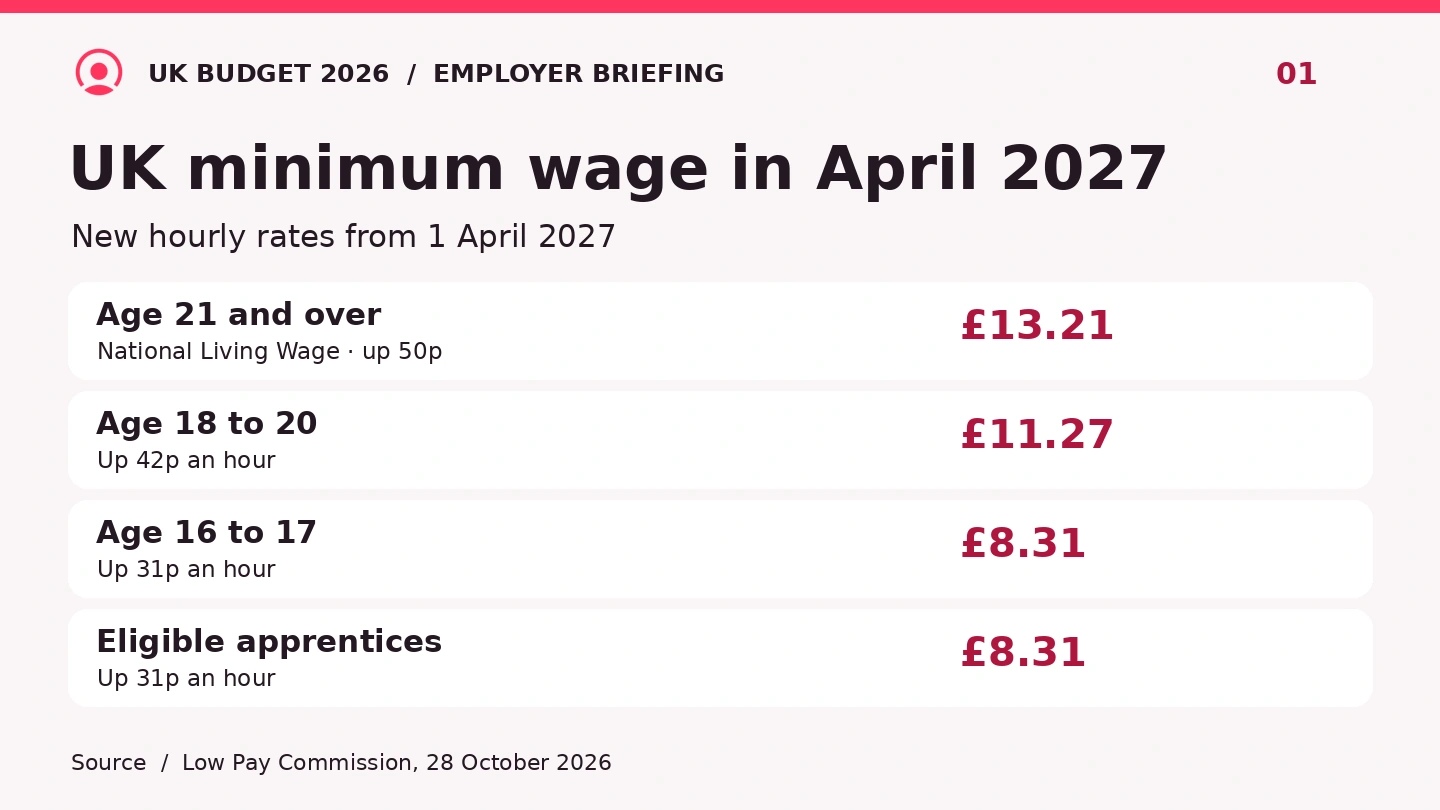
The National Living Wage rises by 50p an hour for workers aged 21 and over. The new rates take effect on 1 April 2027, according to the Low Pay Commission.
| Who the rate applies to | April 2026 | April 2027 | Hourly increase |
|---|---|---|---|
| Workers aged 21 and over | £12.71 | £13.21 | 50p |
| Workers aged 18 to 20 | £10.85 | £11.27 | 42p |
| Workers aged 16 to 17 | £8.00 | £8.31 | 31p |
| Eligible apprentices | £8.00 | £8.31 | 31p |
According to the government guide on calculating minimum wage, the new rate applies from the first pay reference period that starts on or after the change. If your monthly pay period starts on the 16th, for example, the new rate applies from 16 April.
Check upcoming birthdays and apprenticeship milestones so payroll can apply the correct rate when someone moves into a different band. When you set Factorial up and ensure data is added correctly when new starters join your organisation, the platform can help you with automatic reminders. It can also make expense management much simpler with your personal AI agent, One.
How to check the first pay run at the new minimum wage
Start with workers whose hourly rate is at or close to the new minimum, including salaried staff. Ask managers to confirm the hours that count for minimum wage purposes. If someone has to attend a handover before their shift starts, for example, check that the time is included. Review deductions for items such as a required uniform, which can reduce pay for minimum wage purposes.
Which benefits in kind must go through payroll from April 2027?
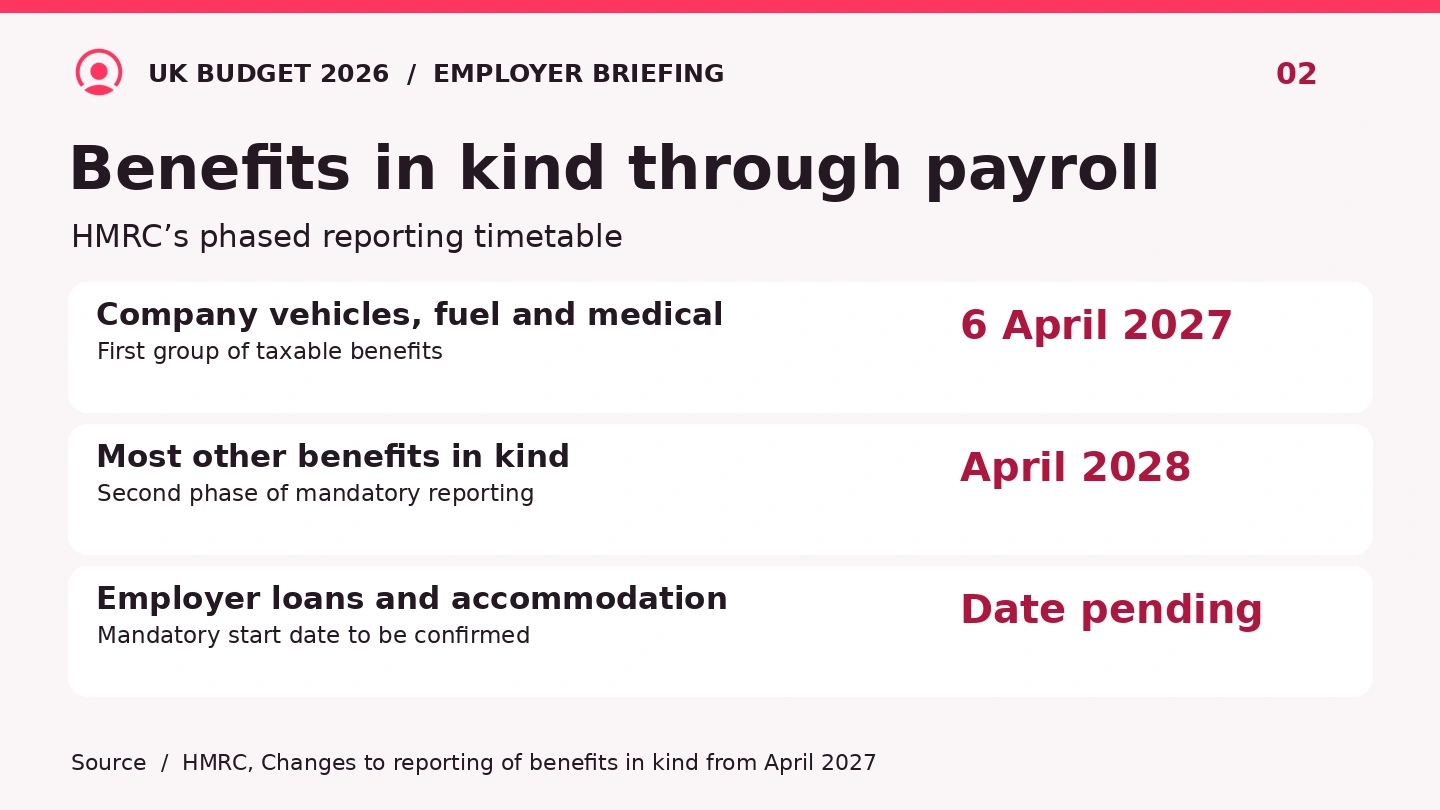
Taxable company cars and vans, private fuel benefits for those vehicles and employer-provided medical benefits move into mandatory payroll reporting from 6 April 2027. A benefit in kind is a perk an employee receives alongside wages, such as private medical insurance. Payrolling means including the taxable value when working out Income Tax through PAYE.
| Date | Benefits affected |
|---|---|
| 6 April 2027 | Taxable company cars and vans, car and van fuel benefits, and employer-provided medical benefits |
| April 2028 | Most other benefits in kind |
| To be confirmed | Employer-provided loans and accommodation |
According to HMRC, employers will report the benefits through Real Time Information, the system payroll software uses to send information to HMRC. Start by checking who receives each benefit, its taxable value and when it starts or ends.
What happens if a taxable benefit changes mid-year?
Suppose an employee returns their company car in September. The fleet team needs to tell payroll when the car stopped being available for private use and whether the employee received a replacement. Give each team a deadline for reporting changes before payroll closes. Keep the supporting record with the payroll update so you can trace the calculation if the employee queries their deductions.
Use a payroll year-end checklist to close 2026/27 separately. Factorial’s guide to P11D and benefits in kind explains which forms are used for year-end reporting.
How do the Budget mileage rates affect expense claims?
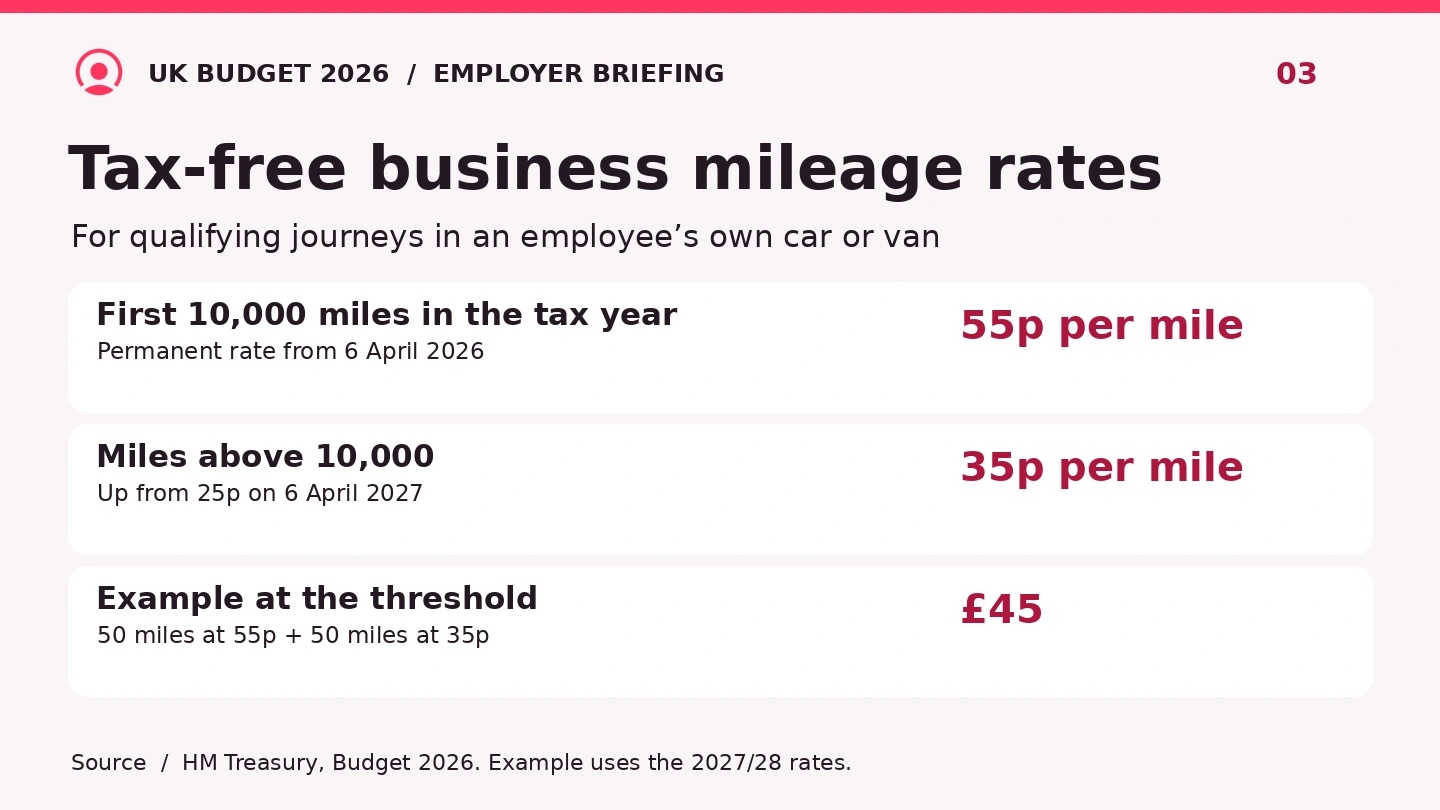
The Budget makes the 55p rate permanent for the first 10,000 qualifying business miles in an employee’s own car or van. The approved rate for miles above that threshold rises from 25p to 35p on 6 April 2027, according to HM Treasury.
| Qualifying miles in the tax year | Approved rate | Effective from |
|---|---|---|
| First 10,000 | 55p per mile | 6 April 2026 |
| Above 10,000 | 35p per mile | 6 April 2027 |
These are tax benchmarks. Check your company’s reimbursement policy to see what staff should receive. If an employee has already logged 9,950 qualifying miles in 2027/28 and submits a 100-mile claim, the approved amount is £45. The first 50 miles count at 55p and the next 50 at 35p. Keep a running total for each employee and record the business purpose of each journey so finance can check the calculation.
If your policy follows HMRC’s rates, test three claims before the April switchover. Use one below 10,000 miles, one that crosses the threshold and one submitted in April for a journey made in March. The last case helps you spot whether your expense system is applying the new rate based on the submission date alone.
How should employers budget for higher pay and staffing costs?
Update your staffing forecast using the new rates and the hours you expect people to work. If 20 employees aged 21 or over each work 35 paid hours a week at the National Living Wage, the increase adds £350 a week in gross wages, or £18,200 over 52 weeks before employer costs.
| What to budget for | What to check |
|---|---|
| Current staff | Reprice contracted hours and extra shifts. Check whether the gap between entry-level and supervisor pay has narrowed. |
| Hiring and cover | Reprice open roles and compare the cost of different start dates, seasonal cover and rota patterns. |
| Employer costs | Recalculate employer National Insurance and pension costs where applicable. Forecast Class 1A National Insurance on relevant benefits. |
| Business travel | Estimate qualifying mileage and apply your reimbursement policy to the forecast. |
How much should you allow for keeping pay bands apart?
Run two forecasts. In the first, raise only the rates that need to change to meet the statutory minimum. In the second, include any increases you want to make to keep a gap between job grades. If a supervisor earns £13.40 an hour, for example, the gap above the National Living Wage shrinks from 69p to 19p. Keeping the old gap would mean paying £13.90 an hour, so include that extra 50p for each supervisor hour in the second forecast.
Review the forecast after the first affected pay run. Compare planned hours with paid hours, investigate unexpected differences and use actual costs to update the headcount plan.
What should employers tell staff before April 2027?
Send a short update before the first affected payday. Tailor it to what is changing for each group, so employees know what to check and who can help if something looks wrong.
| Who needs an update | What to tell them |
|---|---|
| Staff receiving a pay rise | Confirm their new hourly rate and which payslip will first reflect it. Tell them who to contact if the rate or hours look wrong. |
| Staff with a benefit moving into payroll | Explain how to spot the change on their payslip and why their tax deductions may change even if they still receive the same benefit. |
| Staff who claim business mileage | Confirm what your company will reimburse, which journeys the updated policy covers and where to query a claim. |
Give managers the same update before it goes out. They can answer questions about hours and claims, while payroll can investigate individual tax or payslip queries.
How can Factorial help employers manage Budget changes?
Factorial’s Compensation features bring pay changes and other payroll inputs together for review before you send them to your payroll provider. Reusing the reviewed information cuts duplicate entry. Keep the effective date and approval with each change so payroll can trace a figure back to its source if an employee queries their pay.
Factorial brings HR, finance and IT together in one place, with Factorial One as your AI agent for work. Through Factorial’s expense management software, AI can pull details from receipts so employees spend less time typing them in. Staff can submit mileage claims in the same place, and managers can review them before approval. That gives finance a record of expense claims and approvals when it needs to check a reimbursement. Request a free demo of Factorial to see all the ways it can work with you.
FAQs about UK Budget 2026
The UK Autumn Budget was delivered on Wednesday 28 October 2026. Employers should put two dates in their April calendar. The minimum wage rates change on 1 April 2027, and the new tax year begins on 6 April 2027, when HMRC’s first phase of mandatory benefits payrolling starts.
The statutory minimum wage rates rise by around 3.9% from April 2027. For someone aged 21 or over working 40 paid hours a week at the National Living Wage, that’s £20 more in weekly gross pay. The change in take-home pay depends on tax and other deductions.
Beyond pay and mileage, the Budget announces a Parental Allowance for fathers, partners and adopters in Great Britain from April 2029. It also plans to expand access to PAYE tax relief for unreimbursed employment expenses by removing the £2,500 Self Assessment expenses threshold from 6 April 2028.
From 6 April 2027, the Budget raises savings income tax rates by two percentage points across the UK. Property income tax rates also rise by two percentage points in England, Wales and Northern Ireland. For payroll teams, a separate HMRC change moves the first group of taxable benefits into payroll on the same date.
The Budget announced no general change to Gift Aid or tax relief on charitable donations. According to HMRC, donations through an employer’s Payroll Giving scheme come out of pay before Income Tax and after National Insurance. Gift Aid cannot also be claimed on those donations.