If you want to upskill your workforce, now is the time. AI, automation and persistent skills shortages have left many UK organisations without the skill sets they need to stay competitive.
This enables you to keep up with industry changes, and it also helps you attract top talent to your business. Gallup‘s American Upskilling Study found that upskilling is a highly valued employee benefit, as well as a powerful talent attraction tool.
Key takeaways
- To upskill your workforce, run a training needs analysis, then combine courses, e-learning, coaching, peer mentoring and stretch assignments that target the gaps you find.
- The Department for Education’s Employer Skills Survey 2024, published on GOV.UK, found that 12% of UK employers had staff with skills gaps.
- Investment is falling. GOV.UK figures show that employers spent around £1,700 per employee on training in 2024, down from around £1,960 in 2022.
- A 2026 resourcing and talent planning report found that 91% of UK employers already upskill staff in-house or are considering it.
What is Upskilling?
Upskilling definition: a core part of a learning and development strategy that helps HR teams build relevant skills and reduce skills gaps.
In a nutshell, when you upskill your employees, you encourage them to acquire new and relevant skills that will help with their career development and contribute to your growth as an organisation. The aim is to identify and improve existing skill sets in your company so that your employees can advance in their jobs and find different roles and opportunities within the company. This might be through digital upskilling, cybersecurity upskilling, analytical upskilling, or organisational transformation upskilling.
Upskilling can be encouraged through employee training programmes, workplace mentorship and coaching in the workplace initiatives, peer mentoring programs, and performance coaching. The more opportunities you offer to upskill your employees, the more enriching the learning culture will be, and the more you will grow and develop as an organisation.
What is the Difference Between Upskilling and Reskilling?
It’s important to understand the difference between upskill and reskill.
Ultimately, the difference lies in your objective. Upskilling programmes focus on improving existing skills and knowledge to help employees progress in their position. For example, you might upskill a member of staff in order to prepare them for a promotion, to optimise their performance, or to help them become more specialised.
In contrast, when you reskill an employee, you are teaching them new skills so that they can perform a different job. You might do this because of workforce gaps that you are unable to fill externally or to reduce the cost of filling new roles. Think of reskilling as professional recycling.
Upskilling can cost less than retraining an employee in a new area from scratch. Assess the skills already in your organisation before deciding whether to retrain employees who have no experience in the role.
| Upskilling | Reskilling | |
|---|---|---|
| Objective | Deepen skills for the current role | Build skills for a different role |
| Typical trigger | Promotion, new tools, higher targets | Automation, redundancy risk, hard-to-fill vacancies |
| Example | A payroll officer learns advanced reporting | An administrator retrains as a data analyst |
| Starting point | Existing knowledge of the job | Little or no experience in the new role |

What is Digital Upskilling?
Digital upskilling is a form of upskilling that, as you have probably guessed, focuses on improving the digital and technological skills of your workforce. In other words,** it’s about teaching your employees new skills so that they can keep up with evolving technology.**
This obviously takes into account IT upskilling, but it goes beyond teaching your workforce how to use new software and hardware. Digital skills training also covers technologies such as AI and big data.
Digital upskilling examples also include other aspects of your business, such as learning about automated processes and advanced workforce strategies. It involves teaching your workforce everything it needs to know in order to upskill and adapt to a technology-driven world. This helps to ensure that you have the right skills so that you are ready to evolve with the digital age of business.
Why is Upskilling Important?
There are a number of reasons why career upskilling has become so popular over recent years.
Here are some of the benefits:
- One of the biggest reasons is persistent skills shortages. The House of Commons Library reports that England had around 210,000 skill-shortage vacancies in 2024, accounting for 27% of all vacancies. Upskilling programmes help you build these skills internally and meet long-term organisational goals.
- Most employers expect to need it soon. Welsh Government analysis of the Employer Skills Survey 2024 shows that 59% of UK employers believed they would need to upskill their workforce in the following 12 months.
- Companies that offer upskill opportunities are more likely to report higher levels of employee engagement and motivation.
- Upskilling can support retention and reduce recruitment costs. Research published in September 2026 found that 44% of UK employers said retaining staff had become harder, whilst 48% had increased their efforts to develop talent in-house.
- Offering upskill training enhances your corporate reputation. You are also far more likely to attract top talent as candidates favour organisations that value career development and offer opportunities for growth.
- Digital upskilling can help you stay relevant in the face of the technological revolution. For example, you can develop skills relating to artificial intelligence or robotics to help you bridge the digital divide. This helps you stay competitive.
- Upskilling can help you develop a dynamic business culture that thrives on creativity and innovation.
How to Upskill Your Workforce: 5 Practices
There are countless ways to upskill your workforce. The methods that work best for you will depend on the nature of your business,your long-term objectives, and your existing skills and resources.
Before you design your upskilling strategy and create a training agreement, conduct a thorough skills gap analysis as part of your training needs analysis to establish which skills you need to develop. This will help you determine the direction you need to take so that you can design a development plan for employees that targets identified gaps. For a structured framework covering needs assessment, programme design and evaluation, an employee development toolkit is a useful reference.
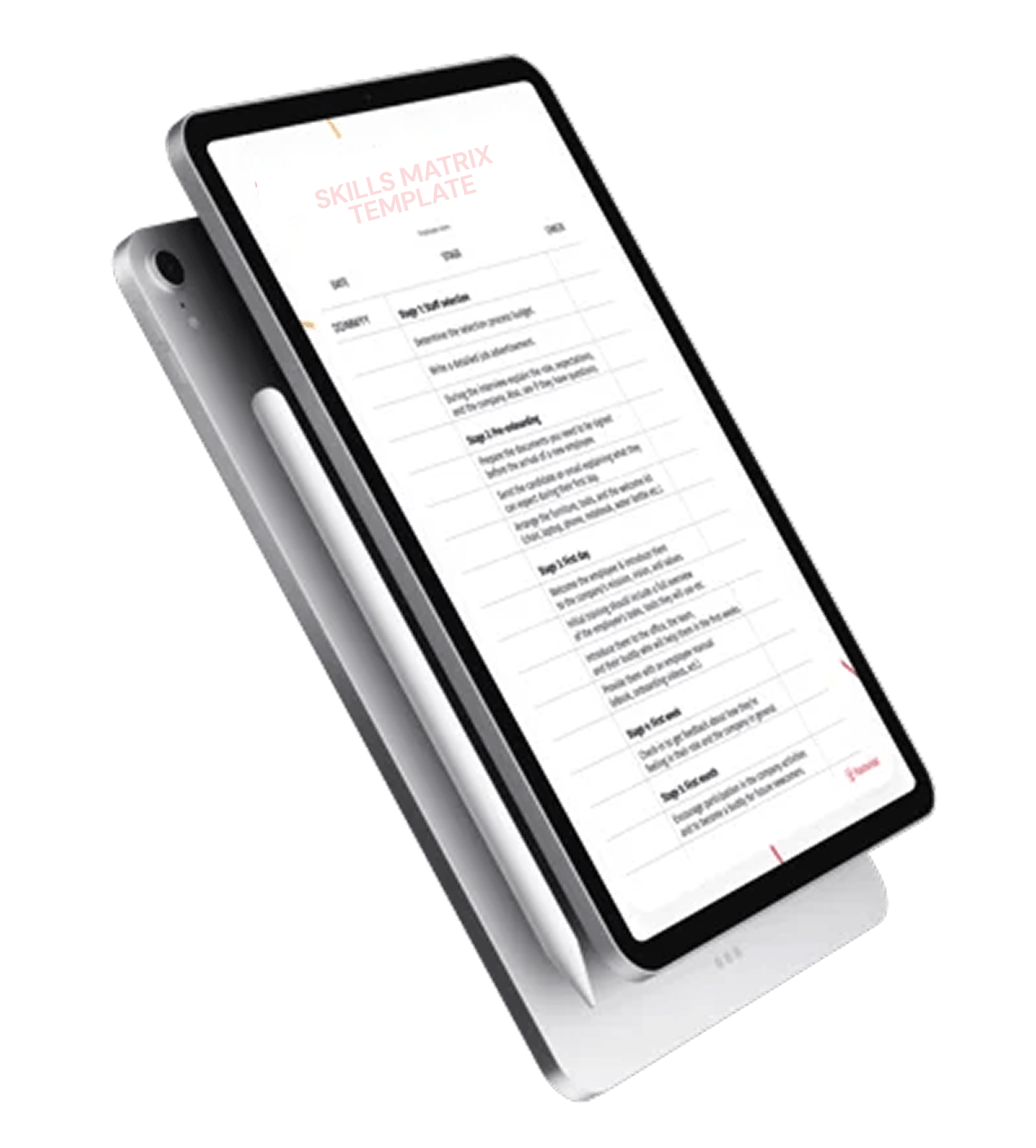
A good way to establish what these gaps are is to use a Skills Matrix Template to help you compare existing skills with overall objectives. You should also gather employee feedback and use design thinking in HR to help you find learning solutions that your employees engage with, as this will make learning far more accessible and enjoyable.
Once you’ve done that, you can select what methods you will use to upskill your workforce. You might decide that a combination of strategies will help you address all L&D requirements and learning styles.
In practice, the process usually follows five steps:
- Run a skills gap analysis as part of your training needs analysis to identify priority gaps.
- Map current skills against business objectives in a skills matrix.
- Ask employees how they prefer to learn and agree protected time for learning.
- Choose a mix of the five practices below.
- Check that new skills are applied on the job. One 2023 survey found that only 8% of learning practitioners prioritised learning transfer to the workplace.
If you use Factorial’s training and performance features, you can record training courses and attendance in one place and connect development goals to performance reviews. This helps line managers check whether employees are applying new skills. Managers still need to agree goals with each employee and approve training requests.
Here are a few valuable practices that can help you find the right talent development strategy to upskill your workforce.
Upskilling Workshops and Courses
External workshops and courses can be a great way to offer individual and team upskilling opportunities. You can find an upskill course for virtually every single job and industry out there. For example, you could arrange for your team leaders to go on a leadership course to improve their management skills.
Aside from learning new skills and gaining exposure to industry trends, with an external course or workshop, your employees will also have the chance to network with their industry peers.
Before booking an external course, check whether funding is available for the employee’s location and chosen intake. Eligibility, availability and application routes vary. Compare the course outcomes, assessment method and time commitment with the skills gap you identified.
Virtual Courses and e-Learning
Another great way to offer upskill training to your employees is to organise a programme of virtual courses and e-learning. Perhaps the biggest benefit of online learning is that employees can study from home or the office. This means they can learn at their own pace. So even if they have demanding jobs, they can still find the time to upskill.
Online learning has become more common. In a 2024 survey of UK workers, 42% of respondents who had received training said it included online learning, up from 27% in 2018. Of those respondents, 71% found it useful. Among employers that provided training, 70% used online or e-learning in 2024. For digital skills training, choose courses that let employees practise with the tools they use at work.
There are countless online learning platforms on the market that offer manageable and cost-effective upskill training solutions. Examples include LinkedIn Learning, HubSpot Academy, and Skillshare. If you’re interested in focusing on digital upskilling, then Udacity is a great solution. The digital learning platform offers courses in artificial intelligence, data science, cloud computing, programming, and development, amongst other areas.
Upskill Coaching
Upskill coaching is a form of on-the-job training in which a manager or another experienced colleague helps an employee develop their existing skills. The main aim of workplace coaching is to promote two-way communication between an employee and their coach. This can help to identify areas for improvement, reinforce strengths, and further develop performance. This is usually done by focusing on specific performance objectives, skills, and goals.
Peer Mentoring
Peer mentoring is another great way to upskill your employees. This is a form of workplace coaching where employees are allocated a peer mentor. The mentor is at a similar level to them in the company. However, they have different experiences and unique skills to share. This relationship helps both peers support each other, learn from each other, and upskill their abilities.
What’s more, peer mentoring can help to strengthen team relationships and create a more positive work environment. It’s also a great way for your employees to build soft skills such as active listening, leadership, and communication.

Upskill Stretch Assignments
Finally, stretch assignments can be a great way to give your employees the opportunity to upskill and gain new experience. A stretch assignment is a task that encourages employees to push out of their comfort zones and “stretch” developmentally. You do this by placing them in a challenging position. This can be a great way to learn and grow.
Courses and seminars can be difficult to schedule for employees with demanding jobs. In contrast, stretch assignments provide on-the-job training. GOV.UK’s Employer Skills Survey data shows that 48% of UK employers provided on-the-job training in 2024. For example, you can encourage an employee to take on a new role in a project. It could even be something as simple as delivering a presentation.
Make sure you provide the right support and resources if you opt for this method. That way, your employee will be equipped to meet the challenge and upskill successfully.
Which upskilling practice should you start with?
Start with the skills gap that costs you most. Use your training needs analysis to choose one or two practices, such as coaching for new line managers or e-learning for digital skills. Review progress during performance reviews, then apply successful methods across the wider workforce.
Frequently Asked Questions
Identify the skills your role requires, ask your manager for feedback and choose a specific goal. You can then build your skills through courses, coaching, peer mentoring or a challenging project, and review your progress regularly.
Start by comparing employees’ current skills with your organisation’s goals, then ask staff what support they need. Set clear development goals, offer a mix of courses, coaching and practical assignments, and review progress. Factorial, all-in-one business management software, can help you organise employee development.
People upskill to perform better in their current role, prepare for promotion and keep pace with changes in their industry or technology. Developing relevant skills can also open up new opportunities within their organisation.
Upskilling means developing skills and knowledge that help someone progress in their current role or area of work. It differs from reskilling, which involves learning skills for a different job.