Managing HR, payroll and employee data across separate systems can quickly become difficult as your business grows. This is especially true in South Africa, where payroll needs to account for local requirements such as PAYE, UIF, SDL and COIDA.
Factorial and PaySpace both combine HR and payroll capabilities, but they take different approaches. This guide compares Factorial vs PaySpace across features, payroll, compliance, pricing, integrations and ease of use to help you decide which platform fits your business.
An Overview of Factorial and PaySpace
Both Factorial and PaySpace help businesses manage HR and payroll processes from the cloud, but their strengths are different.
Factorial is an all-in-one HR and business management platform that brings employee management, time, leave, recruitment, performance, documents, expenses and payroll processes supporting PAYE, UIF, SDL, COIDA and statutory reporting. It is designed to give businesses a centralised system for managing the employee lifecycle.
PaySpace is a cloud payroll and HR platform owned by Deel, with a particularly strong focus on payroll and local compliance. Its South African offering also supports PAYE, UIF, SDL, COIDA and statutory reporting, while its HR tools cover areas such as leave, performance, workforce planning and employee records.
Factorial vs PaySpace Comparison Chart
A quick overview to compare Factorial and PaySpace at a glance.
| Feature | Factorial | PaySpace |
|---|---|---|
| Core HR | Yes | Yes |
| South African payroll | Payroll and payroll integrations | Dedicated South African payroll |
| Time and attendance | Yes | Yes |
| Leave management | Yes | Yes |
| Recruitment & ATS | Yes | Yes |
| Onboarding | Yes | Yes |
| Performance management | Yes | Yes |
| Employee self-service | Yes | Yes |
| Integrations | 80+ | Limited |
| Pricing | $4.40 | Custom quote |
| Free trial | Yes | Limited |
Comparing Factorial vs. PaySpace
Before looking at individual features, it helps to understand what each platform is designed to do.
What Is Factorial?
Factorial is an all-in-one HR and business management platform that brings people, time and workforce processes together.
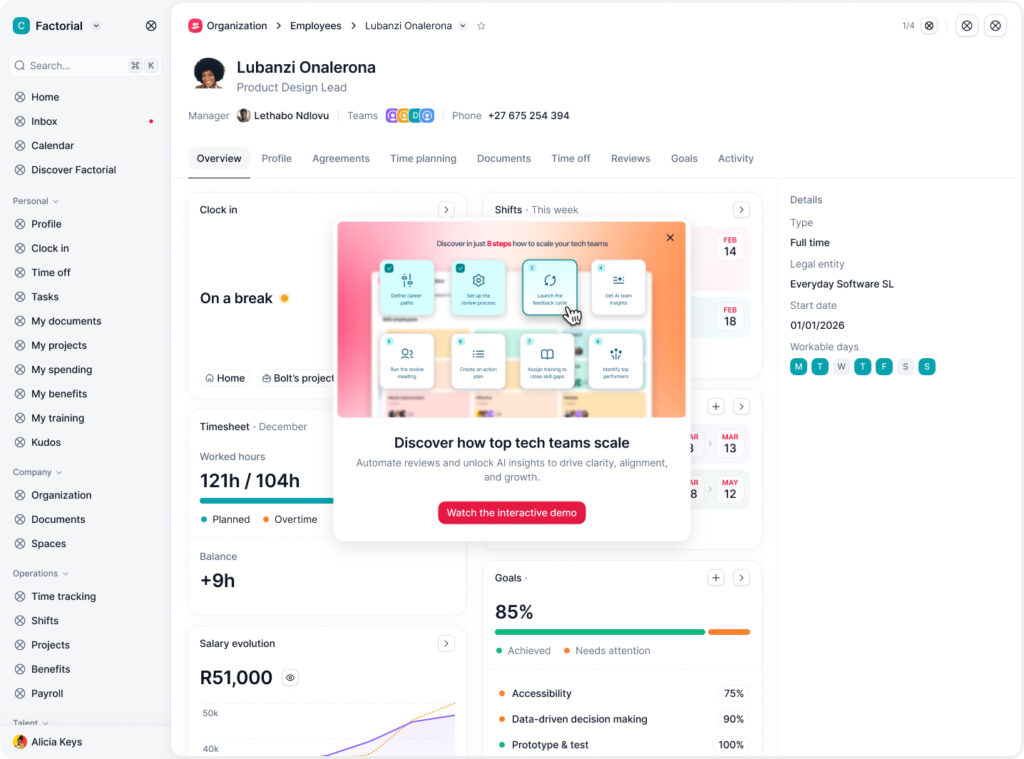
Its platform covers employee records, time and attendance, leave, recruitment, onboarding, performance, documents, employee self-service, payroll and reporting. Factorial’s payroll integration supports PAYE, UIF, SDL and COIDA and provides statutory reports including IRP5, EMP201, EMP501, EEA2 and EEA4.
Factorial also supports payroll integrations, allowing businesses to connect their existing payroll provider with their wider HR processes. This can be useful for organisations that want to modernise HR without immediately replacing their payroll system.
What Is PaySpace?
PaySpace is a cloud-based payroll and HR platform built around payroll processing, employee data and HR workflows.

Its South African product is specifically designed for local payroll requirements. PaySpace supports PAYE, UIF, SDL and COIDA and provides statutory reports including IRP5, EMP201, EMP501, EEA2 and EEA4.
Beyond payroll, PaySpace includes leave management, performance management, workforce planning, training and skills management, talent management and employee self-service.
Factorial vs PaySpace: Core Features Compared
Now that we have a broad picture of Factorial and PaySpace, let’s look at how they compare feature by feature.
1. Leave and Absence Management
Both platforms handle holiday requests, sick leave, and absence tracking without paper forms. Factorial uses a colour-coded calendar with custom absence types, and absence data flows straight into payroll. PaySpace supports leave structures, public holidays and accrual policies by country and entity, with leave information connected directly to payroll.
2. Time Tracking and Shifts
Factorial lets staff clock in from desktop, mobile, or a QR code, and geolocation tracking shows where remote workers are logging in from. PaySpace connects employee and leave information directly with payroll and supports leave policies, accruals and country-specific rules.
3. Payroll
Payroll is one of the biggest differences to consider.
PaySpace has a dedicated South African payroll offering, with automated PAYE, UIF, SDL and COIDA calculations and statutory reporting for IRP5, EMP201, EMP501, EEA2 and EEA4. Its tax tables, statutory rates and employment equity requirements are updated automatically.
Factorial provides payroll functionality and payroll integrations, allowing payroll information to connect with wider HR processes. Its platform can centralise employee, compensation and time information used in payroll workflows.
For a business where South African payroll processing and statutory reporting are the primary requirement, PaySpace has a particularly strong local payroll proposition.
For businesses looking to connect payroll with broader HR processes, Factorial provides a more extensive HR platform around the payroll function.
4. HR Management
Factorial brings a broad range of HR processes into one platform, including employee records, leave, time tracking, recruitment, performance, documents and reporting.
PaySpace also combines HR and payroll, with employee records, leave, performance, workforce planning, training and talent management connected directly to payroll.
5. Finance Tools
Factorial’s finance features cover expense tracking, procurement requests, and tracking costs by project, useful for a growing team that wants to keep spending in check without a dedicated finance system. Based on research, PaySpace has no dedicated finance platform for finance teams.
6. Performance Management
Factorial includes 360-degree reviews, goal-setting, training management, and onboarding workflows, helping businesses that want to track career growth and pull reports on employee performance data. PaySpace provides performance management, skills management and succession and talent management within its HR platform.
7. Recruitment and Applicant Tracking
Factorial includes a built-in Applicant Tracking System. You can build a careers page, post jobs, filter CVs, and move candidates through a hiring pipeline, with automatic emails sent at each stage. This way, you do not need a separate recruitment tool, which saves you time and money if you hire often.
PaySpace also offers e-onboarding, with new employees able to complete their information through online forms before the data flows into payroll.
Factorial places greater emphasis on recruitment as part of the wider employee lifecycle, while PaySpace’s onboarding process is closely connected to payroll setup.
8. AI Tools
Factorial’s “One” AI agent can generate reports, answer HR questions, summarise meetings, and run staff surveys. The goal is to cut down the time managers spend gathering routine information. PaySpace currently features an AI-powered assistant called AI Assist (also referred to as Pacey AI) that answers employee and administrator queries instantly.
Factorial vs PaySpace Pricing
Pricing is subject to change, so always check with each provider directly before making a decision.
Factorial’s current public pricing starts at $4.40 per user per month, with additional products and functionality available depending on business requirements.
Book a free demo now to get to know Factorial better!
PaySpace does not publish a standard South African price on its current product page. Businesses need to contact the provider for a quote based on their payroll and HR requirements.
When comparing costs, look beyond the headline subscription price. Consider implementation, payroll processing, additional modules, integrations, support and the number of employees you need to manage.

Factorial vs PaySpace: Ease of Use
Factorial is designed to bring multiple HR processes into a centralised platform, with employees and managers able to complete routine tasks through the web or mobile app. Its employee portal covers areas such as documents, time off and performance.
PaySpace also focuses on reducing manual HR and payroll administration through employee self-service. Employees can access payslips, request leave, submit claims and update their information without having to contact HR for every task.
The best way to compare usability is to request a demo of both platforms and test the workflows your HR team uses most frequently.
Customer Support
Both platforms provide online resources and support for their customers.
PaySpace currently highlights a 97 NPS score on its South African payroll site and provides access to payroll guidance and support resources.
For Factorial, support and implementation requirements depends on the plan and products selected.
When evaluating support, ask about implementation assistance, payroll migration, employee onboarding, response times and ongoing product support.
Integrations
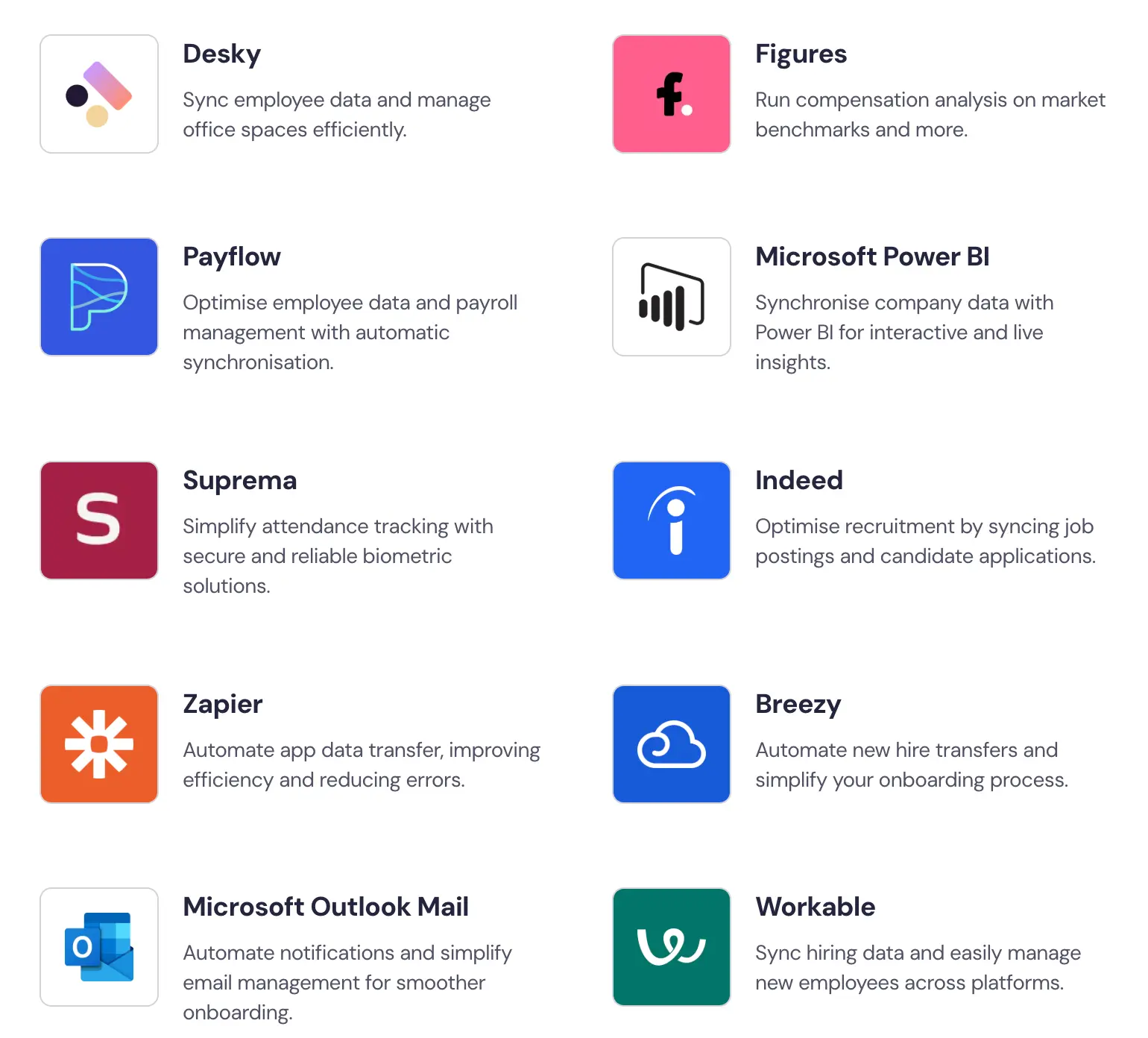
Factorial connects with over 80 third-party tools, including Slack, Microsoft 365, Power BI, Outlook, and Zapier. An open API supports building your own connections too.
PaySpace provides an open API and webhooks and connects with systems including accounting and HR platforms. Its South African product also supports integrations with time and attendance and accounting systems.
If you already use payroll, accounting or workforce management software, check the specific integration you need before choosing either platform.
Who Should Choose Factorial?
Factorial works best if you:
- Want to manage a broad range of HR processes from one platform
- Need employee records, time, leave, recruitment and performance in one system
- Want to connect HR processes with payroll
- Already have a payroll provider and want to integrate it with HR
- Need employee self-service and digital document management
- Want broader workforce reporting and analytics
- Prefer a platform that can expand across different HR functions
Factorial is particularly relevant for businesses that want to bring more of their employee lifecycle into one platform, rather than focusing primarily on payroll.
Choosing Between Factorial and PaySpace
The choice between Factorial and PaySpace ultimately comes down to what you need your HR software to handle.
Factorial takes a broader HR and workforce management approach. It brings employee management, time, leave, recruitment, performance, documents, reporting and payroll processes together, with integrations available for existing payroll providers.
PaySpace has a strong payroll-led approach, with dedicated South African payroll capabilities and statutory reporting alongside its wider HR functionality.
If South African payroll and statutory compliance are your main priorities, PaySpace’s local payroll capabilities should be a central part of your evaluation.
If your priority is to centralise more HR processes and manage the wider employee lifecycle from one platform, Factorial is worth considering.
Before making a decision, compare both platforms against your actual payroll requirements, HR workflows, integrations, employee experience and growth plans. A product demo using your real business requirements can help you see which system fits your day-to-day operations.
The information presented on this page is based on publicly available sources as well as on review sites, including Capterra. The comparisons between Factorial and other providers are intended solely to illustrate respective software features, pricing, and functionalities. All information regarding features, prices, and integrations may be subject to change without prior notice. Factorial assumes no liability for the accuracy, completeness, or timeliness of the information presented. We recommend contacting the respective providers directly to obtain the most accurate and up-to-date information. All applicable fair advertising and competition laws are fully observed. If you have any concerns, please reach out to us. The comparisons presented do not constitute a final evaluation or recommendation for any provider but serve solely as an informational source.
Factorial vs Rippling FAQs
Factorial starts at £5.40 per user per month. Rippling requires a quote. For smaller teams, Factorial is usually cheaper, especially if you need Rippling’s IT and finance add-ons.
Yes. Factorial includes device management, IT inventory, multi-OS MDM, and basic endpoint security. However, Rippling offers more advanced IT tools.
Rippling handles PAYE, National Insurance, and pension auto-enrolment directly. Factorial helps with payroll preparation that works well for most small and medium-sized businesses.
Factorial offers a free trial and a product walkthrough, but a personalised quote will help you evaluate the platform best.
Factorial is usually the better choice for small businesses because it has a lower starting price and quicker setup. Rippling is better suited to larger businesses that need slightly more advanced tools alongside HR.