Eligible UK small and medium-sized businesses can get 75% off a Cyber Essentials assessment, bringing the fee down to £125 from £500 plus VAT, depending on staff numbers. The government announced the offer on 3 November 2026, alongside fully funded certification for selected suppliers. This guide explains who can apply, what certification checks and how Factorial can help you prepare.
Who can get the 75% Cyber Essentials discount?
The Cyber Essentials First Step Fund is open to eligible UK micro, small and medium-sized organisations that have not held Cyber Essentials certification in the last four years. According to GOV.UK, the government has allocated £2.4 million to the fund and estimates that around 6,000 businesses could benefit. Funding is first come, first served.
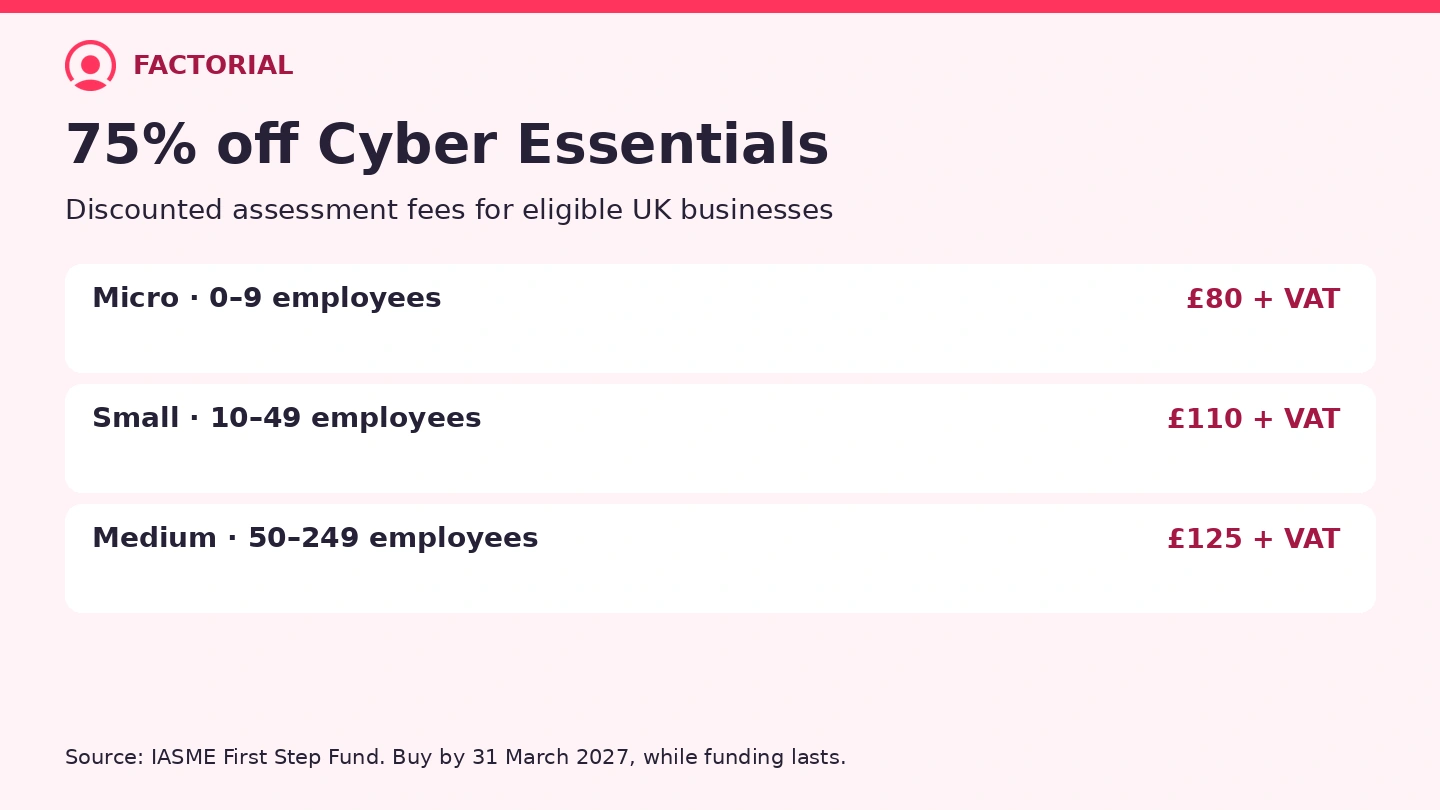
| Organisation size | Employees | Standard assessment fee | With the discount |
| Micro | 0–9 | £320 + VAT | £80 + VAT |
| Small | 10–49 | £440 + VAT | £110 + VAT |
| Medium | 50–249 | £500 + VAT | £125 + VAT |
According to IASME, the scheme’s delivery partner, eligible businesses must register and purchase their assessment by 31 March 2027, while funding lasts. They then have six months from purchase to complete and submit it. If you buy the assessment in January, for instance, the submission window runs from your purchase date. The March deadline is for buying the assessment.
The discount covers the assessment fee. Give yourself a budget for any work you uncover while preparing, such as replacing an unsupported laptop or asking your IT provider to review cloud settings. If an external provider quotes for both preparation and assessment, ask for those charges separately so you can see where the discount applies.
Can suppliers get Cyber Essentials certification for free?
Selected UK SME suppliers can receive a fully funded assessment through the Cyber Essentials for Suppliers Grant. The offer is separate from the 75% discount. A customer that has signed the Cyber Resilience Pledge identifies eligible suppliers and contacts them about applying. The government’s funding package also provides tailored support from an NCSC-assured Cyber Advisor for eligible suppliers through this route.
| Funding route | How to get started | Funding window |
| First Step Fund | Check eligibility and apply through IASME | To 31 March 2027, subject to funds |
| Suppliers Grant | Follow the instructions from a participating customer that nominates your business | To the end of March 2029 |
The suppliers grant is worth up to £7 million, and the government estimates that about 8,000 businesses could benefit. More than 230 organisations had signed the voluntary Cyber Resilience Pledge at the time of the announcement. Signatories commit to board-level responsibility for cyber security, registering for the NCSC Early Warning service and considering Cyber Essentials requirements in their supply chains according to risk.
If a customer has asked you to become certified, check which level it requires and by when. Ask whether it is taking part in the suppliers grant before committing to a paid assessment. Keep the person managing your customer contract involved so they can confirm the timetable and any requirements beyond certification.

What does Cyber Essentials certification check?
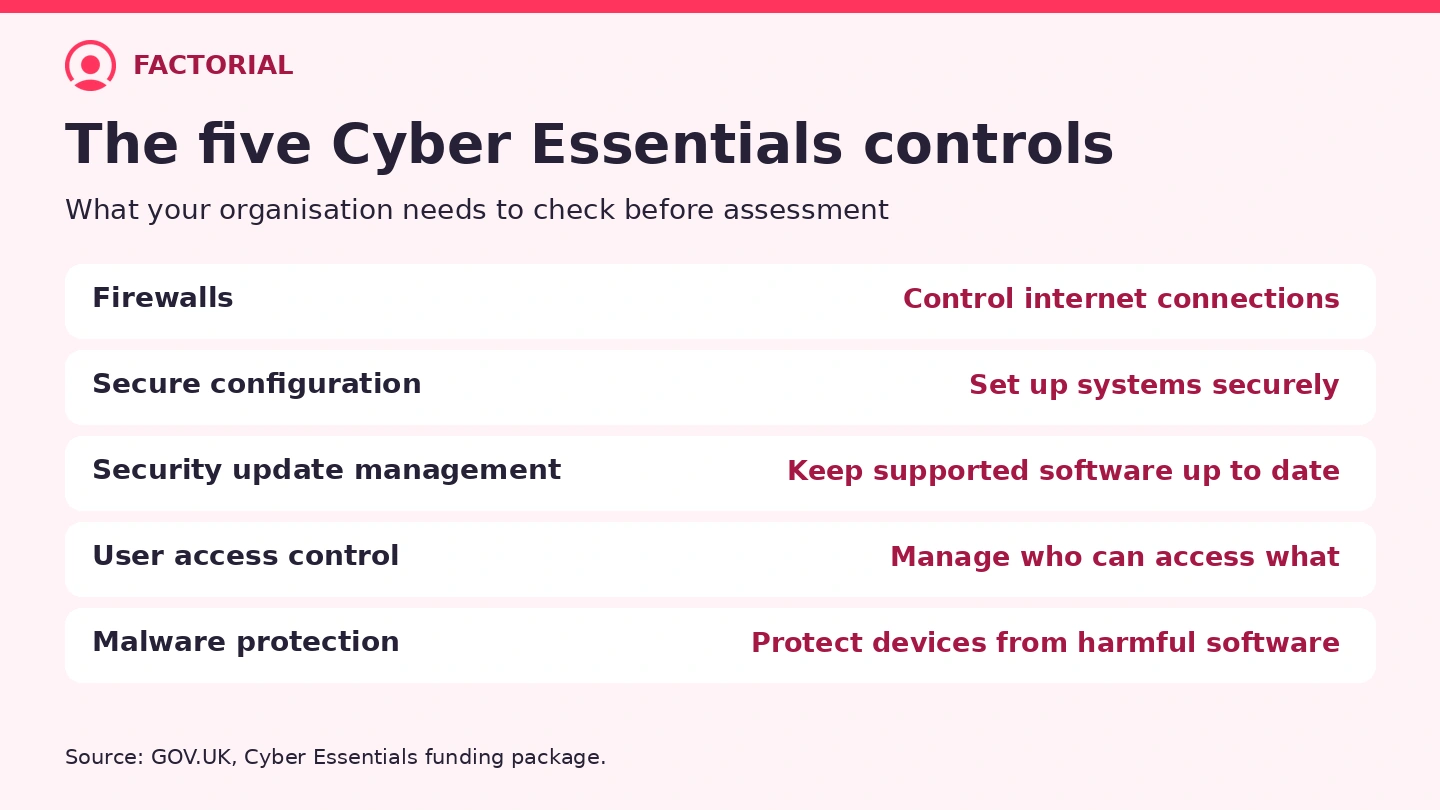
Cyber Essentials is the government-backed baseline for protecting organisations against common online threats. The National Cyber Security Centre developed the scheme around five technical controls. You submit a questionnaire about the systems in scope, and a qualified assessor reviews the answers. The certificate is issued once you pass. IASME explains how assessment and annual renewal work.
| Control | What it means in practice |
| Firewalls | Check how you control connections between your systems and the internet. |
| Secure configuration | Set up devices and services securely, and remove accounts, software and features you do not need. |
| Security update management | Keep supported software and devices updated, and deal with unsupported systems in scope. |
| User access control | Give people access for their work, manage administrator accounts and remove access when it is no longer needed. |
| Malware protection | Use the required protection against harmful software on devices in scope. |
Start with the systems people use to do their jobs. If your team works from home, include remote working in the discussion. Check how the scheme treats company laptops, personal devices used for work, and cloud services with your assessor. An IT provider may manage some controls, but you still need to know which services it covers and who can answer questions about them.
For example, a company with 20 employees might have 20 assigned laptops, two spare devices and several cloud services. The person preparing the application needs to know which devices are still in use, whether they are supported and which accounts have administrator rights. Ask the IT provider for the records it can supply, then compare them with the devices and people you actually have.
Why has the government introduced the Cyber Essentials funding?
The announcement aims to make basic cyber security more affordable for smaller employers and strengthen the supply chains they work in. It cites an estimated average cost of £195,000 for a significant cyber attack on a UK business or organisation. According to the government’s published methodology note, the estimate relies mainly on US disclosures, and the sample for medium and large firms was small. Treat it as an indication of potential losses when assessing your own exposure.
The announcement also introduced 14 new Software Security Ambassadors, including Thales, Capgemini and SANS. The ambassadors will encourage software providers and suppliers to adopt the NCSC’s Software Security Code of Practice. For a small business buying software, that wider work reflects the importance of checking how suppliers support, update and secure the products you depend on.
| Wider Budget measure | What the government announced |
| National Exposure and Real-Time Vulnerability Centre | £70 million for the NCSC to develop a national picture of vulnerabilities. |
| National Cyber Shield | £60 million for AI-supported defences, including a £25 million Challenge Fund for UK innovators. |
| AI Cyber Security Centre of Excellence | An NCSC centre in Manchester to build government expertise in AI and cyber security. |
| National Agentic Security Unit | £40 million to help monitor and respond to incidents involving autonomous software agents. |
| Public-sector cyber defences | £24 million to strengthen protection for public services. |
Factorial’s UK Budget 2026 guide covers the separate pay, payroll and mileage changes employers are planning for. The Cyber Essentials offer gives HR and IT teams another date to put in their plans if their business wants to apply.
What should your business do before applying?
Start by giving one person responsibility for the application. That could be your IT lead, operations manager or business owner. They need input from whoever manages devices and software, and from the people who know when staff join, change roles or leave. If you use an outside IT provider, name someone inside the business who can confirm that the work has been completed.
- Check the funding route. Confirm your staff numbers, previous certification dates and any customer deadlines. Download the current assessment questions from IASME so you can see what information to gather.
- List the systems you use. Record who owns each device, account and cloud service. Include spare devices and equipment held away from the office. Ask the assessor about any part of the scope you are unsure of.
- Check the gaps and assign owners. Record what needs fixing, who will do it and by when. For example, IT may need to update a device, while a manager checks which team members still need access to a shared application.
- Test what happens when someone leaves. Take a recent departure and check whether access was removed and equipment was returned. Include tools that sit outside your main account system and assign someone to chase any missing steps.
- Review the answers before submitting. Ask the person responsible for each control to confirm the answer against current records. Plan how to keep those records current after assessment.
Take the same approach when someone moves internally. A colleague who transfers from finance to operations may need new apps, while their old finance access needs review. Make these changes part of the employee life cycle so the manager, HR and IT each know when to act. A consistent process helps when you review the controls again for renewal.
How can Factorial help you prepare for Cyber Essentials?
Factorial IT brings device and app management together with HR records. It can help you keep track of who has company equipment, which supported devices need attention and what needs to happen when someone joins or leaves. Cyber Essentials assesses your organisation’s security controls. You can choose the tools you use to put them in place, and your assessor makes the certification decision.
- Keep a device inventory you can check: Record who has each laptop, who holds the spares and which devices have been returned. If you find an old laptop on the list, confirm whether it is still in use or should be removed from the record. This gives IT a clearer starting point for checking assessment scope.
- Review updates on managed devices: With Factorial Device Management, IT teams can review device status, flag outdated software and deploy updates on supported, enrolled devices. Check what is covered by your configuration and assign an owner for systems managed elsewhere, such as office routers or cloud services.
- Tie access changes to staff changes: Use HR records to help trigger access updates for connected apps where those workflows are configured. Build a manual check for apps outside the workflow. Factorial’s guide to HR automation explains how to make steps like equipment return and access removal part of an offboarding process.
- Give employees a place to find instructions: Use HR self-service to make policies and documents easier to find. For example, tell employees where to report a lost device and who to contact if they still have access they no longer need.
If your application is coming up, start with the latest device list and one recent leaver. Check the records against what actually happened. If you need a better way to keep devices, access and staff changes in sync, book a Factorial demo to see how those workflows could fit your business.
FAQs about the Cyber Essentials discount
Cyber Essentials can be worth it if a customer asks you for security certification. Before applying, budget for the assessment and any work you may need to do, such as replacing devices that are not supported or reviewing who has access to the apps your organisation uses.
With the 75% First Step Fund discount, eligible UK micro businesses pay £80 plus VAT, small businesses pay £110 plus VAT and medium-sized businesses pay £125 plus VAT. According to IASME, the price depends on how many people your organisation employs.
Selected UK SME suppliers can get their standard assessment fully funded through the Cyber Essentials for Suppliers Grant. A participating customer that has signed the Cyber Resilience Pledge must identify and contact your business about applying.
Cyber Essentials certification is valid for 12 months. Keep your device and access records up to date during that time. When you renew, those records help you check what has changed, such as new cloud services, replacement laptops or a change of IT provider.
Yes, your team can complete the standard Cyber Essentials questionnaire in-house. You can ask your IT provider for details about the systems it manages. A qualified assessor reviews your answers and decides whether your organisation meets the requirements for certification.