Pay transparency means giving candidates clear information about what a job pays. The UK government plans to make salary information compulsory in job adverts, while EU countries are introducing their own rules. While in the near future including salary range in job adverts will be a legal requirement, UK businesses can already prepare by including salary in job adverts starting today. For UK businesses hiring abroad, the requirements depend on where the role is based and the local law.
This guide explains the position in the UK, Ireland and other EU countries, then shows you how to set salary ranges, write clearer adverts and manage recruitment with Factorial. Learn more about pay transparency in the EU by watching our video before reading on for UK specifics.
What is changing in the UK’s pay transparency rules?
The UK government plans to require employers to publish pay information in job adverts, but the start date is yet to be confirmed, and when employers actually need to start putting salary in job adverts. However, employers can prepare now by agreeing salary ranges before advertising and keeping the published figures consistent throughout recruitment.
On 5 November 2026, the Prime Minister called on businesses to publish salaries ahead of the planned legislation. According to GOV.UK, early consultation findings showed support from 94% of respondents, including 93% of businesses that responded.
A statement to UK Parliament added that employers recruiting without an advert would need to give candidates pay information in writing before the interview.
| Hiring situation | What the government proposes |
| You publish a vacancy | Include pay information in the advert. |
| You approach a candidate without advertising | Give them the pay information in writing before interviewing them. |
| You want to update your policy | Prepare your process, then check the final scope, wording and start date when legislation is published. |
The proposal sits alongside existing equal pay and gender pay gap reporting duties. For example, some employers in Great Britain with 250 or more employees must publish gender pay gap information. Those reports describe pay across the workforce. A salary range tells a candidate what they could earn in a particular role.
How do the rules differ across the UK and Ireland?
Check the location of the role and the employing business before deciding which rules apply. England, Scotland and Wales share much employment legislation, Northern Ireland has a separate framework, and the Republic of Ireland follows Irish law and EU requirements.
| Location | What employers should check |
| England, Scotland and Wales | Follow existing pay and equality duties and track the proposed job advert requirements. |
| Northern Ireland | Check Northern Ireland’s employment equality rules and the territorial scope of any new legislation. |
| Republic of Ireland | Track Irish legislation implementing the EU Pay Transparency Directive and any confirmed commencement dates. |
Ireland missed the EU’s 7 June 2026 deadline along with 22 other member states to put the directive into national law. The responsible minister described plans for phased implementation after legislation passes. If your company hires in both Belfast and Dublin, check each vacancy on its own. Always confirm the employing entity, location, currency and applicable pay rules. You can use one recruitment template, and review local details before you publish.
What must UK companies check when hiring in EU countries?
If your UK business hires someone to work in an EU country, check that country’s hiring rules. The EU Pay Transparency Directive sets shared rules on pay transparency, but each country decides how and when to put them into practice.
According to the European Commission, the rules include giving applicants the starting pay or a range early enough for informed negotiation and preventing employers from asking about pay history. The directive also requires gender-neutral job titles and recruitment processes.
Some countries already had salary disclosure rules before the directive. Others have introduced recruitment requirements while work on the rest of the directive continues. A single EU-wide template therefore needs to be reviewed to fit local requirements.
| Country example | What it means when recruiting |
| Austria | Existing rules require relevant minimum remuneration information in job adverts. Check the applicable collective agreement and how additional pay should be described. |
| Poland | Recruitment pay disclosure rules took effect in December 2025. Applicants must receive starting pay or a range at the required stage, and salary history questions are restricted. |
| Ireland | Implementation is progressing through domestic legislation. Confirm the latest Irish requirements before opening a vacancy. |
Check local legislation before determining salary ranges abroad and make sure your job advertisement is in line with legal requirements, especially if you don’t know whether the salary range should be included in the job advertisement or not. The Austrian government’s business portal explains its requirements clearly:
In economic sectors that are not subject to a collectively agreed minimum wage, the salary that is to be used as a basis for negotiating the salary agreement must be indicated. This does not include employee-like persons and employees in senior management positions (e.g. directors).
If you don’t know whether to include the salary in the job advertisement or not, it is best to publish it including the range, to be safe.
For remote vacancies, decide which countries the person can actually work from before publishing “remote”. A London-based company offering a role to someone working from Spain needs to consider that arrangement when checking employment and recruitment requirements. If you use an employer of record, agree who checks the advert and approves its pay information.
Keep a short record for each country covering the required disclosure, deadline, salary history questions, local minimum pay and any collective agreement. Have your local adviser or employment partner review it before the role goes live.
What salary information should a job advert include?
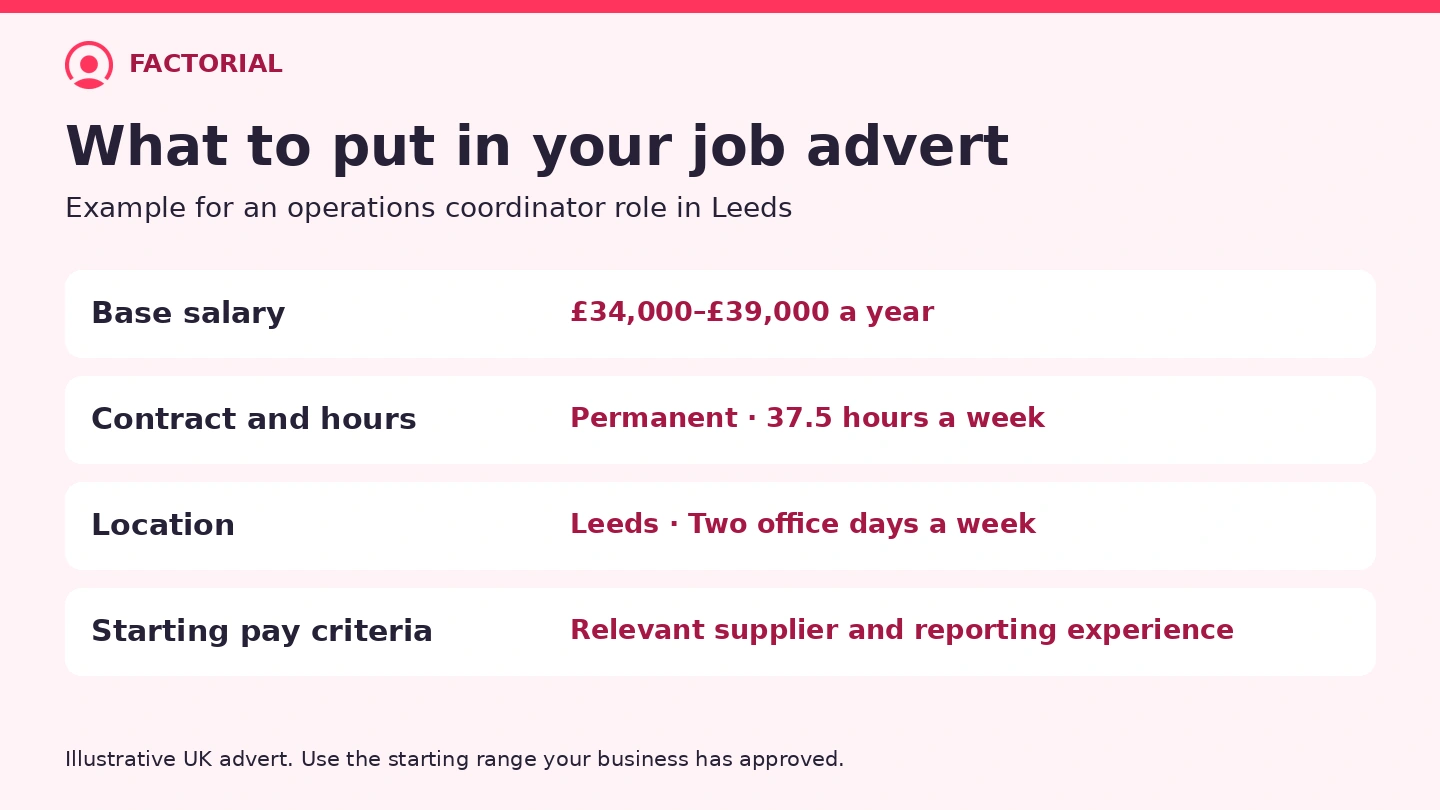
A useful job advert shows the salary or genuine starting range, the currency, the hours and whether the figure is base pay. Candidates should be able to work out what they could earn without waiting for a screening call.
| Information | Example |
| Base salary and currency | £34,000–£39,000 gross base salary per year. |
| Hours and contract | Permanent, 37.5 hours a week. |
| Location | Leeds, with two days a week in the office. |
| Other pay and starting criteria | Explain bonuses separately and say which relevant skills affect the starting offer. |
For part-time roles, state whether the salary is the actual amount for the advertised hours or a full-time equivalent. If you recruit in several countries, explain each local range and currency. Check whether local practice uses annual pay, monthly pay or additional salary payments during the year.
A salary range also needs to survive publication. Open your job advertisement on LinkedIn, your careers page and every other channel. Check that candidates see the same pay, location and hours. If the range changes, update the live listings and tell people already being interviewed.
How do you choose a salary range?
Choose the range from the job’s responsibilities, comparable market pay, your budget and the pay of existing employees doing similar work. Agree the figures and the reasons for them before writing the advert. It is important to be able to explain the salary range so applicants know how much take-home pay to expect.
- Define the role: List the responsibilities and skills needed from the first day.
- Compare similar jobs: Match the location, experience and working hours, and check base pay separately from bonuses.
- Review existing pay: Check how the proposed range compares with colleagues doing similar work and investigate differences.
- Approve the starting range: Publish the amount you can offer a new hire and explain future progression separately.
- Agree the offer criteria: Record what would justify an offer towards the top or bottom of the range.
For example, an operations role might have a long-term band of £32,000 to £45,000, while the approved hiring range is £34,000 to £39,000. Publishing the starting range gives applicants the chance to judge the opportunity. If the upper part of the wider band requires a promotion, explain that when discussing progression.
Use Factorial’s salary range calculator to organise proposed figures, then check them against your budget and local requirements. Factorial’s guide to pay parity can help you review how offers compare with existing pay.
For UK roles, check the National Minimum Wage against the hours and expected start date. For overseas roles you hire for, your payroll team should check local minimum rates and any collective agreement covering the job.
What should you change in your hiring process?
Make salary approval part of opening a vacancy and give everyone involved the same written range. This helps recruiters, managers and candidates discuss pay before they spend time on interviews.
| Hiring Stage | What to check |
| Approve the vacancy | Confirm the employing entity, permitted work locations, hours, currency and range. |
| Publish the advert | Check the local requirements and confirm that every channel displays the approved details. |
| Invite candidates to interview | Share the range in writing and ask whether it works for them. |
| Make the offer | Apply the agreed criteria and record the reason for the amount offered. |
Update your recruitment process policy and application questions. Asking whether the published range works for a candidate gives you information about the current opportunity. Check local restrictions before asking about previous earnings.
After a few vacancies, review pay-related withdrawals and time to hire. Compare similar roles and ask candidates why they withdrew. That helps you see whether clearer adverts are reducing late disagreements over pay.
How can Factorial help you create better job adverts?
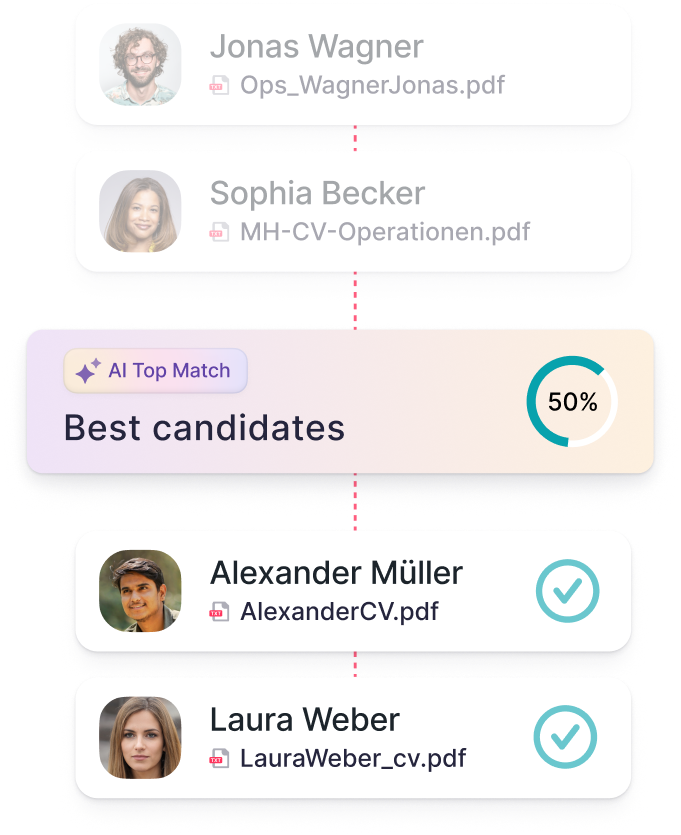
Factorial helps your team draft job descriptions, review openings and manage applications together. Give it the approved salary range and local hiring details so the people reviewing the advert can check everything before publication.
- Create a draft with One: One is your personal AI agent at work. You can create a job opening with One. Our walkthrough shows how you can use it for planning headcount, managing your job catalogue and similar features to draft a description and prepare a job opening for review.
- Keep each opening organised: Use Factorial’s applicant tracking system to manage the opening and candidate stages. For roles in several countries, check the relevant range, currency and location in each advert.
- Publish and check the result: Factorial’s guide to displaying job openings explains careers pages and website options. If you publish through a job board integration, open the final listing to check what candidates see.
Request a free Factorial demo to see how your team can prepare job openings, review descriptions and manage applications in one place.
FAQs about salary range in job adverts
The UK has equal pay rules and gender pay gap reporting for certain employers in Great Britain. The general requirement to include pay in job adverts announced in November 2026 is only a proposal for now. Its final scope and start date still need confirmation.
The government intends to legislate, but the announcement gives no confirmed commencement date. Employers can prepare by approving salary ranges, updating advert templates and reviewing application questions. Check the final legislation before treating 2027 as a deadline.
As a UK applicant, you are generally under no legal obligation to disclose your current salary. If a form asks for expected pay, you can refer to the advertised range. For overseas vacancies, check local rules, including restrictions on employers asking about salary history.
In England, Scotland and Wales, section 77 of the Equality Act 2010 protects relevant pay discussions intended to find out whether pay differences relate to a protected characteristic. Northern Ireland and overseas workplaces have their own rules. The protection does not give someone a general right to obtain a colleague’s salary.
No. In the UK, you do not have to tell a prospective employer your current salary. You can decline and ask to discuss the salary range for the role instead.