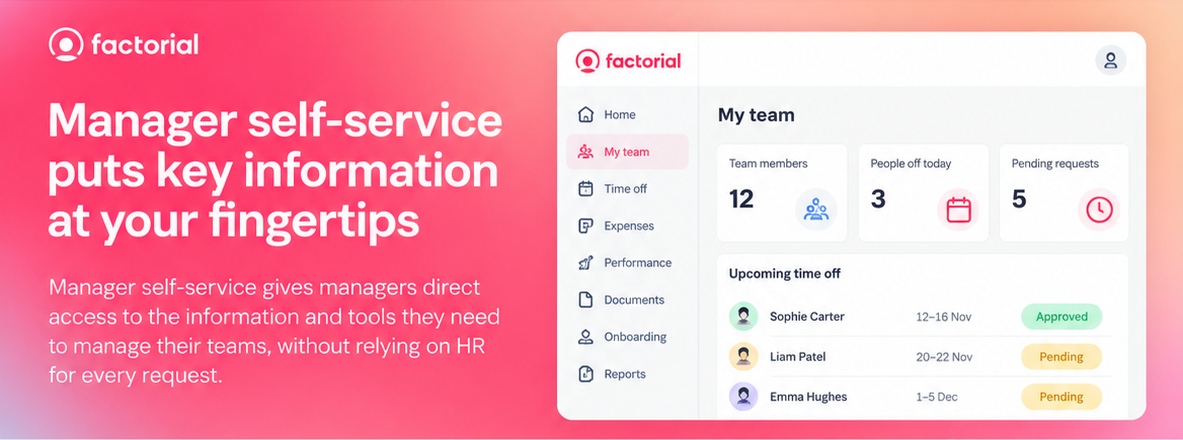
Manager self-service gives managers direct access to the team information and tasks they need to manage day-to-day work. Instead of asking HR to check absences, find team information or pass on approval requests, managers can handle more of these tasks themselves. This can include approving holiday, checking working hours, reviewing expenses, managing shifts and preparing for performance reviews. In practice, that means faster decisions, fewer handovers and less time spent chasing information.
Before you read on, watch this video to see how managers can use Factorial to handle everyday team tasks and approvals more easily.
What is manager self-service?
Manager self-service is a part of HR or business management software that gives managers access to the information and actions they need for their own teams.
For example, a manager may be able to use slef-service to:
- see who is working and who is off
- approve or reject holiday requests
- review working hours and overtime
- check schedules and shift cover
- approve expenses
- complete performance reviews
- check goals and previous feedback
- see which approvals are still waiting
- access relevant team information
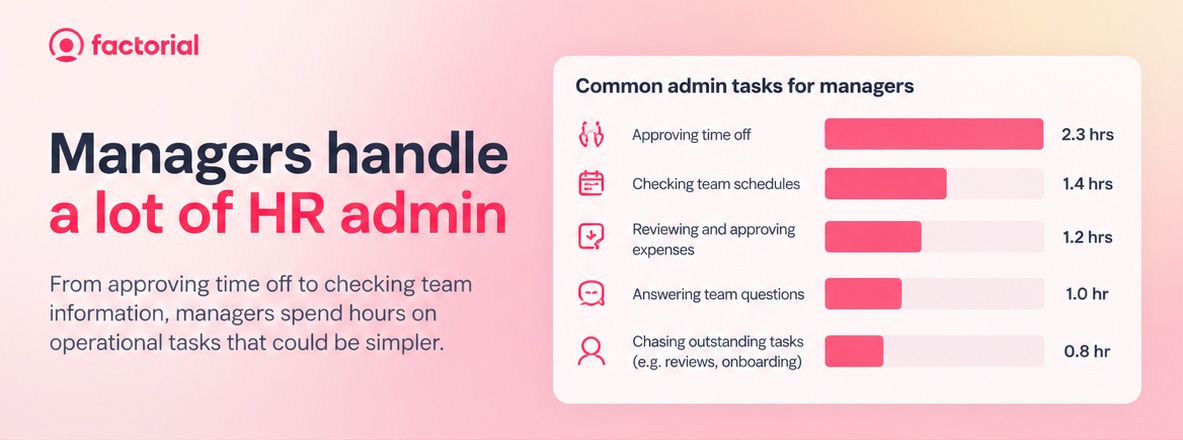
Managers are responsible for many tasks spanning that are connected to many different areas within HR. Enabling self-service should give managers what they need to manage their team without requiring them to be in constant contact with HR. It gives them more control, which in turn saves them time by not requiring them to either wait or submit as many requests for assistance to other departments.
Factorial’s AI agent, One can make this easier by helping managers find the information they already have permission to see. Instead of clicking through different screens, they can ask a question and get the relevant team information more quickly, as well as perform certain actions directly that would have required them to switch to another platform before.

What is the difference between manager self-service and employee self-service?
Employee self-service and manager self-service usually sit in the same system, but they solve different problems.
| Employee self-service | Manager self-service |
|---|---|
| Requests holiday | Reviews and approves the request |
| Submits an expense | Checks and approves the expense |
| Views their own schedule | Reviews team coverage and rotas |
| Completes a self-assessment | Reviews feedback and completes the manager review |
| Views their own information | Views relevant information about the team they manage |
If an employee wants to find a payslip or update their address, that is an employee self-service task. If a manager needs to decide whether approving three holiday requests will leave the team short, that is manager self-service.
Factorial One works across both sides while following existing permissions. Employees can ask about their own information, while managers can ask questions about the teams and processes they are allowed to manage.
Which tasks are best suited to manager self-service?
Manager self-service works best for everyday management decisions where the manager already owns the outcome. The software gives them the information and workflow they need without HR acting as a go-between. Factorial One can help by bringing the right information into the conversation and supporting routine actions before the manager makes the final decision.
Approving holiday with team availability in front of you
A manager should not have to email HR just to find out whether somebody else is already away. With manager self-service, the leave request and the wider team calendar can sit together.
The manager can see:
- who has requested leave
- who else is already off
- the dates involved
- whether there may be a coverage problem
- which requests still need a decision
They can then approve or reject the request directly. This makes the decision easier because the manager has the team context in front of them instead of approving and regretting it later.
Factorial estimates in the Business Facts Index that simple things like showing where shift coverage overlaps in a shared team calendar can help managers approve leave around 50% faster, without as much effort as was needed before.
Factorial’s time management software brings working time, shifts and time off together so managers can see more of the picture before approving a request. With One, a manager can also ask questions such as who is off next week or whether there are other absences during the same period. This can make it quicker to check the situation before making a decision.
Reviewing working hours and overtime
Managers also need a clear view of how their teams are working.
They may need to check:
- hours worked
- overtime
- missing time entries
- attendance
- planned leave
- working patterns
If HR has to pull this information together every time, basic management questions become extra work for the HR team. Manager self-service lets the manager check the information directly and follow up where something looks wrong.
That is especially useful when managers are responsible for larger teams. It becomes even more helpful for hourly workers or when your team is spread out across several locations.
Factorial One can help managers find this information faster. For example, they can ask who has worked extra hours or whether there are missing time records instead of checking each employee one by one.
Managing shifts and finding cover
Shift management is another area where self-service can be very helpful for managers. They may need to build a rota, change a shift or find cover when somebody calls in sick. Doing this in spreadsheets and message groups can make it extremely difficult to see who is actually available to cover a shift.
Factorial’s shift tools can bring schedules, absences and working hours together to one place and warn you when a shift is not covered or there is a scheduling conflict. Reusable rota templates and conflict warnings can be very helpful to managers while they plan. However, One can take this even further. It can check factors such as availability, role, skills, working hours, workplace and rest rules to find possible shift cover. All a manager has to do then is review the option and approve the final decision instead of working through a list of employees manually.
Approving expenses without chasing information
Approving an expense should be a simple management decision. As a manager, you need to know what was purchased, how much it cost and whether it fits the company’s rules. Approval takes longer than it should when that information is not readily available, but spread across emails with receipts and messages in other places. Manager self-service can bring the claim and supporting information into one view so all you have to do is check it quickly before approving the expense in one click.
With Factorial’s expense management software, employees can submit expenses and managers can review the details and approve them from the platform. One can also read expense information, fill in relevant details and check the claim against rules you set. This means a manager can focus on the few exceptions that actually need their judgement.
Preparing for performance reviews
Performance reviews are a manager’s responsibility, but preparation can take a lot of time.
A manager may need to read:
- the employee’s self-assessment
- previous review notes
- peer feedback
- goals
- competency information
- notes from previous conversations
If these sit across documents and systems, the manager spends much of the preparation time simply gathering information. Manager self-service puts more of that information into the performance workflow. Factorial can bring self-assessments, peer feedback and manager input together. One can also summarise this information so that, as a manager, you can see the main points before the conversation, helping you prepare and make the most of the conversation.
One can also help managers find pending reviews or pull together information they already have access to, so they spend less time searching and more time preparing useful feedback. For more on the tools, see our guide to the best performance management software. For performance management, Acas recommends regular conversations, clear objectives and keeping a record of what you discussed.
Why is manager self-service important?
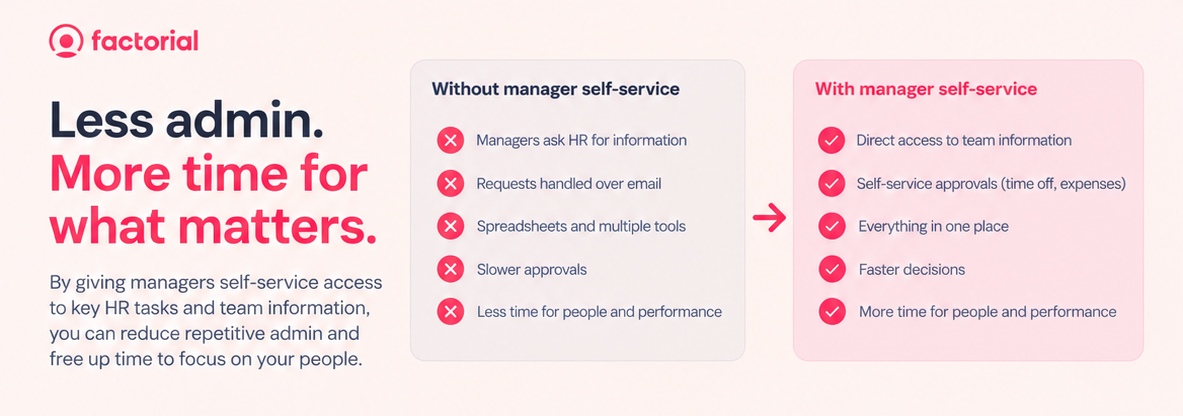
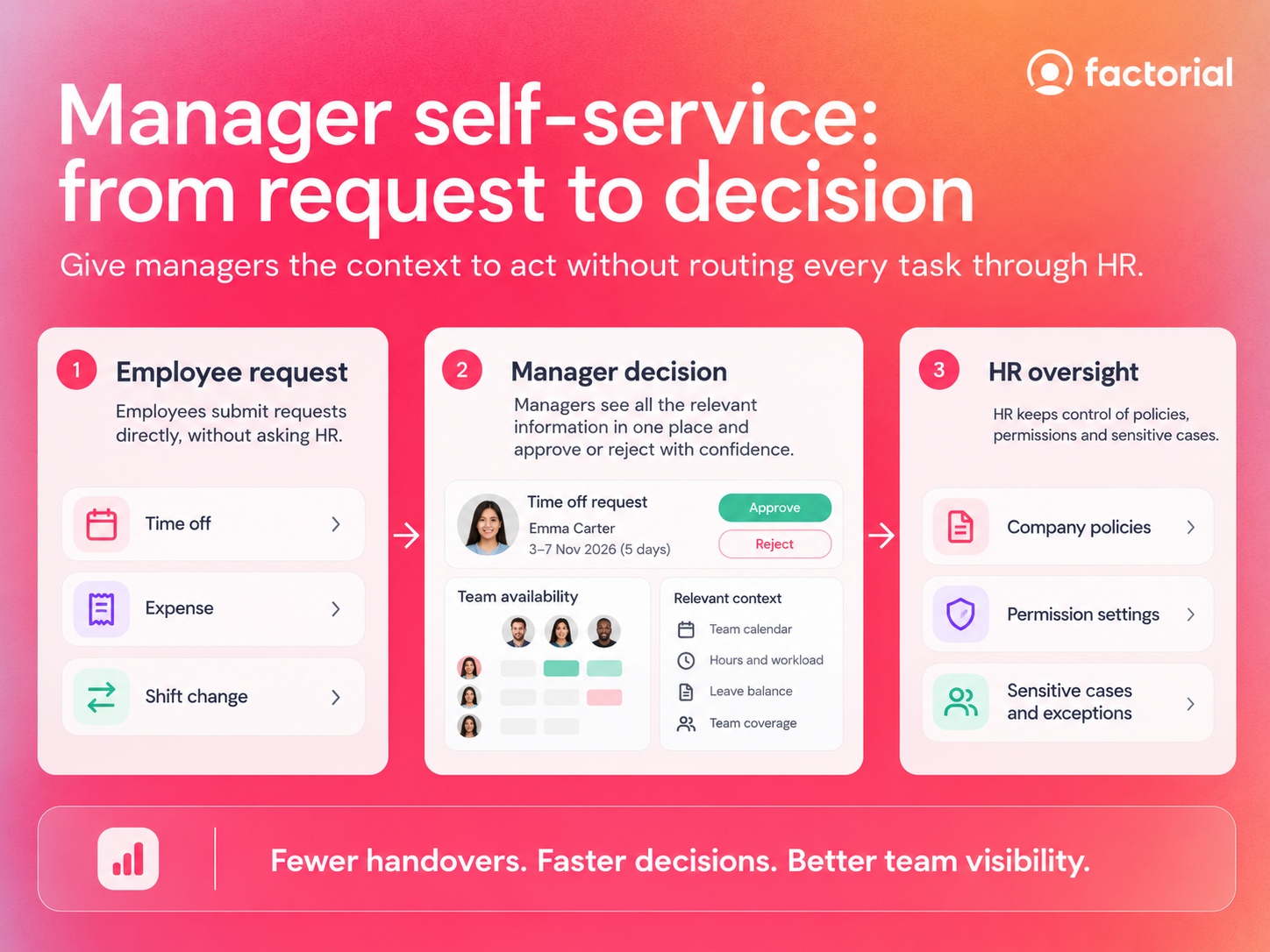
The biggest benefit of manager self-service is that it removes unnecessary steps between you, the manager and the work you already own.
A simple decision can easily turn into:
- An employee asks HR.
- HR asks the manager.
- The manager asks for more information.
- HR finds the information.
- The manager makes the decision.
- HR updates the record.
Manager self-service can shorten that process:
- The employee submits the request through the system.
- You get the information you need and decide.
- The system keeps the record.
Factorial can make this even shorter by helping the manager find the information behind the request without asking HR to pull it together first. It can also list pending tasks and what actions need your attention.
Manager self-service can improve decision-making
Manager self-service is also great because it gives managers all of the context they need to make a decision.
For example:
- A leave request can come with a view of team availability.
- A shift decision can include working hours and absences.
- An expense can include the receipt and relevant details.
- A performance review can include feedback and previous information.
This is more useful than simply giving managers another inbox full of requests. Good manager self-service brings the decision and the supporting information together.
Factorial One adds another layer by letting managers ask questions about that information as if talking to a colleague. Instead of building a report or opening several apps, they can ask for the information they need at that very moment.
It can also help managers spot issues earlier. If overtime is on the rise, reviews are still pending or several people are away at the same time, the manager can get a notification sooner and decide what to do.
When should HR still be involved?
Manager self-service is best for simple, everyday tasks. HR should still step in when a situation is more sensitive or complicated.
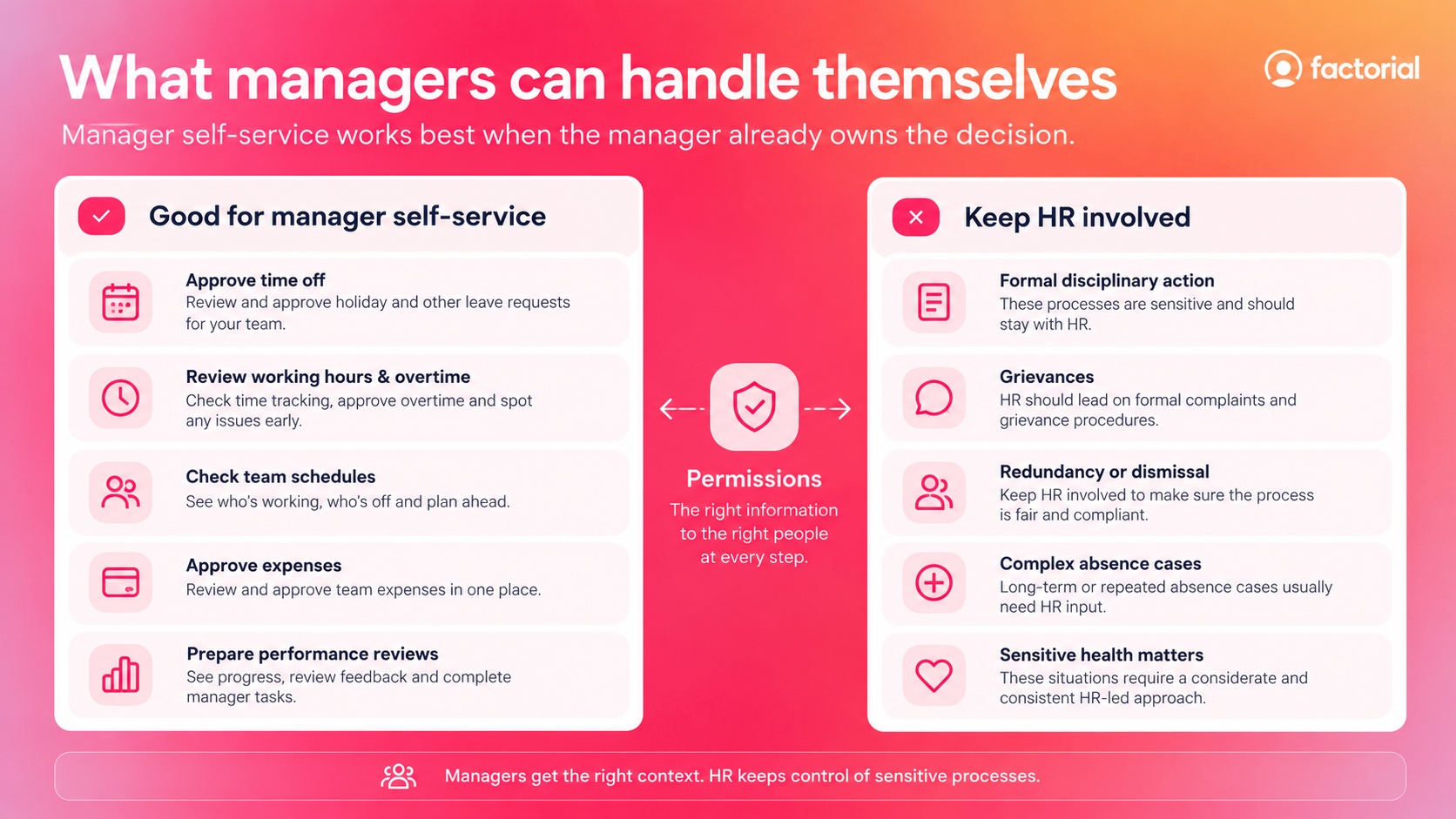
This can include:
- disciplinary action
- grievances
- dismissals
- redundancy
- difficult absence cases
- sensitive health issues
- reasonable adjustments
- serious complaints
- questions about employment law or company policy
Factorial One can help with information and preparation, but sensitive cases still need the expertise of the HR team. The aim is to help managers handle normal team tasks, while HR supports the issues that need more care.
What should you look for in manager self-service software?
The best manager self-service software should make everyday management tasks easier.
A clear view of the team
Managers should be able to quickly see things like absences, schedules, hours, reviews and pending approvals. Factorial One can also help by letting managers ask for this information directly.
Simple approvals
Managers should have the information they need before they approve something. For example, a holiday request should show relevant team availability, while an expense should include the details needed to review it. Factorial One can help bring this information together.
Clear permissions
Managers should only see the information they need for their role. Factorial One follows the same permissions, so managers only get access to information they are allowed to see.
Useful notifications
Managers need to know when something needs their attention. Good manager self-service software should make pending approvals, reviews and other tasks easy to spot. Factorial One can also help surface these outstanding actions.
Connected information
Managers deal with time off, shifts, expenses and performance throughout the day. It is much easier when this information is connected in one place. Factorial One can work across these areas, so managers do not need to jump between different tools to find what they need.
How does Factorial One make manager self-service easier?
Factorial One helps you get more out of manager self-service by making the system easier to use.
Instead of spending time learning where everything sits, you can use One to:
- find the information you need faster
- bring together context from different parts of Factorial
- keep track of what still needs your attention
- move tasks forward without extra admin
The best thing is that with One, manager self-service feels less like yet another system you have to learn how to manage. You can get to the information and actions you need more quickly, while still staying in control of the final decision. For managers, that means less time spent on admin and more time focused on your team. Request a free demo of Factorial to see exactly how it works!
FAQs about manager self-service
Employee self-service lets employees manage their own HR information and requests. Manager self-service is for managers and gives you access to team information, approvals and everyday management tasks.
A self-service system lets you find information or complete tasks yourself without asking someone else to do it for you. In manager self-service, this can include checking absences, reviewing hours or approving requests.
Self-service gives you direct access to the information and actions you need. As a manager, this can help you deal with routine team tasks faster and with less back-and-forth.
A simple example is checking who is already off before you approve a holiday request. You can see the information yourself and make the decision without asking HR to look it up first.
In HR software, you may also see terms such as employee self-service, manager self-service, ESS or MSS. The exact term depends on who is using the system.