A UK tax rise can leave your business with less cash to spend. Higher interest rates can add to the pressure if you borrow at a variable rate or need to refinance. The Bank of England raised Bank Rate from 3.75% to 4% in November 2026. Start by finding out what the changes mean for your business, then look for bills you can reduce and admin time you can free up.
What do a UK tax rise and higher interest rates mean for employers?
Tax changes, borrowing costs and higher wages can all affect the same budget. Each has its own amount and payment date. Keep them on separate lines so you can see what is driving the change and when you’ll need the cash.
| Cost | What it can change | What to put in your forecast |
| Tax | What you owe or when you receive relief | The amount and payment date your finance team expects |
| Interest | What you pay on borrowing that reprices | The balance, lender rate and date the new rate applies |
| Wages | Gross pay and associated employer costs | The workers and paid hours affected, plus employer costs where applicable |
| Operating costs | What you pay for software, suppliers and other running costs | Confirmed renewals, price changes and savings |
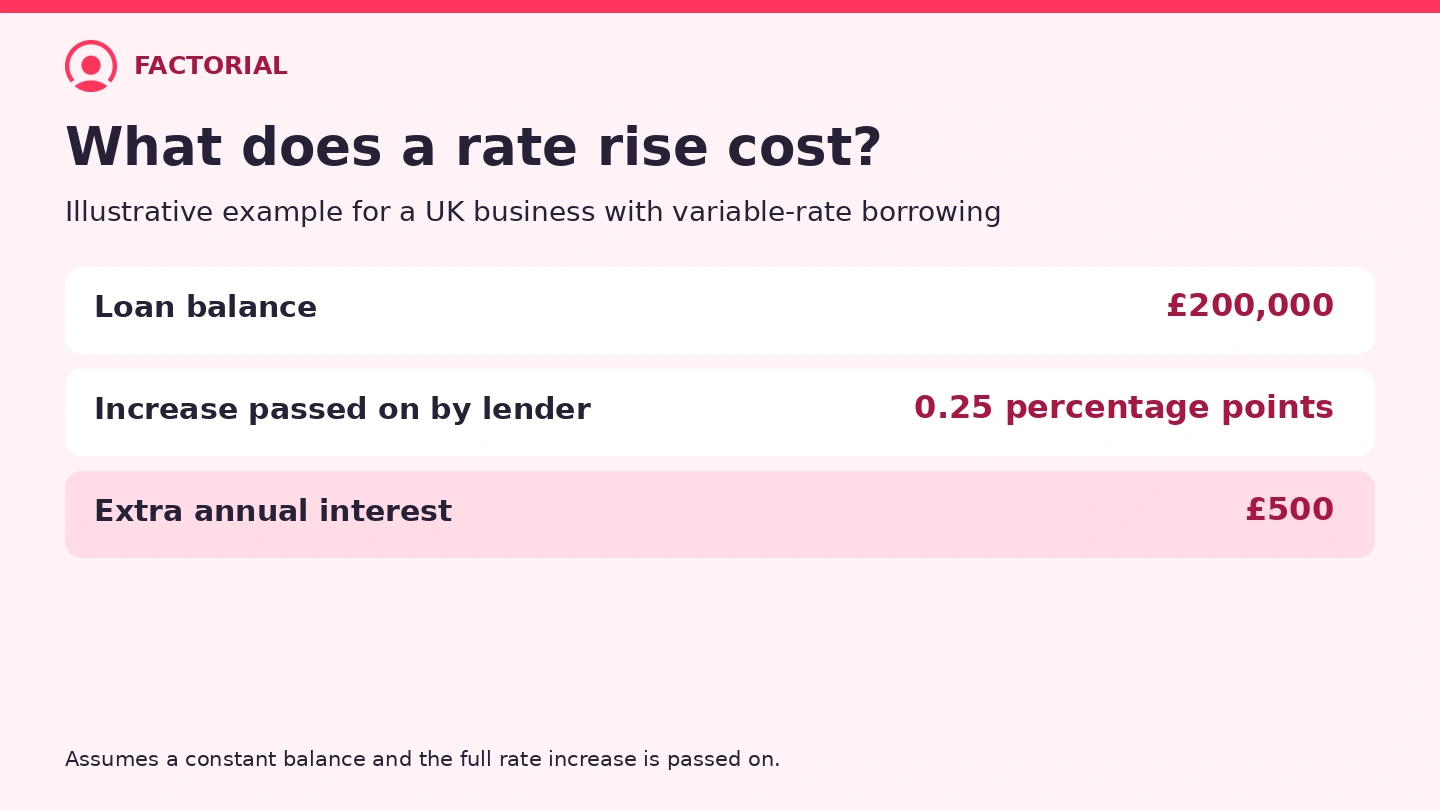
According to the Bank of England, its November decision raised Bank Rate by 0.25 percentage points. If a lender passes the full increase on to £200,000 of borrowing and the balance stays the same, the extra interest would be £500 a year, or about £42 a month. Check your agreement for the rate, balance and date that actually apply. If you have a fixed rate, put the expiry date in your forecast so you can check likely costs before refinancing.
Tax changes also vary by business. For example, a Budget 2026 proposal would reduce the main writing-down allowance from 14% to 12% from April 2027. This allowance lets businesses deduct part of the remaining value of certain equipment for tax purposes over time. The same proposal increases the main first-year allowance on qualifying spending from 40% to 50% from January 2027. Ask whoever prepares your tax figures which allowance applies and whether the change affects when you get relief. HMRC sets out the proposed dates and conditions.
Put the April wage changes on their own line too. The National Minimum Wage guide explains the new rates and which pay period they apply to. See the UK Budget 2026 for the changes to mileage and the separate timetable for reporting taxable benefits through payroll.
Which software costs can you cut first?
Start with the tools you already pay for. Pull a list from invoices, card statements and purchase records. Ask managers what they use, then check the contract to see what you can change. A company might have a separate holiday app, two tools that collect receipts and a reporting subscription that only one team uses. Each needs a different decision.
In Factorial’s 2026 Business Facts Index, 75.3% of surveyed leaders said their company would work better with fewer, more centralised tools. The survey covered 3,760 business leaders in Spain, Germany, France, Italy and Portugal. For a UK business, the way to put a value on that idea is to compare its own invoices with what staff actually use.
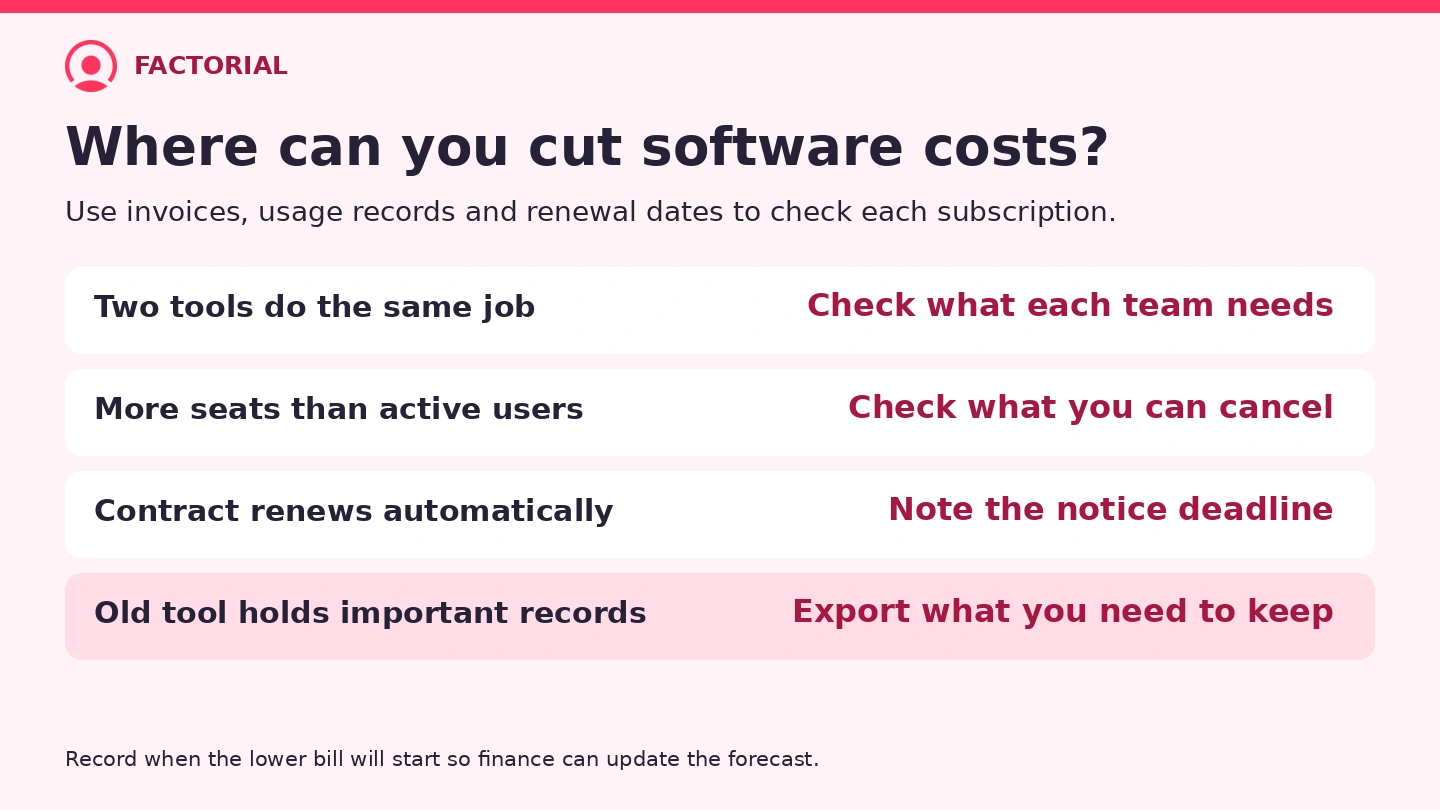
| What you find | What to check before making a change |
| Two apps do much the same job | Check whether one can handle the features, permissions and reports both teams need. |
| You have more licences than active users | Check who still needs access and whether the supplier lets you reduce your bill mid-contract. |
| A tool is rarely used but supports an important process | Ask the owner what depends on it and how they would do that work after a change. |
| A contract renews automatically | Record the notice deadline and agree who will make the decision before it passes. |
For each tool, record its owner, annual cost, users, renewal date and notice period. Include free trials if they could turn into paid subscriptions. If you want to retire an app, check what records you need to export and who needs access to them later. Give the team time to test the replacement with real work before switching.
Savings start when the bill falls. If you find 12 unused licences at £15 a month, that’s £180 a month you could save once the supplier lets you remove the seats. If the change starts in July, it contributes six months of savings to a calendar-year forecast. Record the date so finance can tell when to expect the lower bill.

How do better records reduce admin?
Start with work that crosses teams. A manager approves a pay change, HR updates the employee record, and finance checks what goes to payroll. If each person keeps a separate spreadsheet, someone has to compare the versions before closing the pay run. Track how long that takes and what needs correcting. Then agree where the approved figure lives and who updates it.
| Task | Record to keep | What to measure |
| Pay changes | Approved amount, start date and sign-off | Corrections and time spent checking changes before payroll |
| Expenses | Receipt, business purpose, amount and approval | Time spent chasing receipts and resolving queries |
| Staff changes | Start or leave date, equipment and access tasks | Time spent setting up or closing accounts |
| Monthly reporting | Report owner, source records and review date | Time spent pulling figures together and checking them |
For example, a field services company might receive mileage claims by email. A manager approves the claim, then someone in finance copies the amount into a spreadsheet. If a receipt or trip detail is missing, finance has to go back to the employee. Agree what information is required at submission and give the approver a way to see it with the claim. Finance can spend less time gathering information before it checks the figures. Follow the same principle for other limited company expenses.
You can use HR self-service for routine requests, such as finding a payslip, and HR automation for repeatable steps, such as reminding someone about an outstanding approval. Give staff a clear route for exceptions. For example, a higher expense or a change to someone’s pay can still go to a colleague for review.
How do you work out whether a change will save money?
Compare what you pay today with what you expect to pay after the change. Include the new platform fee, services you still need, and one-off costs such as moving records and training staff. Put each saving in the month you expect to see it. This catches overlapping subscriptions and avoids treating an annual saving as cash available straight away.
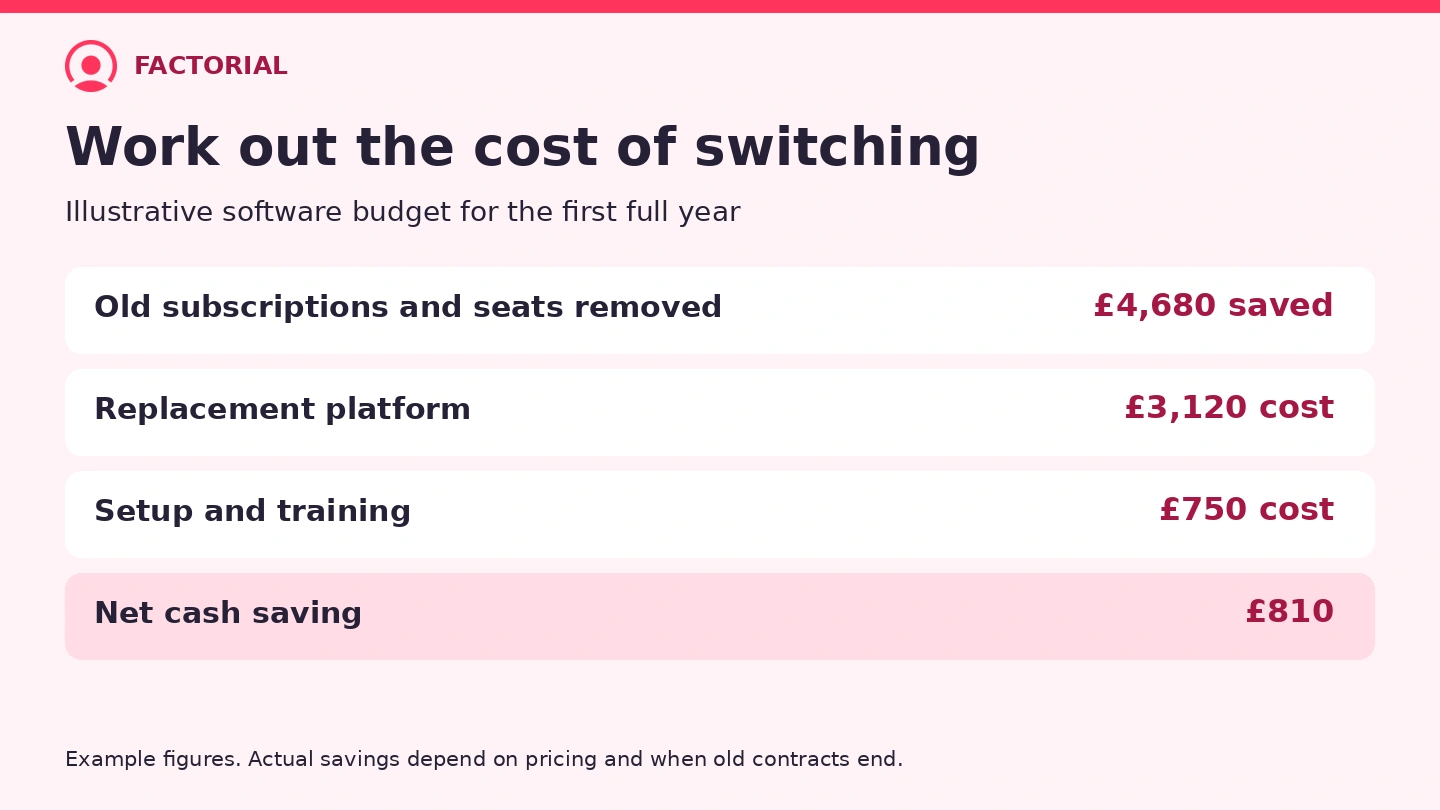
Here is an illustrative example for a business that removes two tools and reduces its licence count. The figures show a full year once the old bills stop. The new platform fee is an assumption for the example.
| Item | Calculation | Cost or saving |
| Remove two overlapping tools | £210 a month × 12 | £2,520 saved |
| Remove 12 unused licences | 12 × £15 a month × 12 | £2,160 saved |
| Add the replacement platform | £260 a month × 12 | £3,120 cost |
| Move records and train staff | One-off cost | £750 cost |
| Net saving over the first full year | £4,680 less £3,120 and £750 | £810 saved |
| Annual saving after setup, at the same prices | £4,680 less £3,120 | £1,560 saved |
In this example, the £810 first-year cash saving is more than the £500 extra annual interest in the earlier example. The comparison depends on when both changes take effect. If old contracts continue for part of the year, put the overlap in the forecast and compare the actual bills once the renewals have passed.
Measure time savings separately. If five managers each save 30 minutes a week, they get back 2.5 hours a week. Decide what the team will do with that time. It might go towards checking rotas, training staff or serving customers. If you also expect a cash saving, such as less paid overtime, check it against payroll once you have enough data. Avoid adding the same saving again as a value for time. Use your HR metrics to track the change over several weeks.
Before you roll out a new process, pick a baseline you can check. For an expenses pilot, record how many claims came in last month, how many had to be sent back and how long finance spent following up. Repeat the check after a month with the new workflow. If more staff were travelling during the second month, compare the time per claim as well as the total. Ask the people doing the work where they still have to use email or copy details by hand. Fix that step before you ask another team to switch.
How can Factorial help you reduce software costs and admin?
Factorial brings HR, finance and IT together so teams can spend less time checking spreadsheets, chasing approvals and updating the same information in different tools. Start with a task your team does every week, like approving expenses or updating access when someone leaves. Check what it costs today and which steps you could simplify.
- Review the licences you pay for: With SaaS Management, IT can review usage for supported apps and spot seats that may no longer be needed. Check your contract to see when removing those seats would lower the bill.
- Spend less time chasing receipts: With Factorial Expenses, employees can submit claims with receipts attached and managers can review them in the same place. Finance can see what’s ready to process and follow up on anything missing.
- Get figures ready for a budget review: One is your personal AI agent at work. A finance lead can ask One to summarise the expense data they have permission to access, then check the figures against the original records before sharing them.
When tax or borrowing costs rise, focus on savings you can see in your bills and admin time your team can put back into the business. Request a Factorial demo to see how your team could manage software licences, expenses and reporting with fewer tools.

FAQs about UK tax rises
From 6 April 2027, the announced Income Tax rates on savings rise to 24%, 44% and 49% across the UK. The same rates apply to property income in England, Wales and Northern Ireland.
It depends on the type of income you receive. The main rates on wages in England, Wales and Northern Ireland stay at 20%, 40% and 45% for 2027/28. Scotland sets its own rates for wages. Even when rates stay the same, a pay rise can leave you paying more tax if the thresholds stay fixed.
One recent rise took effect on 6 April 2026, when the ordinary dividend tax rate increased from 8.75% to 10.75% and the upper rate rose from 33.75% to 35.75%, set out in the Finance Act 2026.
Your Income Tax depends on how much you earn, the type of income you receive, your allowances and where you live. For example, someone earning £30,000 from employment in England in 2026/27 would pay £3,486 in Income Tax if they had the standard Personal Allowance, no other income and no other adjustments. National Insurance is calculated separately.
According to HMRC, it collected £937.8 billion in cash receipts in the 2025/26 tax year. That includes National Insurance contributions as well as taxes such as Income Tax, VAT and Corporation Tax. The figure covers receipts collected by HMRC. For example, council tax is collected separately.