HR teams collect a lot of employee information. Contracts, payroll records, holiday requests, sickness notes, pension details, performance reviews, disciplinary letters and work emails can all become part of an employee record. But how long must you keep employee records in the UK?
That’s where things can get confusing. Different documents need to be kept for different lengths of time. Some have clear legal time limits. Others can be deleted once you no longer have a good reason to keep them.
So, if you are wondering how long companies keep employee documents, it depends on the type of record. This guide covers document retention across recruitment, payroll, holiday, sickness, pensions, performance, health and safety, employee relations and offboarding.
For a wider look at how businesses should collect, store and manage HR information, see our guide to employee records management.
Key facts
- Employee records do not all have the same retention period.
- PAYE records normally need to be kept for 3 years from the end of the tax year they relate to, according to HMRC.
- National Minimum Wage records generally need to be kept for at least 6 years.
- Annual leave and holiday pay records in Great Britain must be kept for 6 years for records made from 6 April 2026.
- Keep right-to-work documents during employment and for 2 years after the employee leaves.
- Most automatic-enrolment pension records need to be kept for 6 years.
- Some health and safety records need to be kept much longer, including certain health-surveillance records that may need to stay on file for 40 years.
Employee record retention periods at a glance
| Type of employee record | Typical legal retention period |
|---|---|
| PAYE and payroll records | 3 years from the end of the relevant tax year |
| National Minimum Wage records | At least 6 years |
| Annual leave and holiday pay records | 6 years from when the record was made |
| Certain Working Time Regulations records | 2 years |
| Right-to-work evidence | Employment plus 2 years |
| Most automatic-enrolment pension records | 6 years |
| Pension opt-out records | 4 years |
| Statutory family pay records | 3 years from the end of the relevant tax year |
| RIDDOR records | At least 3 years |
| Some health-surveillance records | Up to 40 years |
| Contracts, performance and general HR records | Depends on why you still need them |
Why is document retention different for each HR record?
Rules laid out in UK GDPR expect businesses to keep personal information only for as long as it is needed. When it comes to retaining employment records, the ICO recommends setting clear retention periods for different types of employee information. That means knowing what you keep, why you keep it and when it should be deleted.
Some areas of employment law make the decision for you by setting minimum periods. Payroll has its own rules, pensions have their own rules, and health and safety records can have much longer requirements.
This is why a good document retention policy should deal with each type of record separately instead of giving every HR document the same expiry date. Document management software can help you organise and store documents securely, and AI features can even help you set notifications for when documents need to be updated or deleted. Factorial is an AI business management platform that can help you double your productivity by connecting your HR, finance, and IT processes in one place.

Retaining recruitment and candidate records
Recruitment can create CVs, application forms, interview notes, test results, references and offer letters.
For unsuccessful applicants, think about whether you still have a clear reason to keep their information. Interview notes may be useful for a period after the hiring decision in case somebody questions how the decision was made. But old applications should not sit in your recruitment system forever.
Criminal-record information needs extra care. GOV.UK says information from a DBS certificate should normally not be kept for longer than six months after the recruitment decision, although limited details about the check may be retained where appropriate.
What new starter and right-to-work records to keep
Once someone is hired, HR will normally collect their contract, bank details, emergency contact information, tax information and right-to-work evidence.
Right-to-work documents have a clear timeline. Government guidance says you should keep evidence of the check for the whole time the person works for you and for another 2 years after their employment ends. After that, the evidence should be securely destroyed.
You should also keep a clear record of when the check was carried out. A consistent onboarding process makes it easier to collect these documents properly from the start. Our guide to employee onboarding best practices explains how to organise starter information and documents.
How long to keep contracts and general employee files
Contracts, salary letters, promotion letters, flexible working agreements and changes to working hours may all need to stay on file for different reasons. Current documents should normally remain available while the person works for you. Previous versions can also be useful because they show how an employee’s terms changed over time.
For example, if somebody’s salary changed three times, deleting every old salary letter could make it difficult to work out what they were being paid at an earlier date.
When someone leaves, review the documents in their file instead of simply archiving everything forever. Keep what you still need and remove what no longer serves a purpose.
Keeping payroll and tax records
Payroll has some of the clearest document retention rules. HMRC’s info on PAYE record-keeping says employers must keep PAYE records for 3 years from the end of the tax year they relate to.
This includes records of:
- employee pay and deductions
- reports made to HMRC
- payments made to HMRC
- tax code notices
- certain expenses and benefits
- employee leave and sickness information used for PAYE
National Minimum Wage records need to be kept longer. Employers must keep enough evidence to show workers received the correct minimum wage, and those records generally need to be retained for at least 6 years.
What about P45s and P60s?
P45s and P60s are part of the wider payroll record. An employee receives a P45 when they leave. You can read more about when it is issued in our guide to the P45 form. A P60 gives eligible employees a summary of their pay and tax for the tax year. Our guide to the P60 form explains when employers need to provide one.
The important thing is to follow the PAYE record-keeping rules rather than assuming every payroll document needs to stay on file for seven years.
Working hours, annual leave and holiday pay
Time and attendance records can have different retention periods depending on what they are used for. Certain Working Time Regulations records generally need to be kept for 2 years.
Holiday records now have a longer retention requirement. From 6 April 2026, employers in Great Britain must keep adequate records showing they have followed statutory annual leave and holiday pay rules for 6 years from the date the record was made.
GOV.UK’s holiday pay article gives examples such as records showing how much annual leave an employee took and how much holiday pay they received.
So, do not clear holiday records simply because a new leave year has started.
Sickness and family leave records to keep
Sickness information needs careful handling because it can contain sensitive health data.
Fit notes, medical documents and absence records should stay on file only while you still need them. Access should also be limited to the people who genuinely need to see the information.
Statutory pay records are easier because HMRC gives clearer time limits. For example, Statutory Maternity Pay records generally need to be kept for 3 years from the end of the tax year they relate to. Similar record-keeping requirements apply to Shared Parental Pay and other statutory family payments.
It is also sensible to separate basic absence records from more detailed medical information so sensitive data can have tighter access controls.
Retaining pension records
Workplace pension records have their own retention rules. The Pensions Regulator says most automatic-enrolment records must be kept for at least 6 years. This can include employee details, pension scheme information and records of workers joining a scheme. Opt-out records normally need to be kept for 4 years.
Your payroll or pension provider may store some of this information for you. Even so, make sure you know where the records are and that they will still be available if you need them later.
Performance, probation and training records
Performance reviews, probation notes, objectives, training records and performance improvement plans should be kept while they are still useful. They can help show what objectives were agreed, what feedback an employee received and what support or training was offered. This can be especially important if performance concerns later become part of a formal process.
Older records should be reviewed from time to time. If the information no longer has a clear purpose, it may be time to delete or anonymise it. Training evidence may need to stay on file for longer where the training is required for health and safety, professional qualifications or another regulatory reason.
Disciplinary, grievance and complaint records
Disciplinary and grievance files can contain investigation notes, witness statements, meeting notes, warnings, emails and appeal decisions. Acas says employers should keep written disciplinary records confidential and only for as long as necessary.
The same approach works for grievances and workplace complaints. Keep enough information to show what happened, what evidence was considered and why a decision was made. Be careful with expired disciplinary warnings too. A warning may no longer be active, even if you still need to keep the record itself for a while longer.
Health and safety records
Health and safety records can stay on file much longer than ordinary HR documents. Under RIDDOR, records of reportable incidents generally need to be kept for at least 3 years.
Some health-surveillance records need to be stored for decades. The HSE’s health-surveillance info explains that certain records under COSHH can need to be kept for 40 years. This does not apply to every sickness record. The long retention periods are for specific workplace health records, such as those connected to exposure to certain substances or hazards.
How long do you keep records after an employee leaves?
Once an employee leaves, go through their records by type rather than treating the whole personnel file as one document to keep in its entirety. Right-to-work documents stay on file for 2 years after employment ends. PAYE records follow the 3-year tax-year rule. Holiday, minimum-wage and pension records may need to remain for 6 years.
Contracts, performance records and employee-relations documents should stay only while you have a good reason to keep them. Offboarding is a good time to do this review. Instead of moving the entire file into a “former employees” folder and forgetting about it, decide what needs to stay and what can be removed.

How long should you keep work emails?
The content of an email matters more than the fact that it is an email. An email approving a pay rise may form part of a pay record. A message about a grievance may belong with the grievance file. An email agreeing new working hours may be relevant to an employee’s contract history.
If an email contains an important HR decision, save it with the proper employee record rather than leaving it buried in somebody’s inbox. Everyday emails with no lasting business or legal value can be deleted under your normal email retention policy.
How to create a simple document retention policy
A document retention policy does not need to be complicated. Start by listing the main records your HR team holds.
For each one, write down:
- what the record is
- why you keep it
- how long it needs to stay
- when the retention period starts
- who can access it
- when it should be reviewed
- what happens when the period ends
The ICO recommends using a retention schedule so different types of personal information are reviewed at the right time.
Also check for duplicate documents. The same contract might exist in an HR system, email inbox, shared drive and manager’s personal folder. Deleting one copy does not help much if three others are still sitting elsewhere. This is one reason businesses use HR database software to bring employee information together instead of storing it across lots of separate places.
Use document management software to keep records organised
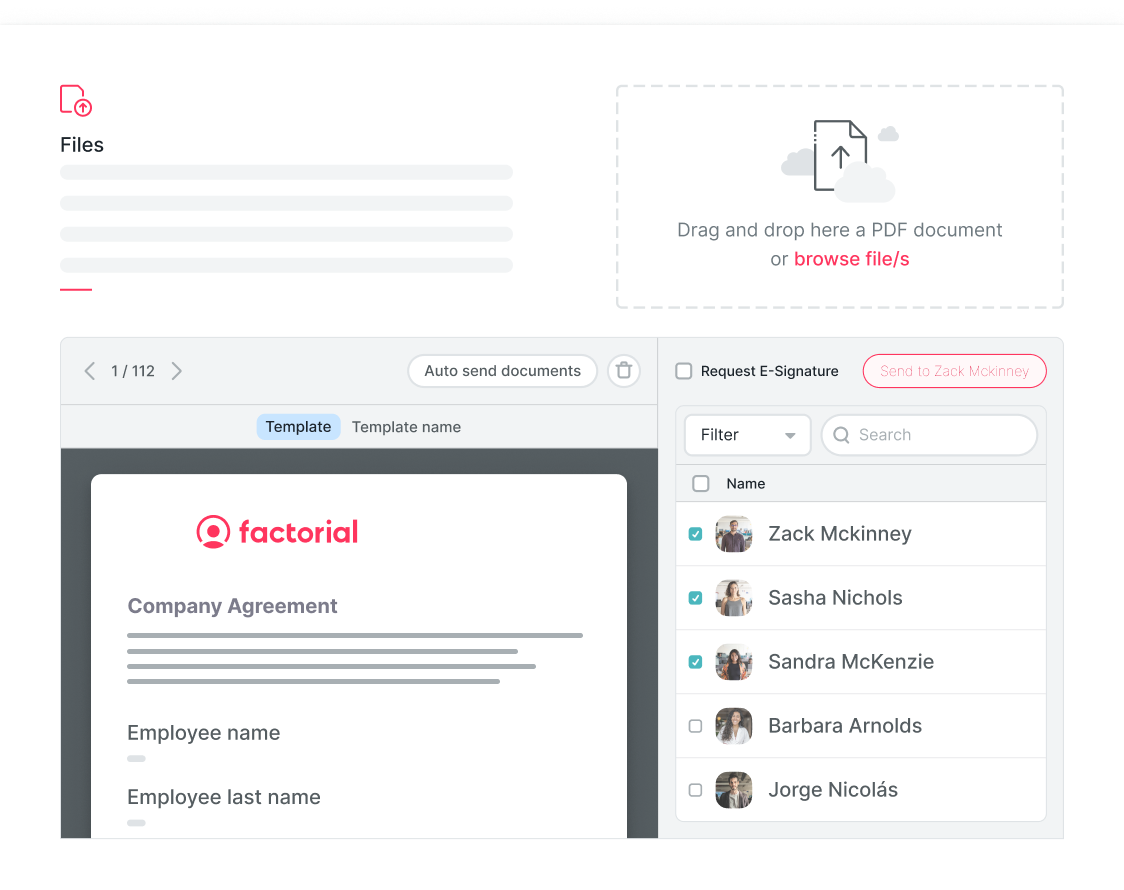
Knowing how long to keep documents is only useful if you can find them when you need them. A document management system can give HR one place to store contracts, policies, payslips and other employee documents. Permissions can also help control who can see sensitive files.
If you are comparing options, our guide to the best document management software explains what these systems do and which features to look for. Digital documents can also make signing and storing employment paperwork easier. Our guide to e-signatures explains how electronic signatures work.
How Factorial and One can help with employee records
Factorial is an AI business management platform that can help businesses keep employee information and HR documents in one place instead of spreading them across spreadsheets, folders and inboxes.
Factorial’s document tools can be used to organise employee files, control access and share documents with employees. An employee portal also gives employees a place to access their own documents and information.
Factorial One AI agent can help people find and work with company information using the permissions they already have. For example, a manager could use One to find an internal document retention policy or locate information stored in Factorial instead of searching through folders manually.

FAQs about employee record retention
For PAYE records, HMRC normally requires employers to keep them for 3 years from the end of the tax year they relate to. This includes employee pay and deductions, reports and payments to HMRC, tax-code notices and certain benefits and expenses. National Minimum Wage records usually need to be kept for longer, at least 6 years.
Seven years is sometimes used as an internal company retention period, but it is not a standard rule for every HR document. Many employment records have shorter or longer legal periods. For example, some records are kept for 2, 3, 4 or 6 years, while certain health and safety records can need to be kept for 40 years.
Employers may need records covering pay and tax, working hours, minimum wage, holiday, sickness, statutory leave, pensions, right-to-work checks and health and safety. Businesses also commonly keep contracts, salary changes, training records, performance reviews and disciplinary or grievance documents where they are still needed.
It depends on the document. Right-to-work evidence is normally kept for 2 years after the employee leaves. PAYE records follow the relevant tax-year rules, while some holiday, minimum-wage and pension records need to stay on file for 6 years. Other documents can be removed once the business no longer has a good reason to keep them.
Keep work emails according to what they contain. An email about pay, a contract change, a grievance or another important HR decision may need to be saved with the related employee record. Routine emails can usually be deleted once they no longer have a business or legal purpose.